Designing Topic Clusters for Scalable Topical Authority

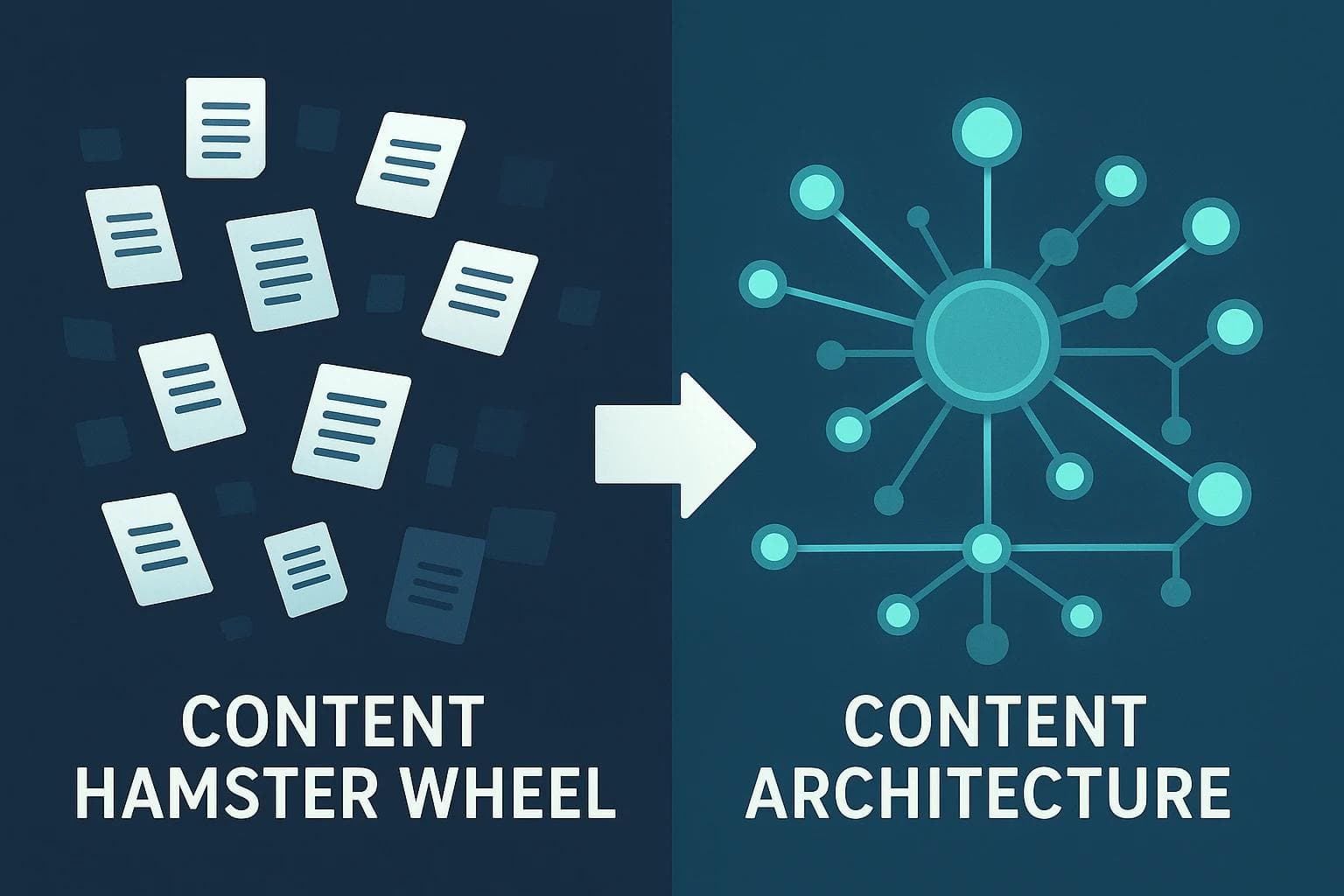
Beyond the Blog Post: A Blueprint for Scalable Topical Authority
Ever feel like you’re publishing content into a void? You write a great article, hit publish, and hope for the best. A small spike in traffic, a few shares, and then… silence. The next week, you do it all over again. It’s the content creator’s hamster wheel, and it’s exhausting because each piece of content lives and dies on its own.
But what if every article you published made every other related article on your site stronger? What if your content wasn't a collection of standalone islands, but a well-organized, interconnected library—one that Google and your audience recognized as the definitive resource on your topic?
That’s the difference between just writing blog posts and building topical authority. It’s a strategic shift from creating content to creating a content architecture. This guide is your blueprint for designing that architecture, transforming your scattered efforts into a powerful, compounding asset that grows in value over time.
The Three Pillars of Content Dominance: Unpacking the Jargon
Before we start building, let's get familiar with our core materials. You’ve likely heard these terms, but they’re often explained in isolation. The real magic happens when you see how they work together.
What is Topical Authority? (Your Digital Reputation)
Imagine you’re the go-to person for advice on sourdough baking. Friends and family trust you because you’ve demonstrated deep knowledge over time. Topical authority is the digital version of that reputation. It’s when search engines like Google see your website as a credible, comprehensive, and trustworthy expert on a specific subject. It’s not about ranking for one keyword; it’s about being seen as the answer for an entire field of questions. This is built on the foundation of Google's E-E-A-T (Experience, Expertise, Authoritativeness, and Trustworthiness) guidelines.
What are Topic Clusters? (Your Library's Architecture)
A topic cluster is the physical structure you build to prove your expertise. Think of it like a section in a library.
- Pillar Page: This is your cornerstone content, like the main sign for the "European History" section. It's a broad, comprehensive guide covering a major topic (e.g., "A Complete Guide to Digital Marketing").
- Cluster Pages: These are the individual bookshelves and books within that section. They explore specific subtopics mentioned in the pillar page in much greater detail (e.g., "Beginner's SEO," "Social Media Advertising," "Email Campaign Strategies").
- Internal Links: These are the pathways connecting the books to the main section sign and to each other. Every cluster page links back to the pillar page, and often to other relevant cluster pages, creating a web of organized information.
What is Content Mapping? (Your Librarian's Guide)
If topic clusters are the library's structure, content mapping is the thoughtful librarian who understands who is visiting and what they need. A content map aligns every piece of content with a specific stage of your customer’s journey. It answers questions like:
- Awareness Stage: What problems are people trying to understand? (e.g., "Why is my website traffic so low?")
- Consideration Stage: What solutions are they exploring? (e.g., "SEO vs. PPC for small business")
- Decision Stage: What information do they need to make a choice? (e.g., "Fonzy.ai vs. hiring a content agency")
By mapping your content, you ensure you have the right information for the right person at the right time, guiding them naturally through your library.
[IMAGE 1: A diagram showing a central circle for "Topical Authority" with three interconnected circles branching off for "Topic Clusters," "Content Mapping," and "Internal Linking," illustrating their synergistic relationship.]
From Chaos to Clarity: How Content Maps Inform Topic Clusters
Here’s the "aha moment" where many content strategies fall short. They treat these concepts as separate to-do list items. They build a topic cluster based on keywords or they map content to a buyer's journey. The elite strategy is to do both, in the right order.
Your content map (the user's needs) should dictate the design of your topic clusters (your site's architecture).
You don’t build a library and then hope people find the right books. You first understand your community’s questions and then build the library to answer them perfectly.
Common Misstep: Creating a "Keyword-First" Content Silo
The old way was to find a keyword, write an article, and repeat. This creates a disorganized collection of content. The new way is to start with your audience's journey.
- Map the Journey: What questions does a beginner have (Awareness)? What comparisons do they make next (Consideration)? What proof do they need to commit (Decision)?
- Design the Cluster: Your main pillar topic is the core problem you solve. The cluster pages are the detailed answers to the questions you just mapped out for each stage of their journey.
This approach ensures that your content isn't just optimized for search engines, but is fundamentally structured to serve human users, which is exactly what search engines are trying to reward.
The Compounding Power of Smart Internal Linking
Internal linking within a topic cluster is more than just linking every cluster page back to the pillar. A truly scalable architecture creates a dense web of relevance.
- Pillar-to-Cluster: The pillar page should link out to each cluster page as it introduces that subtopic.
- Cluster-to-Pillar: Every cluster page must link back to the main pillar page. This is non-negotiable and signals the hierarchical relationship to Google.
- Cluster-to-Cluster (Cross-linking): This is the advanced move. When a detailed article on "Content Calendars" mentions "SEO," it should link to your cluster page on "Beginner's SEO." This builds connections between related concepts, strengthens the authority of your entire cluster, and keeps users engaged on your site longer.
[IMAGE 2: A detailed diagram showing a central pillar page with lines linking out to 8 cluster pages. Some of the cluster pages also have lines linking to each other, illustrating cross-linking within the cluster.]
The Architect's Toolkit: Building Your Topical Authority, Step-by-Step
Ready to move from theory to action? Here’s a simplified process for laying the foundation of your first topic cluster.
Step 1: Choose Your Pillar Topic
This should be a broad topic that is central to your business and has enough depth to be broken down into at least 5-10 subtopics. It should be educational, not promotional. Good: "A Guide to Container Gardening." Bad: "Why Our Self-Watering Planters Are the Best."
Step 2: Map Your Cluster Content
Brainstorm all the specific questions, challenges, and subtopics related to your pillar. Think about the user journey:
- Awareness: "What is container gardening?" "Best plants for beginners."
- Consideration: "Ceramic vs. terracotta pots." "Organic vs. synthetic fertilizer."
- Decision: "DIY container garden checklist." "How to solve common potting soil problems."
Each of these becomes a potential cluster page.
Step 3: Go Beyond Keywords with "Information Gain"
As you create your content, the goal isn't just to "cover the keyword." It's to provide what SEO experts call "information gain"—offering a unique perspective, new data, a more helpful tutorial, or a better explanation than what's already out there. This is your defense against generic, repetitive content and is crucial for establishing true expertise.
The AI Imperative: Integrating Automation Without Sacrificing Strategy
Here's a modern challenge: AI can generate articles at an incredible pace. But if you just pump out standalone AI articles, you’re just making the content hamster wheel spin faster. You’re automating chaos.
The real opportunity is to use AI to help build your strategic architecture at scale. But this requires a critical eye. How do you ensure an AI-generated piece fits perfectly into your carefully designed library instead of being a random book left on the floor?
The AI Litmus Test: A Framework for Strategic Fit
Before publishing any AI-generated content, run it through this simple assessment framework:
- Architectural Alignment: Does this article serve a specific, pre-defined role as a pillar or cluster page in your content map? If you don't know where it fits, don't publish it.
- Information Gain: Does the content offer a unique perspective, consolidate complex information in a new way, or provide actionable insights that aren't just a rehash of the top 10 search results?
- E-E-A-T & Brand Voice: Does the content sound like it came from an expert in your company? Is it accurate, trustworthy, and aligned with your brand's tone and values?
- Structural Integrity: Is the content well-organized? Answering what’s the impact of heading structure on ai extractability? is crucial, as a logical flow of H2s and H3s not only helps human readers but also allows search engines and AI tools to better understand and synthesize your content's key points.
Using a platform designed for strategic content creation can automate this process, ensuring that every piece generated is purpose-built to strengthen your topical authority, not just add to the noise.
[IMAGE 3: A flowchart or checklist graphic titled "The AI Content Strategic Fit Assessment Framework" with the four points listed above as checkpoints.]
Your Questions, Answered: A Topical Authority FAQ
What's the difference between a pillar page and a cluster page?
A pillar page is a long, comprehensive overview of a broad topic (like an ultimate guide). Cluster pages are shorter, more detailed articles that explore one specific subtopic mentioned in the pillar page.
How many cluster pages should I have for one pillar?
There’s no magic number, but a good starting point is between 5 and 20. The goal is to comprehensively cover the topic. If you have fewer than 5, your topic might not be broad enough for a pillar. If you have more than 30, you might want to split it into two separate clusters.
How do I handle keyword cannibalization within a topic cluster?
Topic clusters actually solve keyword cannibalization. Because you have one main pillar page for the broad, high-volume keyword and specific cluster pages for long-tail variations, you are signaling to Google which page is the most authoritative for each specific query. The clear internal linking reinforces this hierarchy.
Can I turn my existing blog posts into a topic cluster?
Absolutely! This is a fantastic strategy. Conduct a content audit to group your existing posts by topic. Identify the most comprehensive article to serve as the pillar (or write a new one if needed), and then update the internal linking to connect the relevant cluster posts to the pillar and to each other.
From Blueprint to Reality: Your Path Forward
Shifting from random acts of content to a deliberate architectural approach is the single most powerful thing you can do to future-proof your SEO and content marketing. It turns your efforts into a compounding asset, where each new piece of content makes the whole stronger.
You don't have to rebuild your entire site overnight. Start small.
- Choose one core topic you want to be known for.
- Map out the questions your audience has about it.
- Design your first topic cluster on paper.
Once you have the blueprint, you can begin building, confident that every piece you create has a purpose and a place in your growing library of expertise.
Roald
Founder Fonzy — Obsessed with scaling organic traffic. Writing about the intersection of SEO, AI, and product growth.
Stop writing content.
Start growing traffic.
You just read about the strategy. Now let Fonzy execute it for you. Get 30 SEO-optimized articles published to your site in the next 10 minutes.
No credit card required for demo. Cancel anytime.

How to Forecast Content Velocity for Traffic and Leads
Learn how to predict traffic, leads, and ROI by modeling content output and quality for smarter growth decisions.

Content Templates and Modular Writing for Better Volume and Depth
Learn how modular writing and templates help produce more content without losing quality or originality.

Keeping Brand Voice Accuracy and Compliance When Scaling Content
Learn how to maintain brand voice accuracy and compliance while producing high volumes of content effectively.