Keeping Brand Voice Accuracy and Compliance When Scaling Content

Scaling with AI? Don't Let Your Brand Voice, Accuracy, and Compliance Become Casualties
You've seen the promise of AI-driven content. The idea of publishing daily, flooding your channels with valuable information, and climbing search rankings at an unprecedented speed is intoxicating. But a nagging question keeps you up at night: If we turn up the volume, what happens to the quality?
It’s a valid concern. In the rush to scale, many businesses find their once-distinct brand voice becomes a generic echo. Factual errors slip through the cracks, eroding trust. And worst of all, they unknowingly cross legal or ethical lines, creating risks they never anticipated.
This isn't just a hypothetical problem. Research has highlighted that a staggering "62% of B2B CMOs" feel unready to compete against companies effectively leveraging AI. The pressure is on, but moving fast without the right safeguards isn’t a strategy—it’s a gamble.
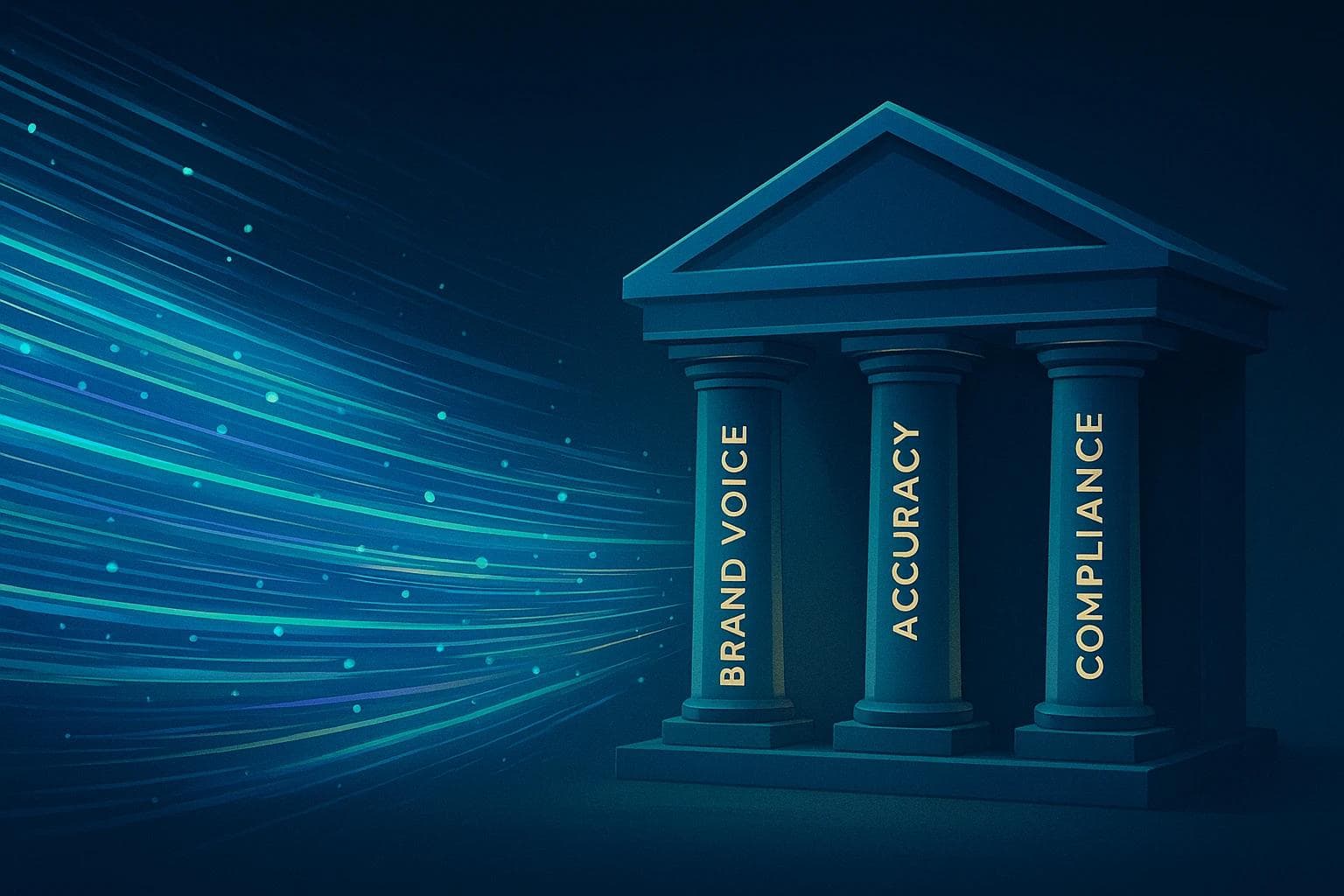
The good news? You can achieve both volume and integrity. The secret lies in building a robust framework around three core pillars: Brand Voice, Content Accuracy, and Compliance.
The Three Pillars of Trustworthy Content at Scale
Before you can automate and scale, you need to understand the foundations you're building on. Think of these three pillars not as separate tasks, but as an interconnected system that protects your brand's reputation and value.
1. Brand Voice: Your Company's Unmistakable Personality
Many people use "voice," "tone," and "style" interchangeably, but they are distinct layers of your brand's personality. Getting this right is the first step to creating content that feels authentic, no matter who or what is creating it.
- Voice is your brand’s enduring personality. Are you the witty expert, the reassuring guide, or the innovative trailblazer? This doesn't change day-to-day. It’s your core identity.
- Tone is the mood or emotion you apply in a specific situation. Your voice remains the same, but your tone adapts. You'd use a more serious tone for a security update than a celebratory one for a new feature launch.
- Style covers the mechanical rules. How do you use capitalization? Do you prefer the Oxford comma? Are certain industry terms always written a specific way? This is the grammar of your brand.
Defining these elements creates a "brand bible" that acts as the source of truth for any creator—human or AI.
2. Content Accuracy: The Foundation of Trust
In the age of AI, accuracy goes beyond simply getting facts right. It’s about actively preventing the spread of misinformation, especially the phenomenon of AI "hallucinations," where an AI model confidently states something that is completely false.
For scaled content, accuracy means:
- Verifying data and statistics against reliable sources.
- Ensuring claims and statements are truthful and not exaggerated.
- Building processes to have subject matter experts (SMEs) review content for technical correctness.
Every piece of inaccurate content is a small crack in the foundation of your audience's trust. At scale, those small cracks can become a catastrophic failure.
3. Content Compliance: The Guardrails That Keep You Safe
Compliance is the broadest and often most overlooked pillar. It’s not just about following your internal brand guidelines; it’s about adhering to a complex web of external rules.
This includes:
- Legal & Regulatory: Following advertising standards (like FTC endorsement guidelines), respecting data privacy laws (like GDPR), and avoiding copyright infringement.
- Ethical: Mitigating bias in AI-generated content and ensuring your messaging is responsible and inclusive.
- Internal Policies: Aligning with your company's values, mission, and established communication policies.
Ignoring compliance at scale doesn't just risk a slap on the wrist; it can lead to hefty fines, legal action, and irreversible damage to your brand’s reputation.

Building Your Safeguarding Framework: From Manual Guardrails to AI Integration
So, how do you put these pillars into practice? It's a phased approach that builds a strong foundation before introducing the complexities of automation.
Phase 1: Solidify Your Foundation (Before You Automate)
You can't automate what you haven't defined. The first step is to document everything.
- Create a Dynamic Brand Bible: Go beyond basic logos and colors. Use a framework to define your voice, tone for various scenarios, and style rules. Document your brand archetype—are you The Sage, The Hero, The Jester? This gives personality to your guidelines.
- Develop a Controlled Vocabulary: This is a list of approved terms, phrases, and definitions. It should also include words to avoid—terms that are proprietary to competitors, legally sensitive, or simply off-brand. This becomes a critical input for training an AI.
- Audit Your Existing Content: Analyze your best-performing pieces. What makes them resonate? Use them as "gold standard" examples of your voice, accuracy, and compliance in action.
Phase 2: Scaling Smartly with Automation and AI
With a strong foundation, you can begin to integrate technology. But not all AI platforms are created equal. The key is to see AI not as a magic button, but as a powerful tool that requires careful instruction and oversight.
Training an AI on your brand involves feeding it your brand bible, controlled vocabulary, and best-in-class content examples. But successful implementation goes deeper. To ensure an AI can truly learn and adapt, understanding what’s the impact of heading structure on AI extractability and other technical nuances becomes vital for creating consistently high-quality output.
Phase 3: Weaving in a Multi-Layered Approval Workflow
Scaling content safely requires a "human-in-the-loop" philosophy. Your workflow should be a series of checks and balances, not a single gate.
This multi-layered approach combines the speed of automation with the nuance of human expertise:
- AI Generation: The AI creates the first draft based on your documented guidelines.
- Automated Checks: Software can scan for style guide violations, forbidden words, and basic grammar issues.
- Human Review: A brand editor refines the content for voice, tone, and flow. This is the art that machines can't fully replicate.
- SME Validation: A subject matter expert verifies all facts, figures, and technical claims for accuracy.
- Legal/Compliance Sign-Off: For sensitive topics, a final review ensures the content meets all legal and regulatory standards before it goes live.

The Buyer's Guide: What to Demand from an AI Content Platform
As you evaluate AI solutions to help you scale, you are no longer just a buyer; you are an architect designing a system. You need a platform with built-in safeguards. Don't be afraid to ask vendors tough questions.
Here is a checklist of capabilities you should require:
Brand Voice Controls
- Can the AI be fine-tuned on our existing content and brand bible?
- Does the platform support dynamic style templates and negative constraints (e.g., "never use these words")?
- How easily can we adjust the tone for different types of content?
Accuracy & Anti-Hallucination Features
- Where does the AI get its information? Can we restrict it to approved data sources?
- Are there built-in fact-checking mechanisms or flags for claims that need verification?
- Does the system use Retrieval-Augmented Generation (RAG) to ground its outputs in your specific knowledge base?
Compliance & Ethical Safeguards
- Does the platform include tools for detecting and mitigating bias?
- Can we build custom content filters and rules to enforce legal and internal policies?
- What protections are in place to prevent copyright infringement in generated content?

Frequently Asked Questions (FAQ)
What's the difference between brand voice and tone?Think of it this way: Your voice is your fixed personality—it's who you are. Your tone is your mood in a given moment—it's how you express that personality. Your friendly, expert voice might adopt a more serious tone for a technical guide and a more enthusiastic tone for a product launch.
Can AI really match our unique brand voice?Yes, but it requires intentional effort. An off-the-shelf AI will produce generic content. A properly trained AI—one fed with your best content, detailed style guides, and specific constraints—can learn to replicate your voice with remarkable consistency, freeing up your human editors to focus on higher-level strategy and refinement.
How do I start building brand voice guidelines from scratch?Start by looking inward and outward.
- Audit Your Audience: Who are you talking to? What are their challenges and communication preferences?
- Define Your Values: List 3-5 adjectives that describe your brand's personality (e.g., "Playful," "Authoritative," "Empathetic").
- Find Examples: Create a "This, Not That" chart showing clear examples of on-brand and off-brand phrasing.
Isn't a human-in-the-loop review slow and expensive?It's far less expensive than a lawsuit, a regulatory fine, or a complete loss of brand trust. Framing it as a cost is the wrong perspective. A human review process is an investment in quality assurance and risk mitigation—two things that become more critical, not less, as you scale.
Your Path to Scaling with Confidence
Scaling content creation isn't a race to produce the most words. It's about building a smart, resilient system that amplifies your brand's message without sacrificing its soul. By focusing on the integrated pillars of voice, accuracy, and compliance, you transform AI from a potential risk into your most powerful ally for growth.
The world of search is constantly evolving, and understanding the future relationship between "GEO and SEO" is key to long-term visibility. A consistent, high-quality, and compliant content engine is the single best way to prepare for what's next, ensuring you're not just creating more content, but creating more impact. Start by defining your standards, building your workflows, and choosing partners who prioritize these safeguards as much as you do.
Roald
Founder Fonzy — Obsessed with scaling organic traffic. Writing about the intersection of SEO, AI, and product growth.
Stop writing content.
Start growing traffic.
You just read about the strategy. Now let Fonzy execute it for you. Get 30 SEO-optimized articles published to your site in the next 10 minutes.
No credit card required for demo. Cancel anytime.

How to Forecast Content Velocity for Traffic and Leads
Learn how to predict traffic, leads, and ROI by modeling content output and quality for smarter growth decisions.

Content Templates and Modular Writing for Better Volume and Depth
Learn how modular writing and templates help produce more content without losing quality or originality.

Automating Content Ops Which Tasks to Automate First
Discover which repetitive content tasks to automate first to save time and boost your content strategy effectively.