Guide to Scaling Content with Governance Roles and Quality Checks

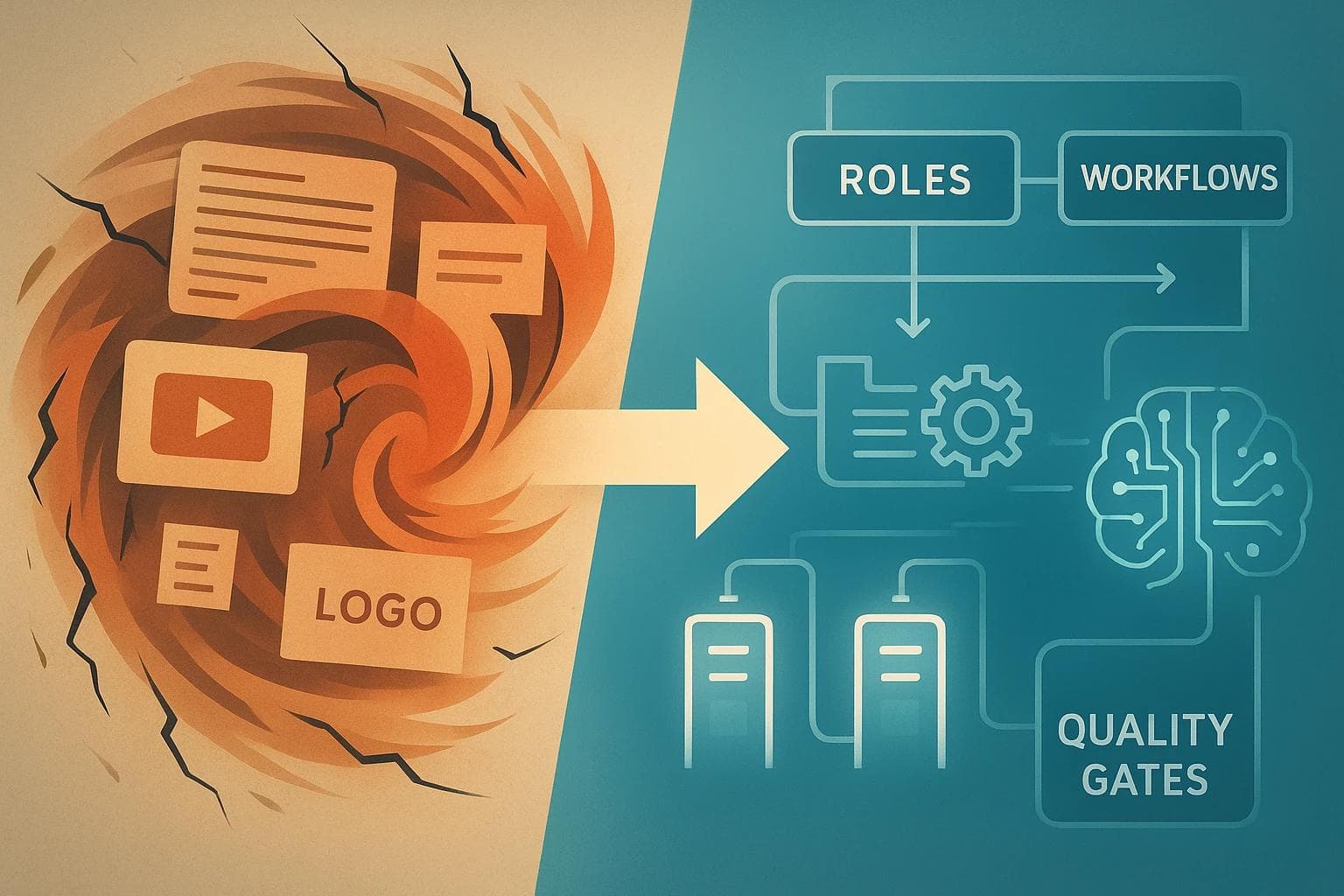
Scaling Content Without Chaos: Your Guide to Governance, Roles, and Quality Gates
You’ve done it. You’ve committed to scaling your content. The goal is to publish consistently—maybe even daily—to capture organic traffic and become a voice of authority in your space. The first few weeks are a rush. Ideas flow, articles get published, and the momentum feels great.
Then, the cracks start to show.
One article sounds like it was written by a marketing professor, the next by a casual blogger. A key product feature is described incorrectly. An image is used without the right attribution. The SEO optimizations you meticulously planned are missed in the rush to publish.
Suddenly, your content engine feels less like a well-oiled machine and more like a runaway train.
Here’s the "aha moment" many teams miss: The problem isn't speed or volume. The problem is the lack of invisible scaffolding. This scaffolding is called content governance, and in the age of AI-powered content creation, it’s not just a nice-to-have—it's the only thing standing between strategic growth and expensive chaos.
What is Content Governance, Really? (Beyond the Buzzword)
It's easy to hear "governance" and think of bureaucracy, red tape, and bottlenecks. But that’s a misconception. Think of it like city planning. A great city doesn't just happen; it's designed with zoning laws, building codes, and traffic systems. These rules don't stifle growth—they enable it, ensuring the city can expand without collapsing into gridlock.
Content governance does the same for your content ecosystem.
To be clear, it’s not the same as its neighbors, content strategy and content management:
- Content Strategy is your blueprint. It answers what you’ll create, for whom, and why it matters.
- Content Management is your toolkit. It’s the systems and platforms (like a CMS) you use to store, manage, and publish content.
- Content Governance is the set of rules, roles, and processes that ensures everything you create is consistent, high-quality, and on-brand, especially when you're producing hundreds of articles. It’s the instruction manual for your content city.

The Core Pillars of a Scalable Governance Framework
A robust governance framework isn't a single document; it's a living system built on three core pillars. When you're just starting, these might be informal, but as you scale, they need to be explicit.
Pillar 1: The People (Clear Roles & Responsibilities)
When everyone is responsible, no one is. Scaling content demands role clarity. While titles vary, the functions are universal. Leading resources like Pantheon.io recommend using a RACI (Responsible, Accountable, Consulted, Informed) matrix to map these out.
Key roles in a modern, scalable content team often include:
- Content Strategist: Owns the "why." They set the editorial calendar, define topics, and ensure content aligns with business goals.
- Subject Matter Expert (SME): The source of truth. They verify the factual accuracy and technical depth of the content, ensuring credibility.
- Content Creator/Writer: The builder. They draft the content according to the brief and style guide. This role is increasingly augmented or filled by AI.
- Editor/Quality Assurance (QA): The inspector. They check for grammar, style, brand voice, and SEO optimization. In an AI-driven world, this role evolves into the "AI Content Editor," who refines and humanizes AI-generated drafts.
- Legal/Compliance Reviewer: The safety officer. For regulated industries or sensitive topics, they ensure content meets legal and compliance standards.
- Content Governance Lead: The city planner. This person owns the governance framework itself, ensuring it's followed, updated, and effective.
Pillar 2: The Process (Workflows for Mass Production)
A workflow is the assembly line for your content. It maps every step a piece of content takes, from a flicker of an idea to a published asset—and eventually, to the archive. At scale, you can't rely on shoulder taps and Slack messages. You need a documented, repeatable process.
A typical workflow for high-volume content might look something like this:
- Briefing: The strategist creates a detailed content brief.
- Drafting: The writer (human or AI) produces the first draft.
- Accuracy Review: The draft goes to an SME.
- Editorial Review: The draft goes to an editor for style, voice, and SEO checks.
- Compliance Review: If needed, it goes to legal.
- Formatting & Publishing: The final version is loaded into the CMS and scheduled.
The key to scaling this process is identifying where you can introduce automations and checkpoints, which brings us to the most critical pillar.

Pillar 3: The Guardrails (Quality Gates in Action)
Quality gates are the heart of content governance at scale. A quality gate is a defined checkpoint in your workflow where content must meet specific, measurable criteria before it can proceed. They are your non-negotiable standards, enforced systematically.
Unlike a simple to-do list, quality gates can be automated. They turn quality control from a subjective art into a repeatable science.
Here are practical examples of quality gates you can implement:
Automated Pre-Review Gate: Before a human editor even sees a draft, an automated check can run to:
Manual SME Accuracy Gate:
- Criteria: Is every technical claim accurate? Are statistics cited correctly? Is the advice safe and sound?
- Result: The SME provides a simple "pass" or "fail with comments," ensuring no misinformation slips through.
Manual Final Polish Gate:
- Criteria: Does the narrative flow? Is it free of typos? Does it match the brand's tone of voice? Are all internal and external links working?
- Result: This is the final human touch that ensures the content resonates with readers.
When you introduce AI into content production, these gates become even more critical. They are your primary defense against AI "hallucinations," brand inconsistencies, and the soulless, generic content that can harm your reputation.
The AI Imperative: What to Expect from Your Content Stack
Scaling with AI magnifies the need for governance. The ability to generate 30, 50, or even 100 articles a month is powerful, but it can quickly amplify any inconsistencies in your process. Therefore, your technology stack must be an active participant in your governance framework.
When evaluating any platform designed to scale content, especially an AI one, you should expect it to have specific operational features to support governance. Platforms like Fonzy AI are designed around this principle, automating not just the writing but also the optimization and strategic alignment necessary for consistent growth.
Here’s what to look for in a modern, governance-aware content platform:
- Automated Workflow Integration: Can you build your review and approval stages directly into the platform, automatically routing content from creator to editor to publisher?
- Style Guide Enforcement: Does the AI actively check its own output against your brand's style guide, terminology, and voice?
- Built-in SEO Checklists: Does the platform ensure every piece of content meets your technical SEO requirements before it can be published?
- Version Control & Audit Trails: Can you easily track changes, see who approved what, and revert to previous versions if needed? This is crucial for accountability.
- Smart Internal Linking: Can the system automatically suggest and implement internal links to build topic clusters and improve SEO authority without manual effort?
Your tech stack shouldn't just be a place to write and store content; it should be an active partner in upholding your quality standards.

Frequently Asked Questions (FAQ)
What's the difference between content governance and content strategy?
Content strategy is the plan (what to create and why), while content governance is the set of rules and processes that ensures the plan is executed with consistent quality. Your strategy sets the destination; governance provides the safe and efficient roadmap to get there.
Isn't governance just bureaucracy that slows things down?
This is the most common myth. Poorly implemented governance can create bottlenecks. But good governance does the opposite at scale. By creating clear rules and automating checkpoints, it eliminates ambiguity, reduces revision cycles, and empowers your team to move faster with confidence. It prevents the chaos that truly slows you down.
How do I start implementing content governance without overwhelming my team?
Start small and be iterative. Don't try to boil the ocean.
- Document one workflow: Choose your most common content type (e.g., a blog post) and map its current journey.
- Create a simple style guide: Start with the top 10 do's and don'ts for brand voice and formatting.
- Define one quality gate: Implement a single, simple checkpoint, like a mandatory SEO check before publishing.Build from there.
Can a small team or even a solo creator have content governance?
Absolutely. Governance is a set of principles, not a headcount requirement. A solo creator has an implicit governance model in their head. The act of writing it down—creating checklists, defining a personal style guide—is the first step to making it scalable, whether for a future team member or for an AI assistant.
From Chaos to Consistency: Your Next Step
Content governance isn't the most glamorous part of content marketing, but it's the most foundational. It's the quiet, consistent work that allows creativity and quality to flourish at scale. It transforms your content program from a series of disconnected efforts into a powerful, strategic asset that drives predictable growth.
You don't need a hundred-page manual to get started. This week, take one small step: grab a whiteboard or a blank document and map out the lifecycle of your last piece of content. Where did it start? Who touched it? Where were the decision points?
Just seeing the process laid out is the first step toward optimizing it. It's the beginning of building the scaffolding that will support your content ambitions, no matter how high you plan to build.
Roald
Founder Fonzy — Obsessed with scaling organic traffic. Writing about the intersection of SEO, AI, and product growth.
Stop writing content.
Start growing traffic.
You just read about the strategy. Now let Fonzy execute it for you. Get 30 SEO-optimized articles published to your site in the next 10 minutes.
No credit card required for demo. Cancel anytime.

How to Forecast Content Velocity for Traffic and Leads
Learn how to predict traffic, leads, and ROI by modeling content output and quality for smarter growth decisions.

Content Templates and Modular Writing for Better Volume and Depth
Learn how modular writing and templates help produce more content without losing quality or originality.

Keeping Brand Voice Accuracy and Compliance When Scaling Content
Learn how to maintain brand voice accuracy and compliance while producing high volumes of content effectively.