How AI Answer Engines Choose What to Cite

Why AI Ignored Your Perfect Article: The 5 Signals You're Missing
You did everything right. You identified a key topic, researched it exhaustively, and wrote a comprehensive, 2,000-word article. It even ranks on the first page of Google.
Then, you open ChatGPT, Gemini, or Perplexity and ask a question your article answers perfectly. The AI confidently responds, citing your competitor… or worse, it provides an answer with a fabricated link.
It’s a frustrating scenario becoming all too common. In the new landscape of search, simply ranking isn’t enough. The goal is to become a cited source for AI answer engines. If your content isn’t being picked, it’s not because the AI has a personal preference; it’s because your content is missing the specific signals these systems are trained to look for.
This isn’t about traditional SEO anymore. This is about Generative Engine Optimization (GEO), and it requires a new way of thinking—one focused on making your content not just visible to algorithms, but fundamentally trustworthy and useful to them.
Beyond Keywords: From Ranking High to "Grounding" AI
For years, the goal of SEO was to climb the ladder of search results. Today, AI answer engines are changing the game. They don't just present a list of links; they synthesize information to create a direct answer. To do this without simply making things up (a problem known as "hallucination"), they rely on a process called Retrieval-Augmented Generation (RAG).
Think of it as a three-step process for a machine:
- Retrieve: When you ask a question, the AI first performs a rapid search across a vast index of web pages to find relevant information.
- Augment: It then reads and analyzes the most promising content to "ground" its answer in facts from those sources.
- Generate: Finally, it uses its language capabilities to generate a cohesive answer, citing the sources it used for grounding.
Your goal is to ensure your content is the most reliable, clear, and authoritative source in that "retrieval" step. To do that, you need to optimize for the five core signals AI looks for.

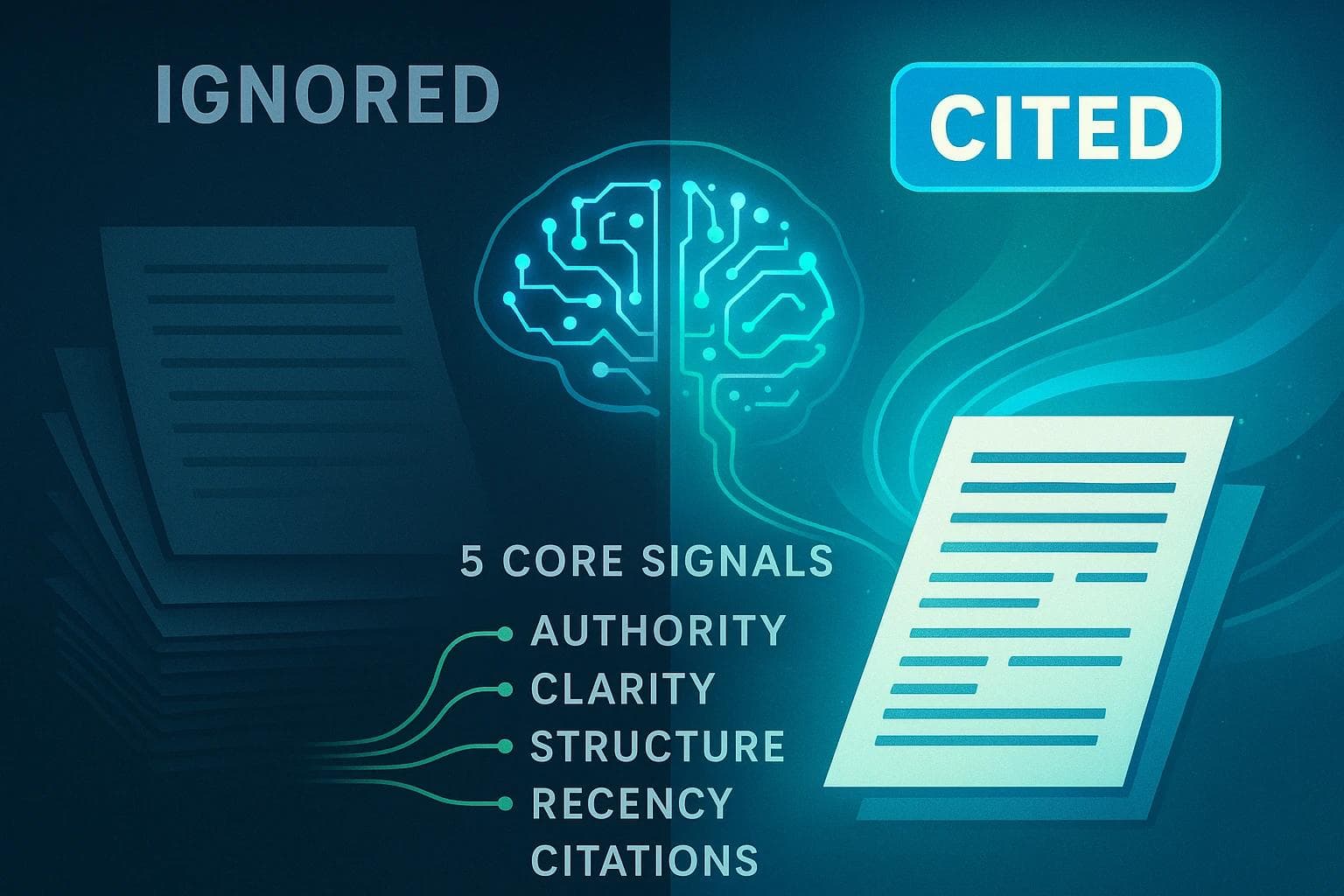
This diagram illustrates the five core signals AI answer engines analyze when selecting sources for citation, simplifying complex model heuristics into accessible visuals.
The 5 Core Signals AI Answer Engines Look For
AI models don't "read" like humans, but they are experts at pattern recognition. They scan for signals of quality and trustworthiness to decide which sources to rely on. Here are the five most critical ones.
Signal 1: Authority & Trust (E-E-A-T Reimagined for Machines)
Your website's general authority still matters, but AI looks for more specific trust signals. It's assessing your Experience, Expertise, Authoritativeness, and Trustworthiness (E-E-A-T) through a machine's eyes.
- Clear Provenance: The AI needs to know who is behind the information. A detailed author bio with credentials, links to social profiles, and a comprehensive "About Us" page are no longer just nice-to-haves; they are critical data points.
- Entity Recognition: AI connects dots across the web. When other authoritative sites (like industry publications or academic institutions) mention your brand or authors in relation to your topic, it reinforces your entity as a trusted source.
- Backlinks as Endorsements: High-quality backlinks remain a powerful signal, but their context is even more important for AI. A link from a relevant, expert source is a strong vote of confidence.
Signal 2: Crystal Clarity & Directness
AI models are not built for nuance or sarcasm. They thrive on clear, unambiguous information. They are looking for content that gets straight to the point.
- Answer-First Writing: Start your sections with a direct answer to a potential question. For example, instead of a long wind-up, a section on RAG could begin with: "Retrieval-Augmented Generation (RAG) is a process AI uses to ground its answers in factual, external sources."
- Simple Language: Avoid jargon and overly complex sentences. The goal is to make your content easy for a machine to parse and extract key facts from. If a 10th grader can understand it, an AI probably can, too.
Signal 3: Scannable Structure & Markup
A well-structured page is like a well-organized filing cabinet for an AI. It allows the machine to quickly find the exact piece of information it needs.
- Logical Hierarchy: Use H1s, H2s, and H3s correctly to create a logical flow. This isn't just for human readability; it's a content map for the AI.
- Lists and Tables: Bulleted lists, numbered lists, and tables are fantastic for structuring data in a way that’s easy for AI to extract and present.
- Schema Markup: Implementing structured data, especially FAQ Schema and Article Schema, explicitly tells the AI what your content is about. It labels your Q&As, author information, and publication dates in a machine-readable format.
Signal 4: Recency & Relevance
For many topics, the most recent information is the most correct information. AI systems are heavily biased toward fresh content because it’s more likely to be accurate.
- Updated Timestamps: Regularly review and update your content, and make sure the "last updated" date is clearly visible.
- Evolving Topics: If your industry changes quickly, maintaining a cadence of fresh content signals to AI that you are a current, reliable source of information.
Signal 5: Verifiable Provenance & Citations
Just as a good academic paper cites its sources, high-quality web content should too. When you link out to authoritative studies, reports, or primary sources, you build a web of trust.
This shows an AI that your claims are not made in a vacuum but are supported by other trusted entities. It demonstrates that you are a responsible participant in the information ecosystem, which boosts your own content's credibility.
Are You GEO-Ready? Two Frameworks to Evaluate Your Content
Understanding these signals is the first step. The next is applying them. Instead of guessing, you can use structured frameworks to audit your content and identify gaps.
The GEO-16 Framework: A 16-Pillar Checklist for Page Quality
Researchers are already working to codify what makes content AI-friendly. One notable arXiv paper outlines a "GEO-16" framework, detailing 16 pillars of page quality that influence generative engine performance. While the specifics are technical, the principle is simple: every aspect of your content, from clarity and factual accuracy to author expertise, contributes to its "citability."
The Citation Confidence Score: A Mental Model for Success
For a more practical approach, think of your content as having a "Citation Confidence Score." You can evaluate your articles by asking simple questions based on the five core signals:
- Authority: Is the author clearly identified with visible credentials? (+10 points)
- Clarity: Does the first paragraph provide a direct, concise summary? (+15 points)
- Structure: Is the article using lists, tables, and FAQ schema? (+20 points)
- Recency: Was the content updated in the last six months? (+10 points)
- Citations: Does it link out to credible, primary sources to support its claims? (+15 points)
- Ambiguity: Does it use vague language or unsupported opinions? (-20 points)
This isn't a real algorithm, but it's a powerful mental model to quickly spot weaknesses and opportunities.

This visual presents the comprehensive GEO-16 framework and Citation Confidence Score elements, helping content creators evaluate and optimize for AI citations.
The Trust Deficit: Why AI Gets It Wrong and How You Can Help
Let's be honest: AI answer engines are far from perfect. Studies have shown they can have shockingly high error rates, with some analyses finding over 60% of citations are misattributed or link to irrelevant sources. They invent facts, create fake URLs, and misunderstand context.
This "trust deficit" is the single biggest opportunity for high-quality content creators.
AI errors often happen when the system encounters a "knowledge gap" and tries to fill it with ambiguous or poorly structured information. By creating content that is exceptionally clear, well-structured, and transparently sourced, you are not just optimizing for GEO—you are actively making the AI ecosystem better.
Your content can become the antidote to AI hallucination. When an AI finds a source that perfectly matches the five core signals, it has a much higher probability of using it correctly. You're essentially providing a safe, reliable harbor of information that the AI can confidently use to ground its answers.

This diagram details the AI citation process, common pitfalls such as hallucinations and misattribution, and proactive strategies to ensure accurate AI citations.
Frequently Asked Questions About Generative Engine Optimization (GEO)
What exactly are AI citations?
It's important to distinguish between two types. First, there are academic guidelines for how humans should cite AI (like ChatGPT) in their work. Second, and what we're focused on here, is how AI answer engines cite web pages as the source of the information in their generated answers. Our goal is to optimize for the second type.
Does domain authority still matter for AI citations?
Yes, but it's part of a much larger picture. A high domain authority can help your content get into the initial "retrieval pool," but the AI's final selection depends more heavily on the clarity, structure, and directness of the content on the page itself. Authority alone won't win if your content is a mess.
Is just adding FAQ schema enough to get cited?
No. Schema is a powerful signal, but it's not a magic bullet. If the content within your FAQ schema is vague, inaccurate, or poorly written, the AI will likely ignore it. The underlying quality of the content is still paramount.
Can AI cite content that's behind a paywall?
Generally, AI models are trained on publicly accessible data and retrieve information from live, open web pages. While there are nuances, content that is freely and easily accessible is far more likely to be retrieved and cited.
Your First Step Towards Becoming a Cited Source
The shift from classic SEO to Generative Engine Optimization is not a distant future—it's happening right now. The principles of creating high-quality content haven't changed, but the technical execution and strategic focus have.
Your first step doesn't require a massive overhaul. Start small. Pick one of your most important articles and audit it using the "Citation Confidence Score" model.
- Is the author's expertise immediately clear?
- Does the first sentence deliver a direct answer?
- Is the information broken down with clear headings, lists, or tables?
- Are your key claims supported by links to trusted sources?
Answering these questions will illuminate the path forward. By focusing on building citable, authoritative assets, you're not just chasing the next algorithm update; you're future-proofing your content for an AI-driven world.
Roald
Founder Fonzy — Obsessed with scaling organic traffic. Writing about the intersection of SEO, AI, and product growth.
Stop writing content.
Start growing traffic.
You just read about the strategy. Now let Fonzy execute it for you. Get 30 SEO-optimized articles published to your site in the next 10 minutes.
No credit card required for demo. Cancel anytime.
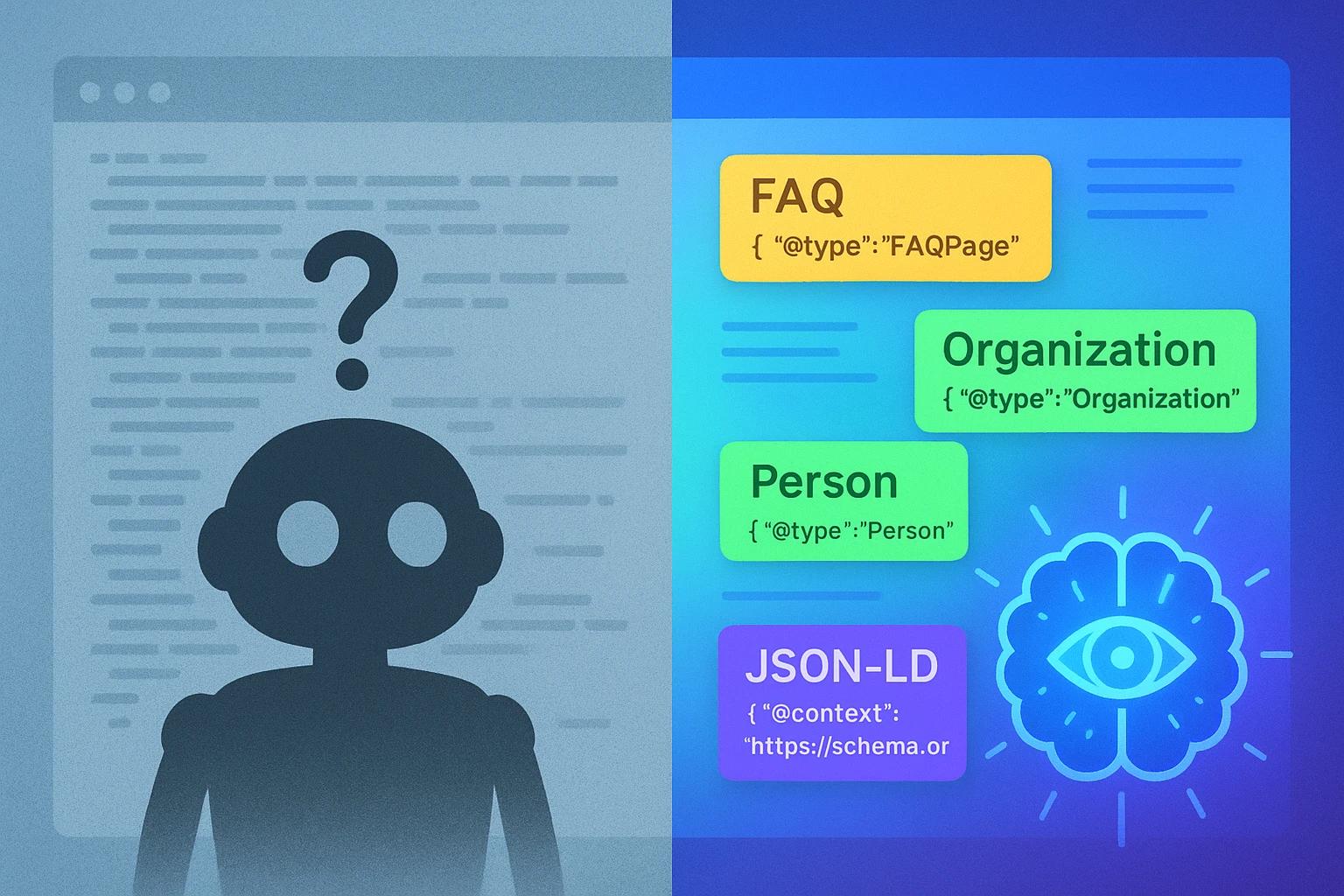
How Schema and FAQ Markup Help AI Understand Your Content
Learn how schema markup and FAQ help AI read your content clearly without needing developer skills.
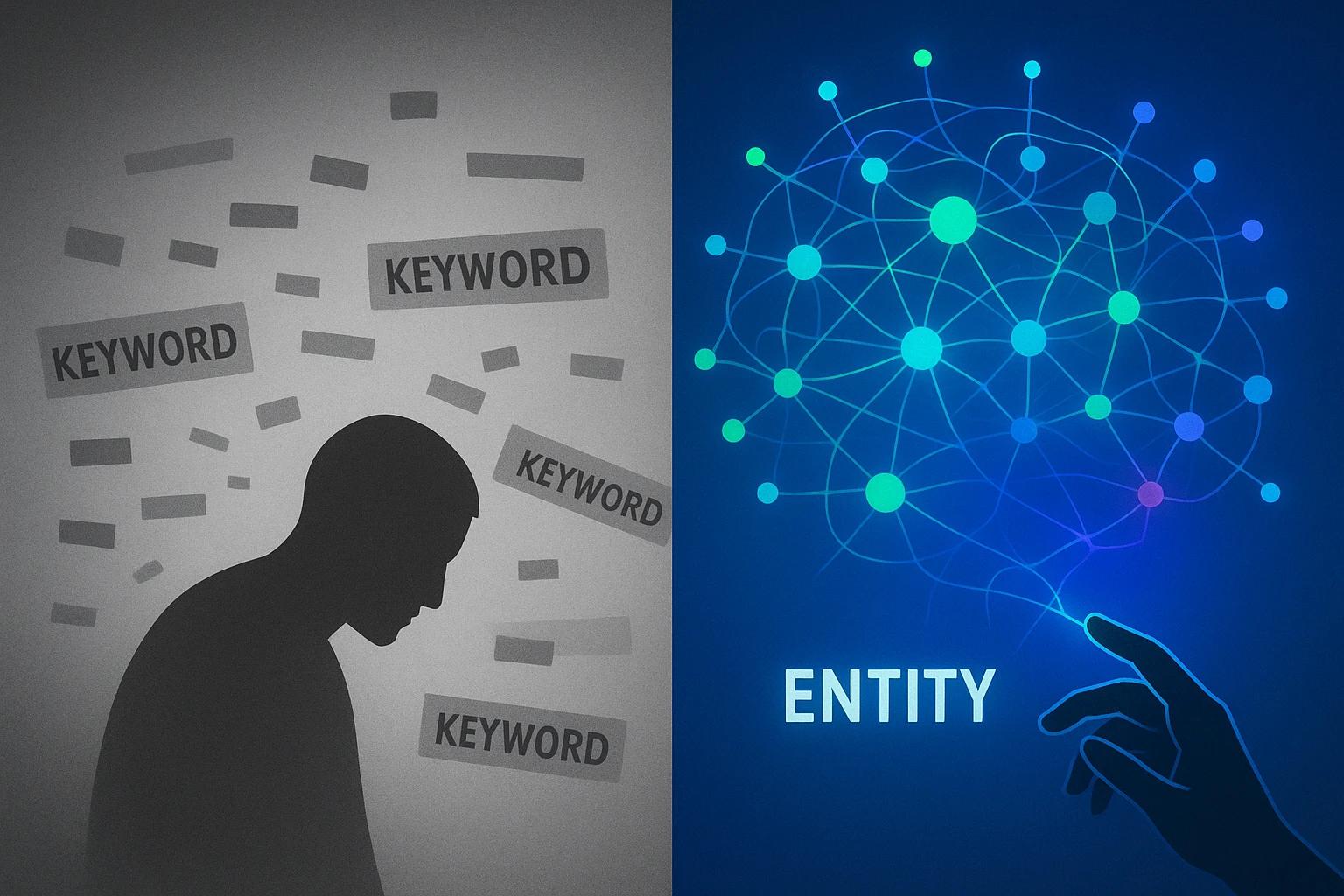
Building topical authority that AI and search engines trust
Learn how to shift from keywords to entities and build the expertise AI and search engines recognize and trust.
What is Generative Engine Optimization and Why It Matters
Learn how Generative Engine Optimization helps your content be trusted and cited by AI in the new search landscape.