The True Cost of Outsourcing SEO: What Agencies Don’t Tell You
You’ve seen the proposals. A monthly retainer of $1,500, $2,000, maybe even $5,000, promising to get you to the top of Google. It seems straightforward enough—a fixed cost for a clear outcome. But what if that number is only the beginning of the story?
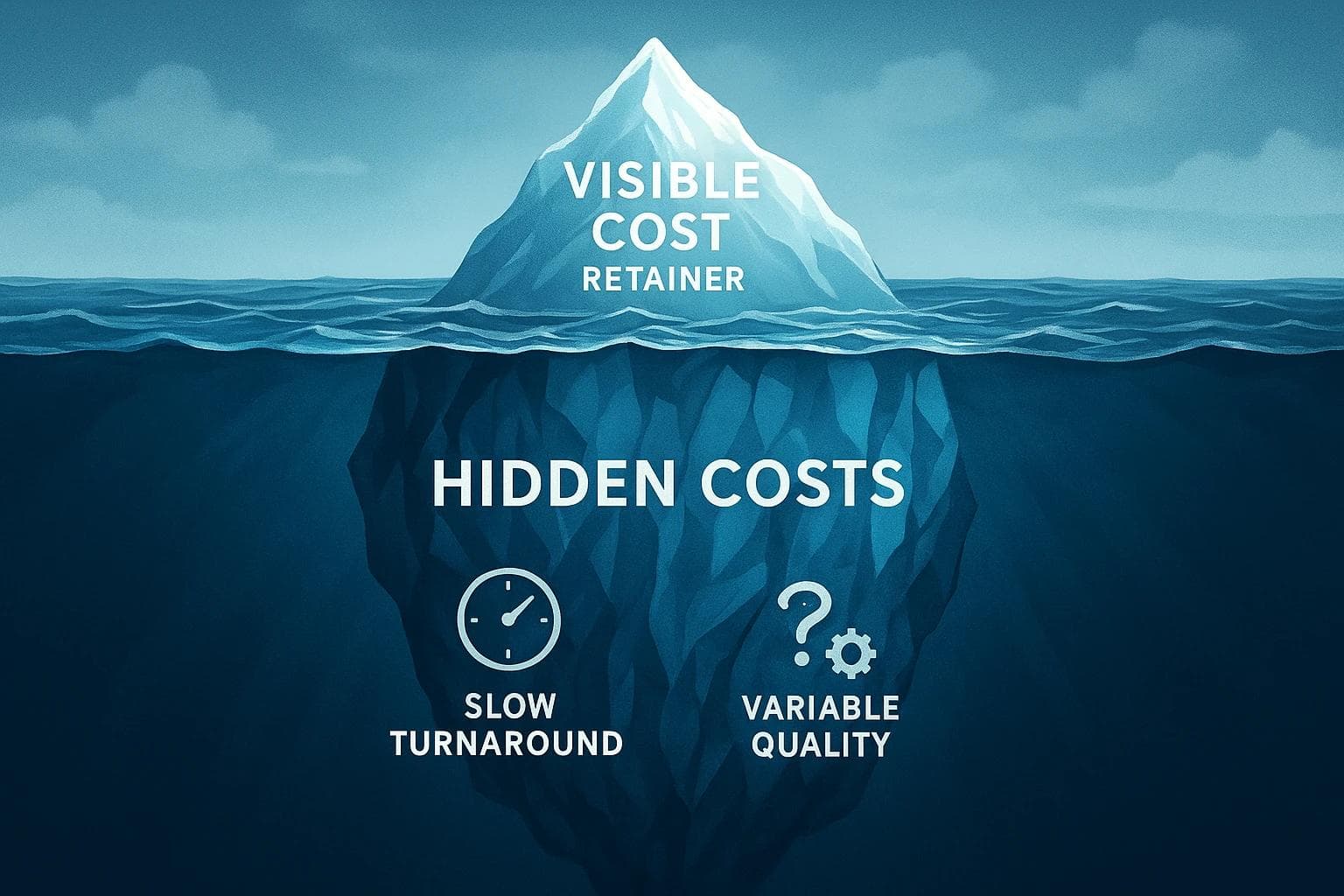
One agency analysis put it bluntly: a "$2,000/month retainer becomes $5,183/month in year one when you factor in reality." That’s a staggering difference. The truth is, the price tag on an SEO agency proposal is often just the tip of the iceberg. The real costs—the ones that drain your time, stall your growth, and quietly inflate your budget—are almost always hidden beneath the surface.
This isn't about finding the cheapest option. It's about understanding the true investment required so you can make a smart, strategic decision for your business's future. Let's pull back the curtain and look at the full picture.

Beyond the Retainer: Understanding Direct SEO Costs
Before we dive into the hidden expenses, it’s important to understand the standard pricing models you’ll encounter. Most agencies structure their fees in one of three ways:
- Monthly Retainer: The most common model. You pay a fixed fee each month for an agreed-upon set of services, like content creation, link building, and technical monitoring. Rates can range from $1,000 for a small local business to over $10,000 for a competitive national campaign.
- Project-Based: You pay a one-time fee for a specific, defined project, such as a website audit or a content strategy build-out. This is great for isolated tasks but less common for ongoing SEO growth.
- Hourly Consulting: You pay an hourly rate for strategic advice or specific tasks. This offers flexibility but can be unpredictable and difficult to budget for.
These direct costs are what agencies want you to focus on. They are clean, simple, and easy to compare on a spreadsheet. But the real story of your total investment lies in the costs they don't put in the proposal.
The Hidden Costs: Unpacking the Agency's Unspoken Truths
Here’s where the real budget gets spent. These hidden costs aren't line items on an invoice; they are drains on your time, your team's resources, and your company's potential growth.
The Management Overhead Tax: Your Time is Money
Outsourcing doesn’t mean you get to be completely hands-off. Managing an agency takes a significant amount of your time—time that could be spent running your business. Think about the hours you and your team spend each month on:
- Weekly or bi-weekly status meetings.
- Endless email chains for approvals and feedback.
- Reviewing reports to understand what’s actually being done.
- Educating the agency on your business, industry, and customers.
Let's quantify this. Imagine you spend just 5 hours a month managing your agency. If your time is worth $150/hour, that’s an extra $750 per month in "management overhead" that never appears on their invoice.
Quick Calculation:(Your Hours/Month x Your Hourly Rate) + (Your Team's Hours/Month x Their Rate) = Your Monthly Management Cost
This simple formula can reveal a shocking addition to your "fixed" retainer.
The High Price of Slow Turnaround: Opportunity Cost in Action
In the world of SEO, speed matters. Every week you’re not ranking for a key term is a week your competitor is capturing those customers. Many traditional agencies are slow to execute. A blog post might take three weeks to go from idea to publication. A critical technical fix could sit in a queue for a month.
This isn't just an annoyance; it's a direct financial cost. Delays mean:
- Slower Time-to-ROI: Your investment takes longer to produce a return.
- Lost Market Share: Competitors who move faster gain ground while you wait.
- Missed Opportunities: A trend or keyword opportunity could be gone by the time your agency gets around to acting on it.
The cost of slow turnaround is the revenue you didn't earn because your strategy was stuck in neutral. It's a key factor when you're trying to figure out how to calculate SEO ROI effectively.
The Compounding Debt of Variable Quality
Not all SEO work is created equal. The biggest risk with outsourcing is inconsistent quality, which can cost you dearly.
- Poor Content: Thin, poorly written, or unoriginal content doesn't just fail to rank—it can damage your brand's credibility and require a complete rewrite, effectively doubling the cost.
- Ineffective Link Building: Low-quality or spammy links can get your website penalized by Google, leading to a sharp drop in traffic that can take months or even years to recover from.
- Technical Errors: Overlooking a critical technical issue, like improper site indexing, can make your pages invisible to search engines, rendering all other efforts useless.
Fixing these mistakes costs time and money. Consistently producing high-quality, relevant content is non-negotiable, which is why many businesses are exploring modern AI-driven content strategies to ensure a high standard of quality at scale.
The "One-Size-Fits-None" Strategy Gap
Many agencies apply a boilerplate SEO strategy to all their clients. They’ll run the same playbook for a local plumber as they do for a national e-commerce store. This generic approach feels efficient for them, but it’s a waste of your money.
A strategy that isn't deeply aligned with your specific business goals, target audience, and competitive landscape will lead to "vanity metrics"—like ranking for an irrelevant keyword—instead of what really matters: leads, sales, and revenue.

A Smarter Comparison: Evaluating Different SEO Models
The traditional agency model is no longer the only option. To make a truly informed decision, you need to compare the full economic picture across all available approaches.
Traditional SEO Agencies
- True Cost: High direct cost + high hidden costs (management overhead, slow turnaround).
- Best For: Large companies with big budgets and an internal marketing manager to oversee the agency.
- Watch Out For: Generic strategies, slow execution, and getting passed off to a junior account manager.
Freelance SEO Consultants
- True Cost: Variable direct cost + high management overhead (you are the project manager).
- Best For: Businesses needing specialized expertise for a specific project or strategy guidance.
- Watch Out For: Limited bandwidth, lack of a comprehensive team (e.g., a technical SEO expert may not be a great writer), and potential for them to become a single point of failure.
In-House SEO
- True Cost: Very high direct costs (salary, benefits, training, software) but potentially lower management overhead if the person is highly skilled.
- Best For: Well-funded companies that see SEO as a core business function and can afford a full-time expert or team.
- Watch Out For: The high cost and difficulty of hiring, training, and retaining top talent.
Automated SEO Platforms
- True Cost: Low, predictable direct cost (monthly subscription) + low management overhead.
- Best For: Small to medium-sized businesses, coaches, and consultants who need consistent, high-quality execution without the massive overhead of an agency.
- Watch Out For: Ensuring the platform can execute a sophisticated strategy. The best platforms use AI to create a data-driven plan and automate its execution, from content creation to publishing. The benefits of content automation are often centered on radical efficiency and consistency.

Your Toolkit for Making a Financially Sound SEO Decision
Knowledge is power. Now that you understand the true cost, you can approach your decision with confidence. Here’s how to protect yourself and make the right choice.
The Agency Vetting Checklist: Questions They Hope You Don't Ask
When you interview a potential agency, go beyond their case studies. Ask these pointed questions:
- Process & Timeline: "What is your average turnaround time for a standard blog post, from approval to publication?"
- Communication: "How many other clients will our account manager be handling? What is your standard response time for emails?"
- Strategy: "Can you walk me through how you would tailor your strategy specifically for my business, beyond a standard audit?"
- Quality Control: "What is your process for quality assurance on content and technical changes? Who on your team is responsible?"
- Reporting: "How do you connect your SEO activities directly to our business goals, like leads and revenue, not just rankings?"
Setting Clear Expectations to Mitigate Risk
A strong contract and clear communication plan are your best defense against hidden costs.
- Define Scope Clearly: Your contract should detail every deliverable, from the number of articles per month to the frequency of technical reports.
- Set Business-Oriented KPIs: Don't just track rankings. Track qualified organic traffic, conversion rates from organic search, and ultimately, revenue.
- Establish Communication Protocols: Agree on a schedule for meetings and a primary point of contact. This minimizes time-wasting back-and-forth.
- Confirm Ownership: Ensure your contract states that you own all the content and data created on your behalf, even if you terminate the agreement.
Frequently Asked Questions About SEO Outsourcing Costs
What's a reasonable monthly SEO budget for a small business?
For most small businesses, a realistic starting budget for a traditional agency is between $1,500 and $3,000 per month. However, remember to factor in at least 25-50% more for your internal management time. Automated solutions can often deliver consistent activity for a fraction of that cost, typically in the $100-$500 range.
Are long-term contracts a red flag?
Not necessarily, but they can be. A 3-6 month initial contract is reasonable for an agency to show results. Be very wary of any agency that tries to lock you into a 12-month contract from day one without a proven track record or a clear performance-based cancellation clause.
How long does it take to see ROI from SEO?
SEO is a marathon, not a sprint. It typically takes 4-6 months to start seeing meaningful traction and 6-12 months to see a significant return on investment. Any agency promising #1 rankings in 30 days is selling snake oil.
Can I outsource just one part of SEO, like content creation?
Absolutely. Many businesses find success with a hybrid model, keeping strategy in-house while outsourcing execution-heavy tasks like writing. This can be a cost-effective way to leverage expert skills without committing to a full retainer.
Moving from Cost to Investment
Choosing an SEO partner isn’t just about finding a vendor—it’s about making a strategic investment in your business's growth. By looking past the shiny retainer fee and calculating the true, all-in cost, you shift from being a price-shopper to a savvy investor.
The right solution isn't the one with the lowest price tag. It's the one that delivers the greatest results with the highest efficiency, respecting both your budget and your time. Whether that's a specialized agency, a nimble freelancer, or a powerful automation platform, understanding the full economic picture allows you to find a partner that will help you grow, not just send you an invoice.

Roald
Founder Fonzy — Obsessed with scaling organic traffic. Writing about the intersection of SEO, AI, and product growth.
Stop writing content.
Start growing traffic.
You just read about the strategy. Now let Fonzy execute it for you. Get 30 SEO-optimized articles published to your site in the next 10 minutes.
No credit card required for demo. Cancel anytime.

5 Signs Your Content Strategy is Losing Customers
Discover key signs your content strategy is stuck and quietly losing customers before it impacts your growth.

How to Measure SEO ROI with Business Metrics
Learn simple ways to measure SEO ROI focusing on leads, conversions, cost, and customer value beyond keywords and rankings.

The Role of Human Oversight in AI-Driven Content
Learn how human oversight ensures quality and brand voice in AI-generated content for agencies.