How Syndication Mentions and Links Improve Content Discoverability

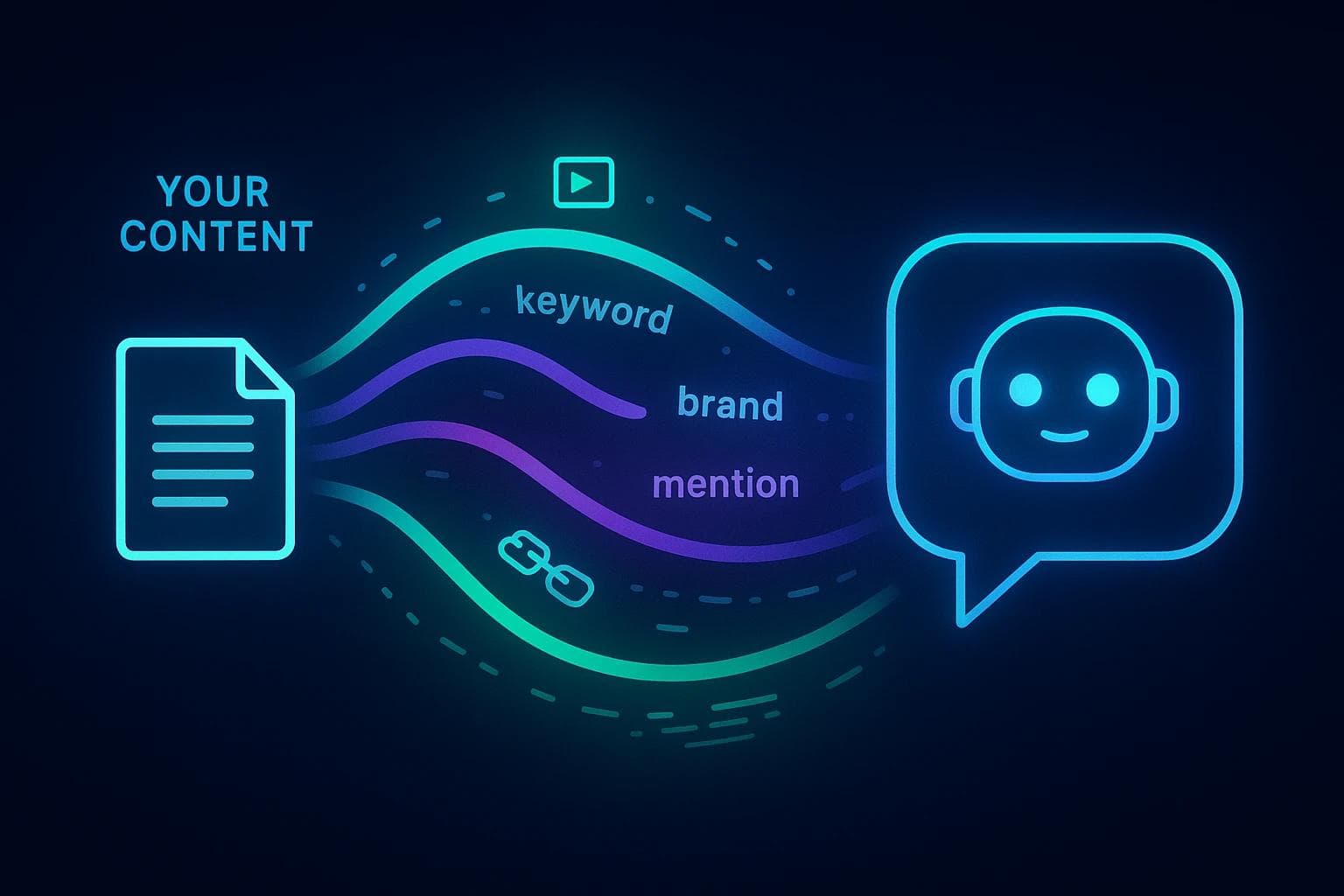
Beyond Google: How Your Content Gets Found by AI Chatbots
Have you ever asked an AI chatbot, like ChatGPT or Perplexity, a question about your specific area of expertise? You know the answer inside and out. You’ve written articles, created guides, and shared your knowledge online. Yet, the AI gives a generic, surface-level response, completely ignoring your definitive content.
It’s a frustrating experience that’s becoming more common. Why is this happening?
Because the rules of being "found" online are changing. For years, we focused on ranking in Google. But now, a new layer of discovery is emerging through conversational AI, and it doesn't play by the same old rules. If your content isn't visible in the places AI looks for trustworthy information, it's as if it doesn't exist.
The good news is, the solution isn't about abandoning everything you know. It's about understanding how to make your existing efforts work harder in this new landscape. It’s about learning how distribution pathways like syndication, mentions, and links act as the breadcrumbs that lead AI right to your door.
The New Definition of Discoverability
For a long time, "discoverability" meant SEO. Today, it’s much broader. True discoverability is about making your content available and authoritative wherever your audience—and the AI tools they use—are looking for answers.
This is driven by a technology called Conversational Retrieval. Think of it like this: an AI chatbot has a massive digital library. When you ask it a question, it doesn't "think" of an answer from scratch. Instead, it quickly skims its library for the most relevant, trustworthy books and articles, then synthesizes an answer from what it finds.
Your goal is to ensure your content is a go-to, five-star resource in that library. How do you do that? By building a strong presence through three foundational pillars that signal your authority and relevance to these retrieval systems.

Let's break down how each of these pillars works in the age of AI.
The Pillars of AI Discoverability
These concepts might sound familiar to anyone who has dabbled in marketing, but their importance has been supercharged by AI. They are no longer just tactics for traffic; they are fundamental inputs for teaching AI what to trust.
1. Content Syndication: Broadcasting Your Authority
In simple terms, content syndication is the practice of republishing your content on other, often larger, websites. You've seen this with articles on platforms like Medium, LinkedIn, or industry-specific news sites that feature content from other creators.
- The Old Way of Thinking: "This will get my content in front of a new audience and maybe bring some traffic."
- The AI-Era Reality: When a conversational retrieval system sees your high-quality article appearing on your blog and a well-respected industry journal, it registers a powerful signal. It tells the AI, "This piece of information is so valuable that other trusted sources are broadcasting it." This increases the likelihood that the AI will cite your original article as a foundational source.
A crucial piece here is the "canonical tag." It's a small snippet of code that tells search engines (and AI) which version of the content is the original. As HubSpot’s experts often emphasize, this prevents duplicate content issues and ensures you get the credit, solidifying your authority.
2. The Power of a Mention: When AI is Listening
A mention is any time your brand, product, or name appears online. They come in two flavors:
Linked Mentions: A direct link back to your website.
3. Contextual Links: The Super-Signals for Understanding
A contextual link is a hyperlink placed within the body of a piece of content, rather than in a footer or sidebar. As SEO guru Neil Patel has shown for years, these are the most powerful types of links.
- The Old Way of Thinking: "I need links with my target keyword in the anchor text to rank higher."
- The AI-Era Reality: For an AI, a contextual link is a rich story. The text in the link (the anchor text) is important, but so is the text in the sentences surrounding the link. This context tells the AI not just what your page is about, but why it's being recommended in that specific situation. A link from a detailed product review, for example, tells the AI that your page is a trusted resource for that product, making it more likely to be retrieved for related queries.
Each of these pillars contributes a different signal. Syndication broadcasts your message, mentions build your reputation, and contextual links clarify your specific expertise. Together, they form a powerful system for feeding conversational AI the information it needs to find and recommend your content.

The Distribution Gap: Why Your Content Is Still Invisible
So, if these are the pillars, why is so much great content still getting missed by AI?
The problem is that most creators and businesses treat these activities as separate, isolated tasks.
- You might write a guest post to get a contextual link.
- You might occasionally share an article on LinkedIn.
- You might have a PR team trying to get brand mentions.
These efforts are rarely connected. There's no single, unified plan. This creates a "distribution gap"—a disconnect between creating great content and ensuring it’s seen by the systems that are now shaping how we find information. Without a plan to weave these pillars together, your signals are scattered and weak, easily lost in the noise.
This is why a simple "publish and pray" approach no longer works. You need a coordinated optimization strategy that views content creation and distribution as two sides of the same coin. An effective strategy ensures that every piece of content is supported by a distribution plan designed to build authority and relevance signals across multiple channels, making your expertise undeniable to both humans and AI.

Frequently Asked Questions (FAQ)
It's natural to have questions as the digital landscape shifts. Here are answers to some of the most common ones.
What is content syndication?
Content syndication is the process of republishing an article or piece of content that originally appeared on your website to a third-party site. This can be done on free platforms (like Medium or LinkedIn Articles) or through paid partnerships with larger media outlets. The goal is to reach a wider audience and build authority.
How does content syndication affect SEO? Will I be penalized for duplicate content?
This is a common and valid concern. You won't be penalized for duplicate content as long as you ensure the syndicating site uses a canonical tag (rel="canonical") pointing back to the original article on your website. This tag tells search engines and AI systems, "This is a copy, and here is the original author you should give credit to."
What makes a good contextual link?
A great contextual link comes from a reputable website relevant to your industry. The link itself should feel natural within the text and use anchor text that accurately describes the page it's linking to. The content surrounding the link should also be on-topic, as this provides additional context and strengthens the signal of relevance.
Are unlinked brand mentions really valuable?
Absolutely. Modern search and AI systems are sophisticated enough to understand entities and sentiment. When your brand is mentioned positively on authoritative sites, even without a link, it helps build a stronger reputation and association with your topics of expertise. It's a key part of building a brand that AI systems recognize and trust.
Your Next Step: From Awareness to Action
Understanding that your content needs to be discovered by AI is the first major step. You now see that syndication, mentions, and contextual links are no longer just items on a marketing checklist—they are the essential ingredients that feed the new engines of discovery.
The challenge is no longer just about creating content, but about creating a system. A system where every article is published with a clear distribution plan to maximize its visibility and authority. This is the heart of modern AI-driven content strategies.
If you’re ready to close the distribution gap and turn your expertise into a resource that both people and AI can rely on, your next step is to explore how to build a coordinated optimization strategy that makes this process seamless. In an era of constant content creation, the brands that win will be the ones that master discoverability.
Roald
Founder Fonzy — Obsessed with scaling organic traffic. Writing about the intersection of SEO, AI, and product growth.
Stop writing content.
Start growing traffic.
You just read about the strategy. Now let Fonzy execute it for you. Get 30 SEO-optimized articles published to your site in the next 10 minutes.
No credit card required for demo. Cancel anytime.

How Schema Markup Helps AI Understand Your Content
Learn how schema markup boosts AI visibility and trust without needing developer skills to optimize your content.

Technical Foundations of Crawlability Schema and AI Page Signals
Learn how crawlability schema and page signals impact AI understanding and trust of your website content.

Why AI Needs Linked Sources and Primary Data for Citations
Learn why original data and clear attribution are vital for AI to trust and cite your information correctly.