Technical Foundations of Crawlability Schema and AI Page Signals

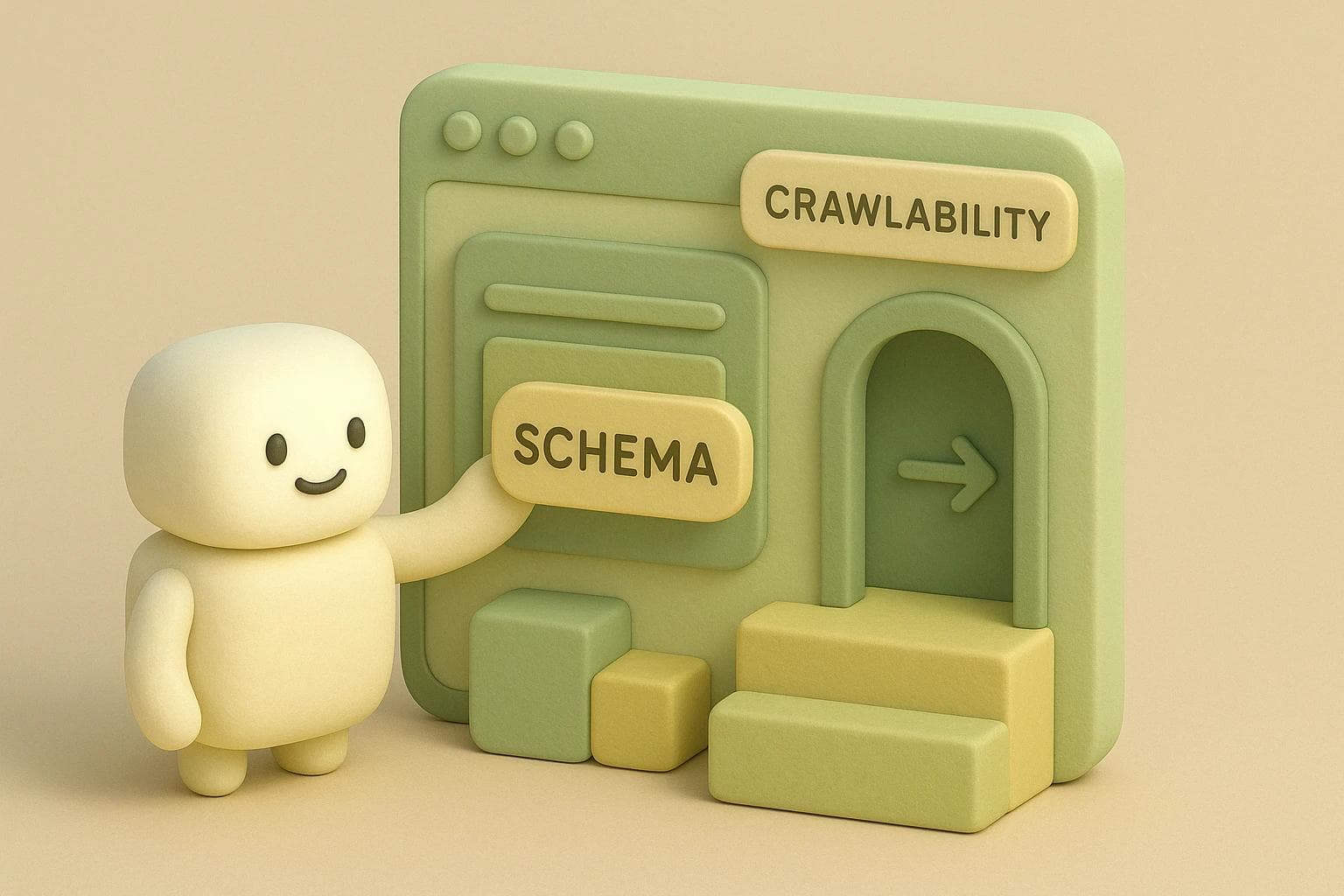
Your Website's First Impression: A Guide to Technical SEO for AI Search
Ever walked into a library where the books are piled on the floor, the lights are off, and there’s no card catalog? You might find something valuable, but it would be a frustrating, inefficient mess.
For many websites, this is the exact experience they offer to AI search crawlers.
In the new era of AI Overviews and generative answers, your website is no longer just being read by people—it's being understood, analyzed, and cited by artificial intelligence. If your site’s technical foundation is messy, AI systems will struggle to find, trust, and recommend your content.
This isn't about complex coding. It's about setting up your digital "library" so that AI can easily walk in, find the right book, understand its contents, and confidently recommend it to others. Let's turn on the lights and get organized.
The Digital Doorway: Is Your Site Even Open for AI?
Before an AI can appreciate your brilliant content, it first has to get in the door. This is the concept of crawlability. If a crawler can't access your pages, your content might as well be invisible.
Think of AI crawlers as hyper-efficient researchers. They are different from traditional search bots like Googlebot. As noted by SEO platforms like Conductor, AI crawlers are often more aggressive in how they process complex code like JavaScript and may visit your site more frequently to keep their knowledge base fresh.
Here are the essential keys to your digital doorway:
- Robots.txt: This is the welcome sign on your door. It’s a simple text file that tells crawlers which areas of your site are open for exploration and which are private. A misconfigured
robots.txtcan accidentally block crawlers from your most important content. - Sitemap: Your sitemap is the library's floor plan. It's an XML file that lists all your important pages, making it easy for AI to discover everything you have to offer without having to wander down every hallway.
- Clean URL Structure: Logical, easy-to-read URLs (e.g.,
your-site.com/services/ai-content) act as clear signposts. Messy URLs with random numbers and characters are like unlabeled hallways—confusing and unhelpful. - Canonicalization: Sometimes you have multiple pages with similar content (like product pages with different color options). The canonical tag (
rel="canonical") tells AI, "Of all these similar pages, this is the main one you should pay attention to." This prevents confusion and consolidates your authority.
Getting these basics right is the non-negotiable first step. Without a clear path in, even the most advanced AI optimization efforts are pointless.
Speaking AI's Language: Semantic Structure and Schema Markup
Once a crawler is inside your site, it needs to understand what it's reading. AI doesn't "see" a webpage like we do. It reads the underlying code to understand hierarchy, context, and meaning. This is where speaking its language becomes critical.
Semantic HTML: The Building Blocks of Meaning
HTML tags are more than just formatting tools; they provide structure and meaning. Using them correctly is like using proper grammar.
- Headings (<h1>, <h2>, etc.): These create a logical outline. Your
<h1>is the book's title,<h2>s are chapter titles, and so on. This hierarchy tells AI what the main topics and subtopics are. - Paragraphs (<p>): Clearly defines distinct blocks of text.
- Lists (<ul>, <ol>): Structures information in an easily digestible format, signaling processes or groups of items.
- Image Alt Text (alt="..."): Describes an image for visually impaired users and for AI, providing crucial context for the visual elements on your page.
As highlighted in technical guides from agencies like Monogram, this logical structure is a foundational element for AI comprehension. It’s the difference between a structured report and a wall of unformatted text.
Schema Markup: The AI "Cheat Sheet"
If semantic HTML is proper grammar, then Schema Markup (also called structured data) is an executive summary written specifically for AI. It’s a vocabulary you add to your site's code that explicitly tells search engines what your content is about.

Instead of making an AI guess that your page is a recipe, you can use Recipe schema to label the ingredients, cooking time, and calorie count.
Why is this a game-changer for AI?
- It removes ambiguity: AI knows for certain what each piece of information represents.
- It builds trust: Providing clear, structured data is a strong signal of quality and authority.
- It enables rich results: It’s what powers features like review stars, event listings, and FAQ dropdowns in search results, making your content more visible and useful.
Common types of schema include Article, FAQPage, HowTo, Product, and LocalBusiness. Implementing the right schema is one of the most powerful ways to improve how AI understands and features your content. This structured data acts as one of the core technical signals that helps AI verify the expertise and trustworthiness of your information.
Signals of Quality and Trust: What Makes AI Prefer Your Page?
With access and understanding sorted, the final piece is trust. AI systems are designed to surface the most reliable, high-quality information. They look for specific "page signals" that indicate your content is authoritative and offers a good user experience.
Page Speed and Core Web Vitals
A slow-loading, clunky website is a poor experience for users, and AI knows it. Google’s Core Web Vitals are a set of metrics that measure the real-world user experience of a page:
- Largest Contentful Paint (LCP): How quickly does the main content load?
- Interaction to Next Paint (INP): How quickly does the page respond to user interaction (like a click)?
- Cumulative Layout Shift (CLS): Does the page layout jump around as it loads?

Optimizing for these metrics by compressing images, streamlining code, and using modern hosting isn't just a technical task—it's a direct signal to AI that you care about your users' experience.
E-E-A-T: The Foundation of Trust
Expertise, Experience, Authoritativeness, and Trustworthiness (E-E-A-T) are the principles Google uses to assess content quality. While not a direct ranking factor, these concepts are woven into the algorithms that decide which content to trust. AI systems lean heavily on these same signals.
You can demonstrate E-E-A-T technically through:
- HTTPS: A secure site is non-negotiable. It’s a basic trust signal.
- Clear Authorship: Linking content to a real author with a bio and credentials shows expertise.
- Content Freshness: Regularly updating your content signals that your information is current and relevant.
- Strong Internal and External Links: Linking to other authoritative sources and having them link back to you builds credibility within your topic.
Before you even begin making changes, it's wise to establish a baseline of your current standing by looking at key pre-optimization metrics. Once you start improving these trust signals, you can begin to measure AI visibility signals to see the impact of your efforts.
Your AI Readiness Playbook: A Quick-Start Checklist
Feeling overwhelmed? Don't be. Getting started is about focusing on the fundamentals. Use this checklist as your guide to making sure your technical foundation is AI-ready.
Phase 1: The Digital Doorway (Crawlability)
- [ ] Check robots.txt: Ensure you aren’t accidentally blocking important pages.
- [ ] Submit a Sitemap: Make sure Google and other search engines have your sitemap submitted via their respective webmaster tools.
- [ ] Review URL Structure: Are your URLs simple, clean, and descriptive?
- [ ] Fix Canonical Issues: Use a tool like Google Search Console to find and fix duplicate content warnings.
Phase 2: Speaking the Language (Comprehension)
- [ ] Audit Heading Structure: Is there only one
<h1>per page? Do<h2>,<h3>, etc., follow a logical order? - [ ] Implement Basic Schema: Start with
Organizationschema on your homepage andArticleschema on your blog posts. - [ ] Add Alt Text: Ensure every important image has descriptive alt text.
Phase 3: Building Trust (Quality Signals)
- [ ] Test Page Speed: Use Google's PageSpeed Insights to check your Core Web Vitals.
- [ ] Enable HTTPS: Secure your entire site.
- [ ] Establish Authorship: Create author bios and link them to your content.
Fixing these foundational elements is the most impactful thing you can do to prepare your site for the future of search. It ensures that when you do create great content, AI systems can actually find, understand, and trust it.
Frequently Asked Questions (FAQ)
What is the difference between crawlability and indexability?
Crawlability is about whether search engine bots can access the content on your pages. Indexability is the next step: whether they can add that content to their massive database (the index) to be shown in search results. You can't be indexed if you aren't crawlable first.
How do AI crawlers differ from traditional Googlebot?
While they share the same goal of understanding content, AI crawlers (like those for Google's AI Overviews or Perplexity) are often more sophisticated. They are better at rendering and understanding JavaScript-heavy websites and are focused on extracting specific facts, relationships, and nuances from your text to use in generative answers.
What is schema markup and why is it so important for AI?
Schema markup is a code vocabulary that provides explicit context about your content. It’s important for AI because it eliminates guesswork. Instead of inferring that "25 minutes" is a prep time in a recipe, schema tells the AI directly, "This is the prepTime." This clarity makes your content more likely to be used accurately in AI-generated answers.
How can I test if my site is crawlable?
The easiest way is to use Google Search Console. The URL Inspection tool will tell you if Google can access a specific page and if there are any crawl errors. You can also look at the "Pages" report under the "Indexing" section to see which pages are crawled and indexed, and which aren't.
The Future is Built on a Strong Foundation
Optimizing for AI isn't about chasing a mysterious new algorithm. It's about doubling down on the fundamentals of good web development and clear communication. By ensuring your site is accessible, understandable, and trustworthy, you’re not just preparing for AI—you're creating a better, faster, and more useful experience for everyone.
With a solid technical base in place, you can more effectively structure your content for AI, confident that your message is being received loud and clear.
Roald
Founder Fonzy — Obsessed with scaling organic traffic. Writing about the intersection of SEO, AI, and product growth.
Stop writing content.
Start growing traffic.
You just read about the strategy. Now let Fonzy execute it for you. Get 30 SEO-optimized articles published to your site in the next 10 minutes.
No credit card required for demo. Cancel anytime.

How Schema Markup Helps AI Understand Your Content
Learn how schema markup boosts AI visibility and trust without needing developer skills to optimize your content.
Why AI Needs Linked Sources and Primary Data for Citations
Learn why original data and clear attribution are vital for AI to trust and cite your information correctly.

Semantic Clarity for AI Search Success
Learn how semantic clarity links questions to content for precise AI answers and better search results.