
How to Spot the Content Gaps Costing You Organic Visibility
You’ve done everything right. You’re writing blog posts, sharing your expertise, and hitting “publish” on a regular basis. But when you check your analytics, you hear crickets. The traffic you expected just isn't showing up, and you can’t figure out why.
If this sounds familiar, you’re not alone. The problem often isn’t the quality of your content, but the invisible “gaps” it’s failing to fill. These are the spaces between what your audience is desperately searching for and the answers you actually provide.
These gaps are more than just missed opportunities; they're silent traffic killers. They prevent you from showing up in Google searches, getting featured in AI answers, and connecting with customers who need you most. But what if you could learn to see them?

First, What Exactly Is a Content Gap?
Think of a content gap analysis as creating a map. On one side, you have all the questions, problems, and needs of your ideal customer. On the other side, you have all the content you’ve created. A content gap is any unanswered question or unsolved problem on that map.
It’s easy to confuse this with a keyword gap, which is simply a list of keywords your competitors rank for that you don’t. A content gap is much deeper. It’s about understanding the intent behind the keywords and the journey your customer is on. You're not just asking "what keywords are they using?" but "what problems are they trying to solve?"
The 7 Types of Content Gaps You Might Be Missing
Content gaps aren't just about missing topics. They come in many forms, and learning to spot them is the first step toward claiming your visibility.
1. Topic Gaps (The Obvious One)
This is the most straightforward gap: your competitors are covering a topic relevant to your audience, but you aren’t.
- Example: A financial advisor for small businesses has articles about tax planning and invoicing but has never written about choosing the right business bank account.
2. Intent Gaps (The "Why" Mismatch)
You’re covering a topic, but you're missing the reason someone is searching for it. Search intent typically falls into four categories: informational (to learn), navigational (to find a specific site), transactional (to buy), and commercial (to research before buying).
- Example: Someone searches "best running shoes for beginners." They don't want a history of Nike (informational); they want a comparison article to help them make a purchase (commercial/transactional). If your article is just a history lesson, you’ve missed the intent.
3. Depth Gaps (The Skim-Level Problem)
Your article scratches the surface of a topic, but searchers are looking for a comprehensive guide. Google and other search engines prioritize content that thoroughly answers a user's question.
- Example: You have a 300-word blog post titled "What is SEO?" while top-ranking results are 2,500-word ultimate guides covering every aspect of the topic for beginners.
4. Format Gaps (The Wrong Delivery)
Sometimes, the gap isn't in the information but in how it's presented. Your audience may prefer a video, a checklist, a template, or an infographic over a long-form blog post.
- Example: For a search like "how to tie a bowline knot," a short video or a step-by-step image guide is far more useful than a text-only article.
5. Freshness Gaps (The Outdated Advice)
Your content was great when you published it three years ago, but now the information is outdated. This is especially critical in fast-moving industries like technology, marketing, and finance.
- Example: An article from 2020 listing the "Top Social Media Marketing Trends" is no longer relevant or trustworthy.
6. Authority Gaps (The "Who Says?" Problem)
You've made claims, but you haven't backed them up. In an age of misinformation, Google prioritizes content that demonstrates Experience, Expertise, Authoritativeness, and Trustworthiness (E-E-A-T). This means citing sources, featuring expert authors, and providing evidence.
- Example: A health and wellness blog makes bold claims about a new diet trend without linking to any scientific studies or quoting a registered dietitian.
7. AI Visibility Gaps (The New Frontier)
This is a new and increasingly critical gap. When someone asks a question to a generative AI like Google’s AI Overviews or Perplexity, the AI synthesizes information from top sources to create a direct answer. If your content isn't structured for easy extraction, you'll be invisible in these AI-powered summaries. Answering a specific question clearly and concisely is key, and it raises the question of what’s the impact of heading structure on ai extractability? Answering this correctly ensures your content is primed for this new form of search.
How to Find Your Gaps: From Manual Methods to AI-Powered Discovery
Spotting these gaps can feel like finding a needle in a haystack, but there are clear methods to get you started.
The Manual Approach (And Its Limits)
For those just starting, you can uncover some valuable insights with a bit of digital detective work:
- "People Also Ask" (PAA): Search for one of your core topics on Google. The PAAs are a goldmine of related questions your audience is asking.
- Forums and Social Media: Go to where your audience lives online—Reddit, Quora, Facebook groups. What questions do they ask over and over? Those are your content gaps.
- Your Own Site Search: What are people searching for when they land on your website? If they can't find it, that's a gap you need to fill immediately.
While these methods are great for finding low-hanging fruit, they quickly become unmanageable. It’s time-consuming, difficult to scale across hundreds of topics, and you risk missing the bigger strategic picture that a comprehensive analysis provides.

The Augmented & Automated Approach
This is where technology becomes your partner. SEO and content strategy platforms are designed to analyze massive amounts of data in minutes, revealing opportunities you’d never find on your own. They can compare your entire content library against multiple competitors, map out entire topic clusters, and pinpoint the exact articles you need to create or update to gain an edge.
For businesses aiming for consistent growth, an AI-driven platform like Fonzy AI takes this a step further by not just identifying the gaps but automatically generating a content plan to fill them, ensuring your strategy is always on and always optimizing for visibility.
You've Found Gaps… Now What? A Simple Prioritization Framework
Discovering dozens of content gaps can feel overwhelming. You can’t tackle everything at once, so how do you decide where to start? Use a simple Impact vs. Effort matrix.
Plot each content gap on this matrix to see where your focus should go first:
- High Impact, Low Effort (Quick Wins): Do these immediately! This could be updating an old post with fresh data or adding a new section to an article to better match search intent.
- High Impact, High Effort (Major Projects): These are your big strategic initiatives. This might be creating a comprehensive, 10-part guide on a core topic that will become an industry resource.
- Low Impact, Low Effort (Fill-Ins): Tackle these when you have spare time. They won't revolutionize your traffic, but they help round out your content library.
- Low Impact, High Effort (Reconsider): Put these on the back burner. The return on investment is too low to justify the resources right now.

Common Pitfalls to Avoid in Your Content Gap Analysis
As you begin this journey, steer clear of these common mistakes:
Pitfall 1: Focusing Only on Keywords, Not Intent
Don't just create a new page for every keyword variation. Instead, understand the underlying question and create one comprehensive piece that answers it fully.
Pitfall 2: Getting Lost in Competitor Copying
Use competitor analysis for inspiration, not for imitation. The goal isn't to be a carbon copy of their blog but to find the gaps they've also missed and create something uniquely valuable.
Pitfall 3: Ignoring Your Existing Content
Your best opportunities might be hiding in plain sight. Often, updating, expanding, and improving an existing article (a "content refresh") can bring much faster results than creating something from scratch.
Frequently Asked Questions
What's the difference between a content gap and a keyword gap?
A keyword gap is tactical; it's a list of keywords a competitor ranks for that you don't. A content gap is strategic; it’s about understanding the entire landscape of your audience's needs and questions, whether or not a competitor is already addressing them.
How often should I perform a content gap analysis?
A deep analysis is valuable once or twice a year, especially when planning your content strategy. However, you should always be in a "gap-spotting" mindset, listening to customer questions and monitoring industry trends on a weekly or monthly basis.
Can I do this without expensive tools?
Yes, the manual methods mentioned above can help you find initial opportunities. However, as your site and goals grow, manual processes become a significant bottleneck. Tools are essential for scaling your efforts and performing a truly comprehensive analysis.
The Future is Automated: Taking the Next Step
Understanding content gaps is like switching on the lights in a dark room—suddenly, the path to more organic traffic becomes clear. You can see the questions that need answers, the topics that need covering, and the opportunities everyone else has missed.
While manual analysis is a great starting point, the future of content strategy lies in automation. AI-driven platforms can analyze the entire digital landscape in real-time, handing you a prioritized roadmap for growth without the hours of manual spreadsheet work. They transform content gap analysis from a time-consuming project into a continuous, automated engine for organic visibility.
By focusing on filling these gaps, you stop creating content in a vacuum and start building a library of resources that serves your audience, builds trust, and naturally attracts the right customers to your door.

Roald
Founder Fonzy — Obsessed with scaling organic traffic. Writing about the intersection of SEO, AI, and product growth.
Stop writing content.
Start growing traffic.
You just read about the strategy. Now let Fonzy execute it for you. Get 30 SEO-optimized articles published to your site in the next 10 minutes.
No credit card required for demo. Cancel anytime.
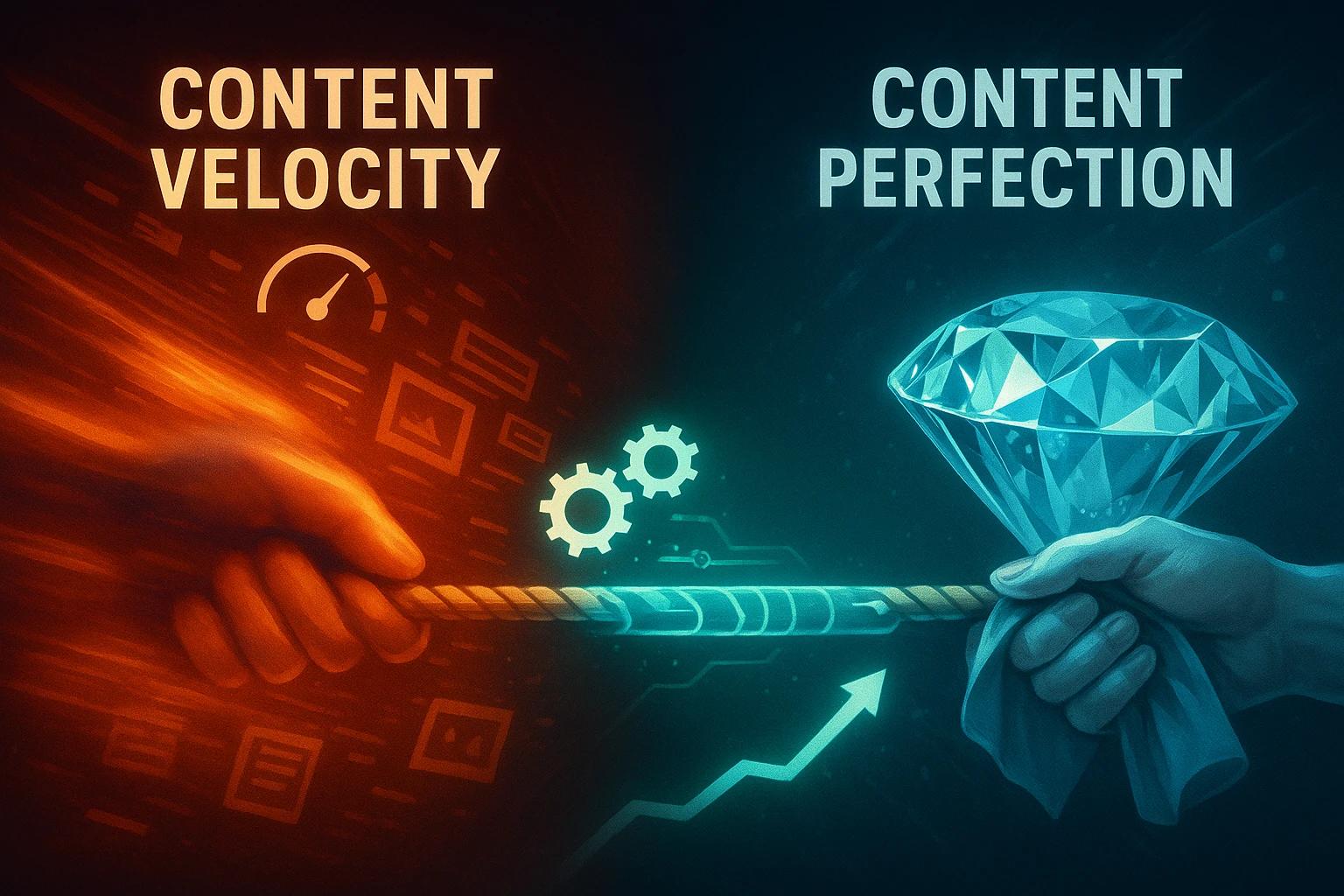
How Content Frequency Affects SEO Rankings and What to Prioritize
Explore how balancing content speed and quality impacts SEO and learn when to focus on velocity or perfection.
5 Signs Your Content Strategy is Losing Customers
Discover key signs your content strategy is stuck and quietly losing customers before it impacts your growth.

How to Measure SEO ROI with Business Metrics
Learn simple ways to measure SEO ROI focusing on leads, conversions, cost, and customer value beyond keywords and rankings.