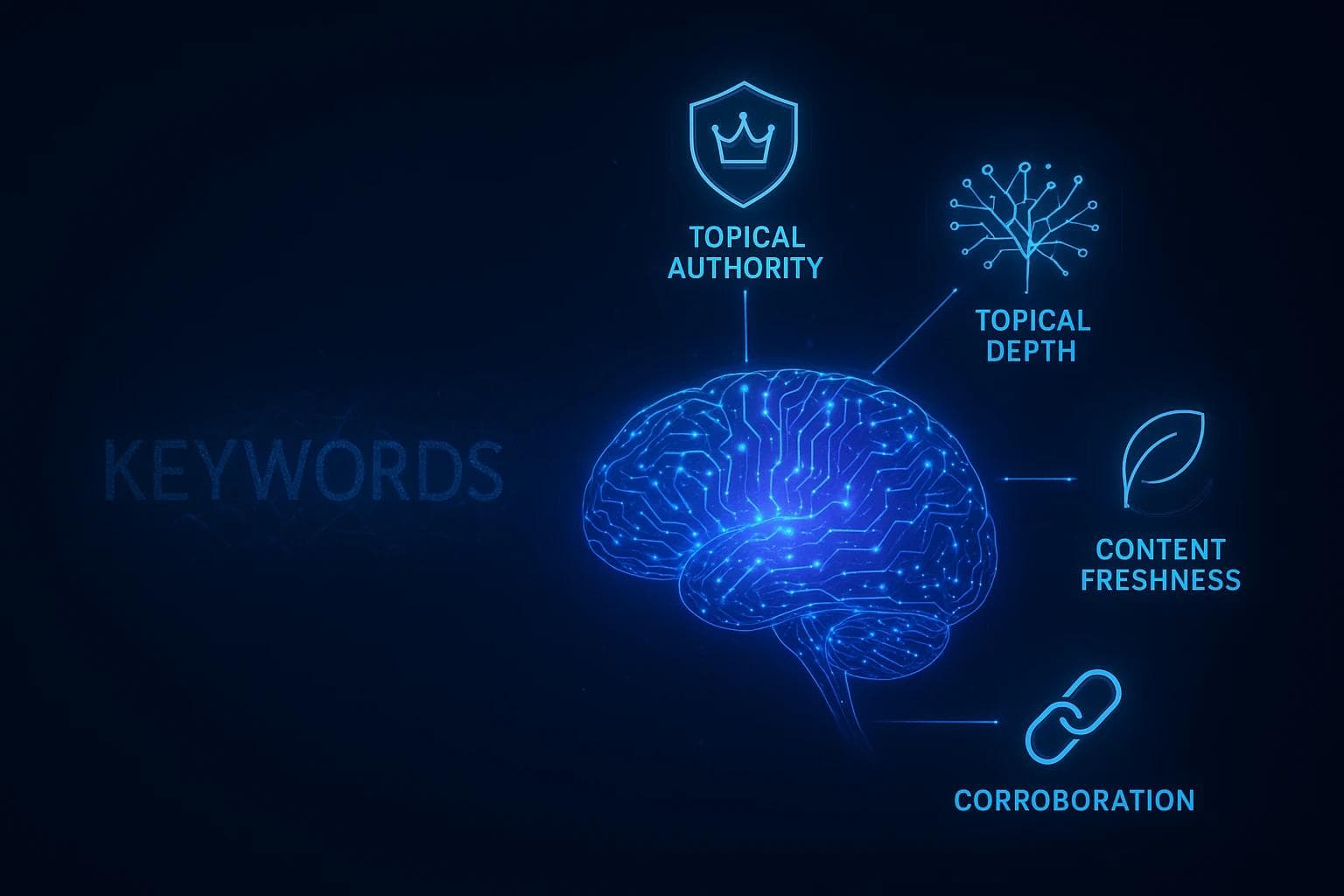
Beyond Keywords: The 4 Signals AI Answers Actually Care About
You did everything right. You researched the keywords, checked the search volume, and crafted a blog post that ticked all the traditional SEO boxes. You hit publish, expecting the traffic to roll in. But when you ask Google or Perplexity a question your article should answer, you see a competitor’s name cited in the AI-generated response. Your page is nowhere to be found.
If this sounds familiar, you’re not alone. You've just run into the new reality of search: a world where simply matching keywords is no longer enough.
Welcome to the era of Answer Engine Optimization (AEO). AI language models, the engines behind the instant answers at the top of your search results, think differently. They don't just scan for keywords; they seek to understand concepts, evaluate expertise, and deliver the most trustworthy, comprehensive answer possible.
Relying on a keyword-only strategy today is like trying to win a chess match by only knowing how the pawns move. To get found in AI answers, you need to understand the entire board. It's time to learn the four core signals that AI truly values: authority, depth, freshness, and corroboration.
The Four Pillars of AI Trust: What AI Looks for Besides Keywords
Think of an AI as a hyper-diligent research assistant. It's tasked with finding the most reliable, in-depth, and current information to answer a user's question. To do this, it looks for four key pillars of trust in your content.
1. Topical Authority: Are You the Go-To Expert?
In the simplest terms, topical authority is your website’s reputation for being a genuine expert on a specific subject. It's the difference between having one book on gardening versus being the entire gardening section of the library.
Traditional SEO often focuses on Domain Authority (DA), a score that predicts a site's overall ranking potential. But AI is more nuanced. A high DA website that writes one-off articles on hundreds of topics might be seen as a generalist. A smaller, focused website that has exhaustively covered every facet of, say, "SaaS marketing for startups" will have higher topical authority on that subject. AI prefers the specialist over the generalist.
How do you build it? By creating comprehensive topic clusters—a deep and interconnected web of content around a central theme.
- Pillar Page: A long-form, comprehensive guide on a broad topic (e.g., "A Complete Guide to Content Marketing").
- Cluster Content: More specific articles that delve into subtopics mentioned in the pillar page (e.g., "How to Create a Content Calendar," "10 SEO Writing Tips," "Measuring Content ROI").
Each cluster article links back to the pillar page, and the pillar links out to the clusters. This structure makes it undeniably clear to AI that you haven't just touched on a subject; you've mastered it.
[IMAGE: a diagram showing a central pillar page with spokes leading to cluster content pages, illustrating a topic cluster]
2. Topical Depth & Your Internal Link Graph: Is Your Knowledge Connected?
Having lots of articles on a topic isn’t enough. AI needs to see that your knowledge is deep and interconnected. This is where your internal link graph comes into play.
If your articles are islands, AI has no way of knowing how they relate. But if you use internal links to connect related concepts, you create a map of your expertise. Think of it as the synapses of your website's brain. These links are more than just navigation tools; they are powerful corroborating signals that demonstrate relationships between ideas.
A strong internal link graph shows an AI:
- Semantic Relationships: How "content strategy" relates to "SEO," "keyword research," and "analytics."
- Hierarchy: Which pieces are foundational (pillar pages) and which are detailed explorations (cluster content).
- Comprehensiveness: That you've covered a topic from multiple angles, leaving no stone unturned.
A keyword-stuffed article stands alone. A deeply linked topic cluster works as a team, with each piece reinforcing the authority of the others.
[IMAGE: a network graph visualization showing nodes (pages) and edges (internal links), with a dense cluster in one topic area and sparse connections in another]
3. Content Freshness: Is Your Information Still Relevant?
Would you trust a medical journal from 1985 for advice on modern treatments? Of course not. AI models feel the same way about your content. Stale, outdated information is a major red flag that erodes trust.
Content freshness signals to AI that your information is current, accurate, and relevant right now. This doesn't mean you have to publish a new article every single day, but it does require a strategic approach to content maintenance.
AI looks for several freshness cues:
- Publishing Cadence: Regularly publishing new, relevant content shows you're an active voice in your field.
- Significant Updates: Making major revisions to older articles—updating data, adding new sections, replacing outdated information—is often more valuable than minor typo fixes.
- Recency: For topics where timeliness is critical (like "AI marketing trends"), recently published or updated content is heavily favored.
A consistent schedule of publishing new content and proactively refreshing your existing "evergreen" articles is crucial for maintaining your status as a reliable resource.
[IMAGE: a simple timeline graphic showing a piece of content being published, then receiving several updates over time, with labels like "Major Revision" and "Data Update"]
4. Corroborating Signals: Does the Rest of the Web Vouch for You?
Finally, AI looks for outside validation. It's not enough to say you're an expert; you need proof. These corroborating signals are like letters of recommendation for your content, and they come in many forms.
This is where the concept of E-E-A-T (Experience, Expertise, Authoritativeness, and Trustworthiness) becomes critical. AI wants to cite sources that are demonstrably credible.
Key corroborating signals include:
- Author Expertise: Clear author bios that showcase credentials, experience, and social proof.
- External Backlinks: Links from other reputable websites in your industry serve as a powerful vote of confidence.
- Structured Data (Schema): Using code to label your content (as an article, FAQ, event, etc.) helps AI understand it more easily and accurately.
- Citations and Mentions: Being mentioned on other trusted sites, even without a direct link.
By making your expertise clear and earning validation from others, you complete the circle of trust, giving AI every reason to choose your content for its next answer.
[IMAGE: an infographic with icons representing different corroborating signals: a backlink icon, an author headshot icon, a schema code icon, and a user review star icon, all pointing towards a central "Trust" shield]
Frequently Asked Questions (FAQ) about AI Answer Signals
What's the difference between Topical Authority and Domain Authority?
Domain Authority (DA) is a broad, site-wide metric that predicts overall ranking ability. Topical Authority is subject-specific; it measures how much of an expert your site is on a particular topic. A law firm could have a high DA but zero topical authority on baking, while a small baking blog could dominate that specific topic. AI increasingly favors topical authority.
How can a small site or new business compete with established giants?
By niching down. Don't try to be an expert on everything. Pick a specific topic where you can realistically become the definitive resource. Build out a comprehensive topic cluster, master your internal linking, and focus on becoming the go-to authority in that small pond. Your focused expertise will shine brighter to AI than a large site's scattered, superficial content.
Do I need to update every article all the time?
Not all of them, and not all the time. Prioritize your most important "pillar" content and articles on fast-changing topics. For evergreen content, a review and update every 6-12 months is a good practice. The goal is consistency and relevance, not constant frantic activity.
Is keyword research dead?
No, but its role has changed. Keywords are no longer the target; they are the starting point. Use keyword research to understand user intent, discover subtopics for your clusters, and learn the language your audience uses. Then, build your content around the topic and the concept, not just the keyword string.
Your Next Step: Building an AI-Ready Content Engine
Moving beyond a keyword-first mindset is the single most important strategic shift you can make for your content today. Success in the age of AI search isn't about winning a single keyword; it's about building a deep, interconnected, and trustworthy library of knowledge.
This requires a holistic approach that weaves together content strategy, consistent execution, and smart optimization. It's a continuous cycle of planning, creating, linking, and refreshing—an engine that builds authority over time. While this may sound complex, understanding these principles is the first step toward future-proofing your content and ensuring your expertise gets found.
As you begin to think about how to apply these concepts, you might explore different ways to build your content engine, from manual processes to more streamlined approaches. The key is to start building your topical authority today, because AI is already looking for its next expert answer. If you want to learn more, a great place to start is by [learning how Fonzy.ai automates content strategy]() or by [exploring automated SEO solutions]() that are built for this new era of search.

Roald
Founder Fonzy — Obsessed with scaling organic traffic. Writing about the intersection of SEO, AI, and product growth.
Stop writing content.
Start growing traffic.
You just read about the strategy. Now let Fonzy execute it for you. Get 30 SEO-optimized articles published to your site in the next 10 minutes.
No credit card required for demo. Cancel anytime.
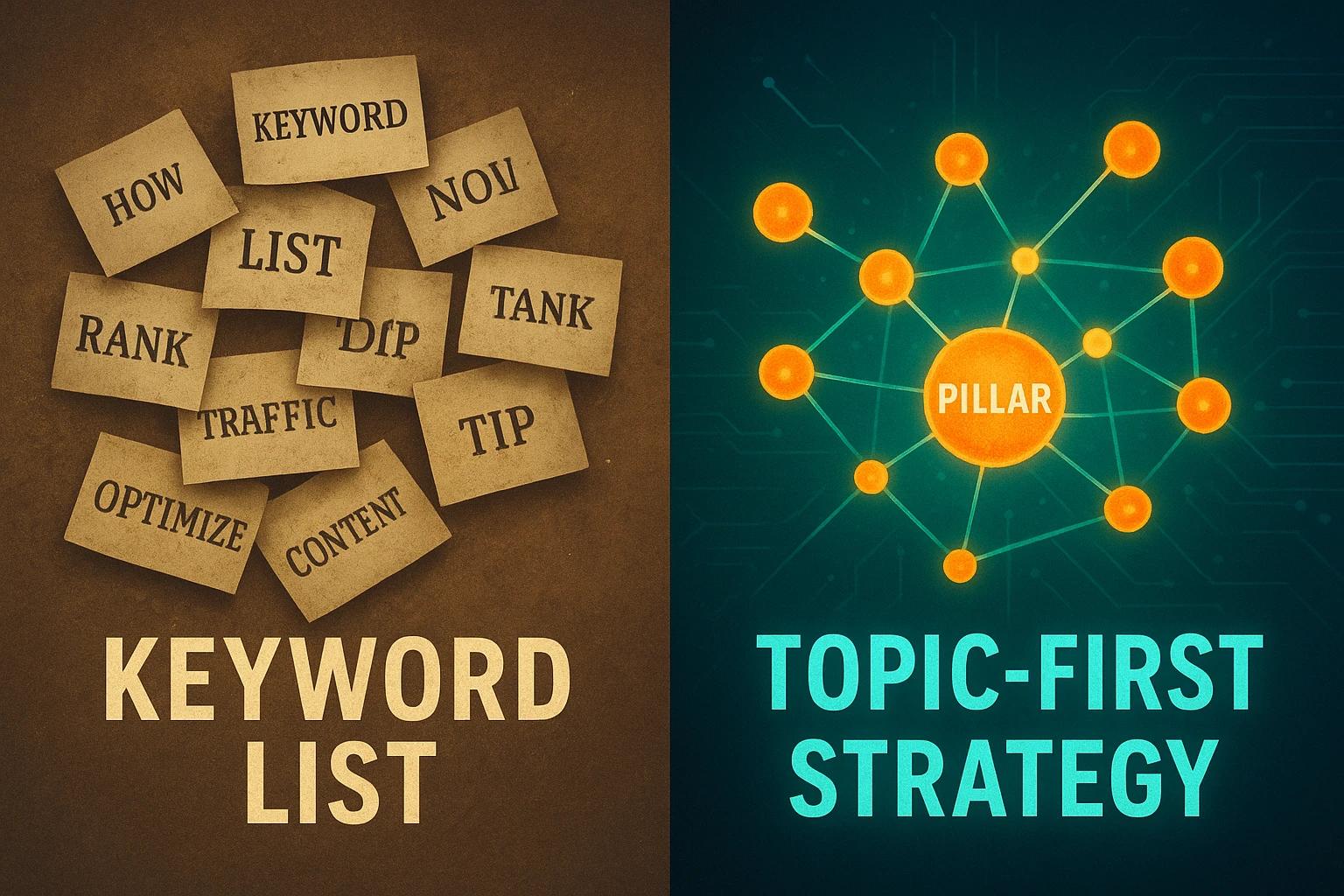
Topic-First Content Strategy for AI-Driven Search
Discover why focusing on topics over keywords drives SEO success in AI-powered search environments.
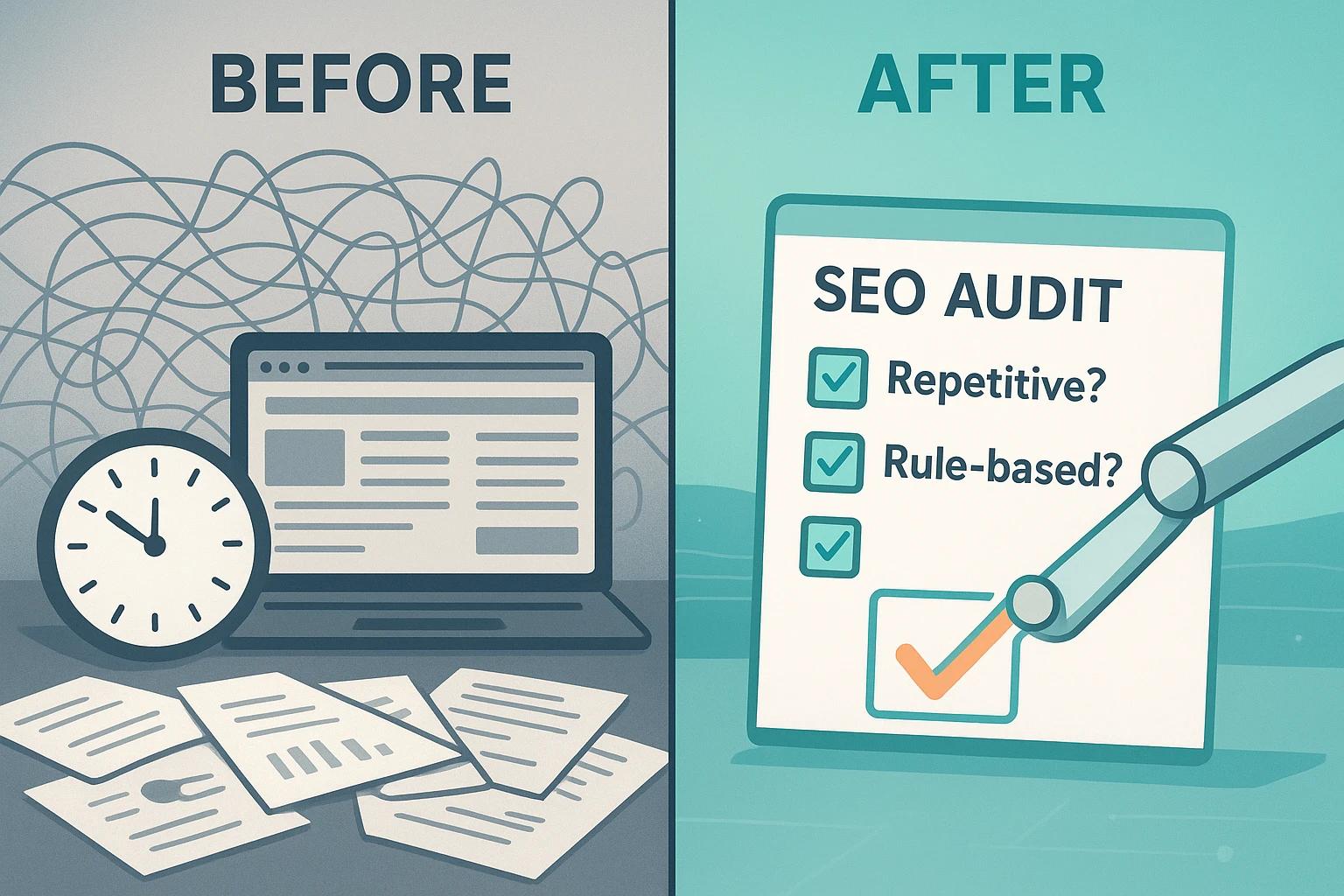
How to Audit SEO for Automation Opportunities
Discover a simple non-technical checklist to identify SEO tasks you can automate and save time for strategic work.

5 Signs Your Content Workflow Is Blocking Growth
Discover common content workflow problems slowing your growth and how automation can help improve efficiency and results.