Search Features Changing Clicks and Content Priorities

Search Features That Steal Clicks: How SERP Changes Affect Your Content Priorities
You’ve done everything right. You’ve researched keywords, written a compelling article, and hit “publish.” But the traffic you expected isn’t showing up. Your rankings might even be good, but the clicks just aren’t there. It’s a frustratingly common scenario, and you might be looking for the problem in the wrong place.
The issue may not be your content, but the search results page itself. Google has quietly transformed from a list of links into a dynamic answer machine. And in the process, it has started answering questions directly on the results page, often making a click to your website unnecessary. This is the new reality of "zero-click searches," and understanding it is the first step to reclaiming your visibility.

The Big Shift: Google Is Now an Answer Engine
For years, the goal of SEO was simple: get the #1 spot. That top blue link was the holy grail, promising a flood of organic traffic. But Google’s goal is different. It wants to provide the best, fastest answer to a user's query.
This has led to a fundamental paradigm shift. Google is no longer just a search engine that points you to information; it's become an answer engine that delivers information directly.
This is made possible by a growing number of SERP (Search Engine Results Page) features—elements that appear alongside traditional search results. These features are designed to provide instant gratification, but they often do so by summarizing, repurposing, and displaying your content without requiring a user to visit your site. A recent study highlights that nearly two-thirds of Google searches now end without a click to another website.
A Field Guide to Google’s “Click-Stealing” Features
To adapt, you first need to know what you’re up against. These features are everywhere, and they are the primary drivers of the zero-click world.
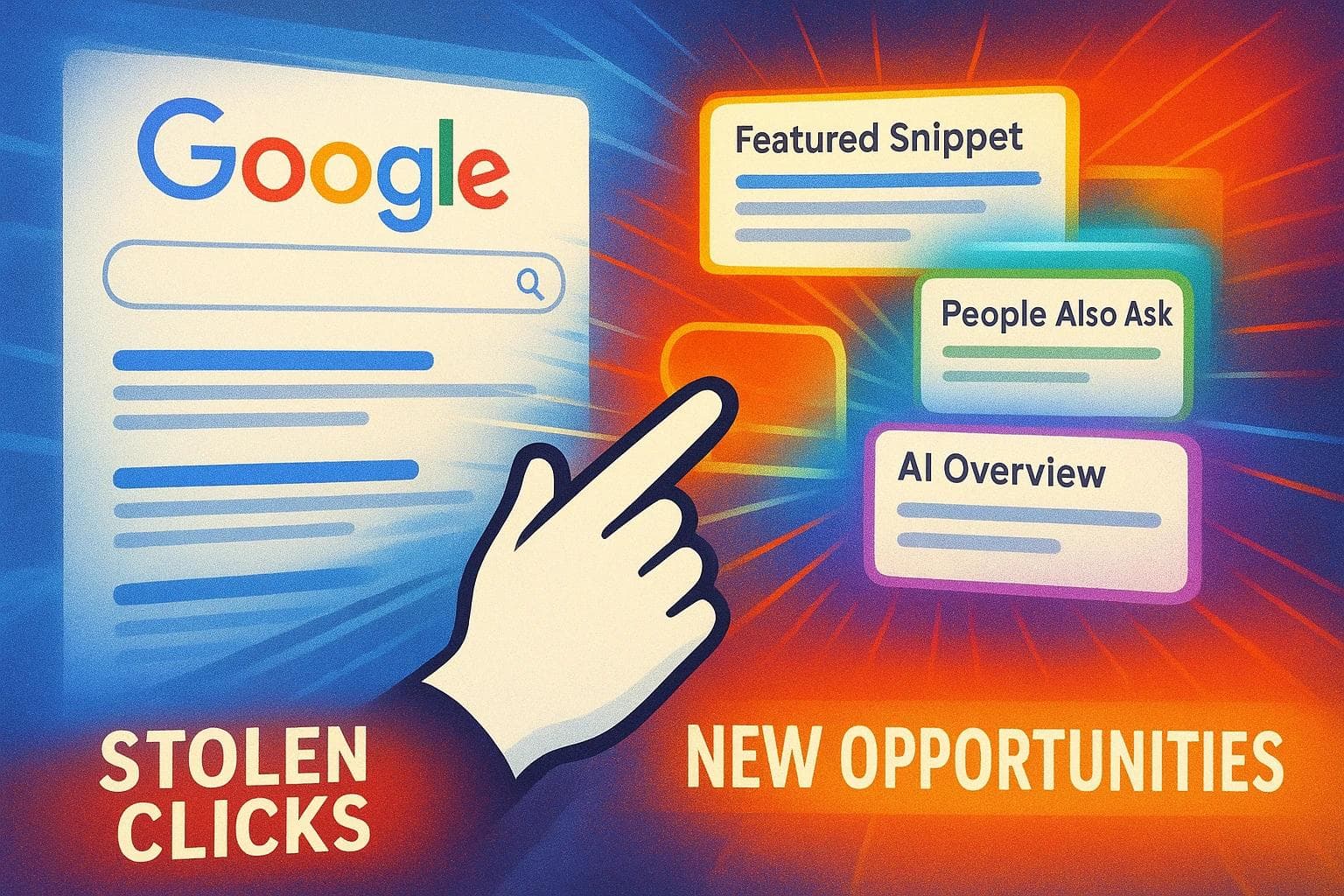
Featured Snippets (Position Zero)
This is the box that often appears at the very top of the results, providing a direct, concise answer to a question. It might be a paragraph, a bulleted list, or a table pulled directly from a webpage. While earning a Featured Snippet gives your brand incredible visibility, it can also satisfy the user's query on the spot, eliminating their need to click.
People Also Ask (PAA)
This is the accordion-style box of related questions that expands when you click on it. Each answer is a mini-featured snippet. PAA is a goldmine for understanding user intent, but it also keeps users on Google, leading them down a rabbit hole of questions and answers without ever leaving the SERP.
Knowledge Panels
These large panels, typically on the right side of the desktop SERP, provide a comprehensive overview of a person, place, or thing (known as an "entity"). Google pulls this information from various sources, including Wikipedia and your own website, to create a one-stop-shop of information that drastically reduces clicks to source websites.
AI Overviews
The newest and most significant player is the AI Overview. This feature uses generative AI to synthesize information from multiple web pages into a single, comprehensive answer at the top of the SERP. Instead of just pulling a snippet from one site, it creates a brand new summary. Getting your content cited as a source in these overviews is the new frontier of SEO, as it positions your brand as a foundational authority on a topic, even if it doesn't result in a direct click.

If Clicks Aren't the Goal, What Is? Adapting Your Content Priorities
Seeing these features might feel discouraging. If Google is just going to take your content, what’s the point? This is the "aha moment": the goal is no longer just to earn a click. The new goal is to become the source of the answer.
Visibility within these features is the new brand-building. Being the name cited in an AI Overview or the source for a Featured Snippet establishes you as the authority. The focus shifts from measuring direct traffic to measuring brand presence and influence. Here’s how to adapt your content strategy.
From Keywords to Concepts: Master Topical Authority
AI doesn't just look for keywords; it looks for understanding. It wants to see that you've covered a topic comprehensively. Instead of writing one article about a single keyword, you need to build content clusters that cover a topic from every angle.
Think like a teacher. If your topic is "drip irrigation," you should have content explaining what it is, its benefits, how to install it, common problems, and the best systems for different garden types. This demonstrates deep expertise and makes your entire website a more reliable source for AI to pull from. Building a cohesive, [personalized SEO and content plan] around topics, not just keywords, is essential to [achieve consistent organic growth].
Become Citable: The New Rules of E-E-A-T for AI
Google's quality guidelines are built around E-E-A-T: Experience, Expertise, Authoritativeness, and Trustworthiness. AI models rely heavily on these signals to determine which sources to trust and cite. You can't just claim expertise; you have to prove it.
- Experience: Include first-hand accounts, case studies, or original research. Show, don’t just tell.
- Expertise: Have qualified experts write or review your content. Feature clear author bios with credentials.
- Authoritativeness: Build backlinks from other reputable sites in your industry and ensure your brand is mentioned as a leader.
- Trustworthiness: Provide clear contact information, cite your sources, and ensure your site is secure (HTTPS).
Structure is Strategy: Formatting Your Content for AI Extraction
AI models and search crawlers are like picky eaters; they prefer their food served in a specific way. To make your content easy for them to digest and feature, you need to structure it strategically.
- Answer Questions Directly: Use your headings (H2s, H3s) to pose common questions and answer them immediately and concisely in the following paragraph.
- Use Lists and Tables: Bulleted lists, numbered lists, and data tables are easily digestible formats for both humans and machines. They are prime candidates for being pulled into Featured Snippets.
- Keep Paragraphs Short: Write short, focused paragraphs (2-3 sentences) that each contain a single, clear idea.
- Leverage Structured Data: Use Schema markup in your site's code to explicitly label your content (e.g., this is a recipe, this is an FAQ, this is a review). This removes any guesswork for search engines.
Effectively [optimizing your content for AI search] means making it as clear, credible, and digestible as possible.
Frequently Asked Questions (FAQ) About SERP Changes
What are SERP features?
SERP features are any result on a Google search results page that is not a traditional organic link. Examples include Featured Snippets, People Also Ask boxes, Knowledge Panels, video carousels, local map packs, and AI Overviews.
What is a zero-click search?
A zero-click search is a search query where the user gets their answer directly on the Google results page and does not click through to any of the listed websites. This often happens because a SERP feature like a Featured Snippet or AI Overview has already satisfied their need for information.
Why is my website not showing up on Google search?
There could be several reasons. It might be a technical issue, such as Google being blocked from crawling your site (check your robots.txt file) or the site not being indexed yet. It could also be a content issue, where your content isn't seen as high-quality, relevant, or trustworthy enough to rank for your target queries. Finally, it could simply be that strong competitors are dominating the results page.
How do I optimize for both traditional search and AI Overviews?
The good news is that the strategies are converging. Optimizing for AI Overviews is an evolution of good SEO. Focus on creating high-quality, comprehensive, and well-structured content that demonstrates strong E-E-A-T. The same content formatting that helps you win a Featured Snippet (clear headings, lists, short paragraphs) also makes your content easier for AI models to parse and cite. A unified strategy that prioritizes being the best answer will serve you well for both.

The Future is Answer-Driven
The search landscape is no longer just about ranking; it's about being the definitive answer. The decline of the click isn't a death sentence—it's an invitation to build a stronger, more authoritative brand.
By shifting your focus from chasing clicks to providing undeniable value, you position yourself to win in the new era of search. Create content that is so comprehensive, trustworthy, and well-structured that Google has no choice but to feature you as the source. This is the foundation of modern [AI-driven content strategies] that don’t just earn traffic, but build lasting authority. Your goal is no longer just to be found; it's to be the answer.
Roald
Founder Fonzy — Obsessed with scaling organic traffic. Writing about the intersection of SEO, AI, and product growth.
Stop writing content.
Start growing traffic.
You just read about the strategy. Now let Fonzy execute it for you. Get 30 SEO-optimized articles published to your site in the next 10 minutes.
No credit card required for demo. Cancel anytime.

How Content Frequency Affects SEO Rankings and What to Prioritize
Explore how balancing content speed and quality impacts SEO and learn when to focus on velocity or perfection.
5 Signs Your Content Strategy is Losing Customers
Discover key signs your content strategy is stuck and quietly losing customers before it impacts your growth.

How to Measure SEO ROI with Business Metrics
Learn simple ways to measure SEO ROI focusing on leads, conversions, cost, and customer value beyond keywords and rankings.