Guide to Repurposing Long-Form Content into Evidence-First Microcontent

Beyond Repurposing: A Guide to Creating Evidence-First Microcontent for the AI Era
You did it. You poured weeks of research, expertise, and writing into a comprehensive, 3,000-word pillar article. It’s packed with insights, data, and brilliant analysis. You hit publish, and… silence.
It’s a frustratingly common scenario. In a world of infinite scrolls and AI-powered summaries, even your best long-form content can feel like a tree falling in an empty forest. Your most powerful points—the hard data, the expert quotes, the game-changing statistics—are buried deep within paragraphs, invisible to both hurried human scanners and the AI engines tasked with summarizing the web.
What if you could change that? What if you could strategically lift those key pieces of proof from your articles and transform them into bite-sized, credible nuggets that build trust and get noticed?
That’s the shift from simple content repurposing to creating evidence-first microcontent. It’s not about just chopping up your content; it’s about strategically extracting the proof to build authority in a fragmented, AI-driven world.
The Foundations: Understanding Repurposing and Microcontent
Before diving into the "evidence-first" approach, let's get our terms straight. You've likely heard "content repurposing" and "microcontent" before, but the distinction is crucial.
What is Content Repurposing, Really?
Many people mistake content repurposing for simply cross-posting—copying a link to your blog and pasting it on LinkedIn. True repurposing is more like a master chef using a whole chicken for multiple, distinct dishes. The original ingredient is the same, but the output is uniquely adapted for a new purpose and audience.
As experts at Backlinko note, the goal is to adapt the format and substance to fit a new platform. A deep-dive blog post becomes an engaging video script, a webinar Q&A transforms into a series of insightful tweets, and a dense whitepaper is reimagined as a visually compelling infographic. It’s about maximizing the value of your initial effort.
What is Microcontent?
The Nielsen Norman Group, a leading authority on user experience, defines microcontent as small, independent fragments of information meant to be consumed at a glance. Think headlines, email subject lines, or the captions on an Instagram post.
Good microcontent has two key traits:
- It’s scannable: It communicates a key idea in seconds.
- It’s context-independent: It makes sense on its own, without needing the full article for support.
When you combine these two ideas, you get the common practice of turning a blog post into a series of social media updates. But there's a missing ingredient that separates standard practice from a truly authoritative strategy.
***![Infographic defining Evidence-First Microcontent and its key benefits: Enhanced Credibility, AI Answer Visibility, and Higher Engagement.]***
The Game-Changer: What is Evidence-First Microcontent?
Now, let's connect the dots. The knowledge gap that most content strategies miss lies at the intersection of these concepts, optimized for today's AI-driven search landscape.
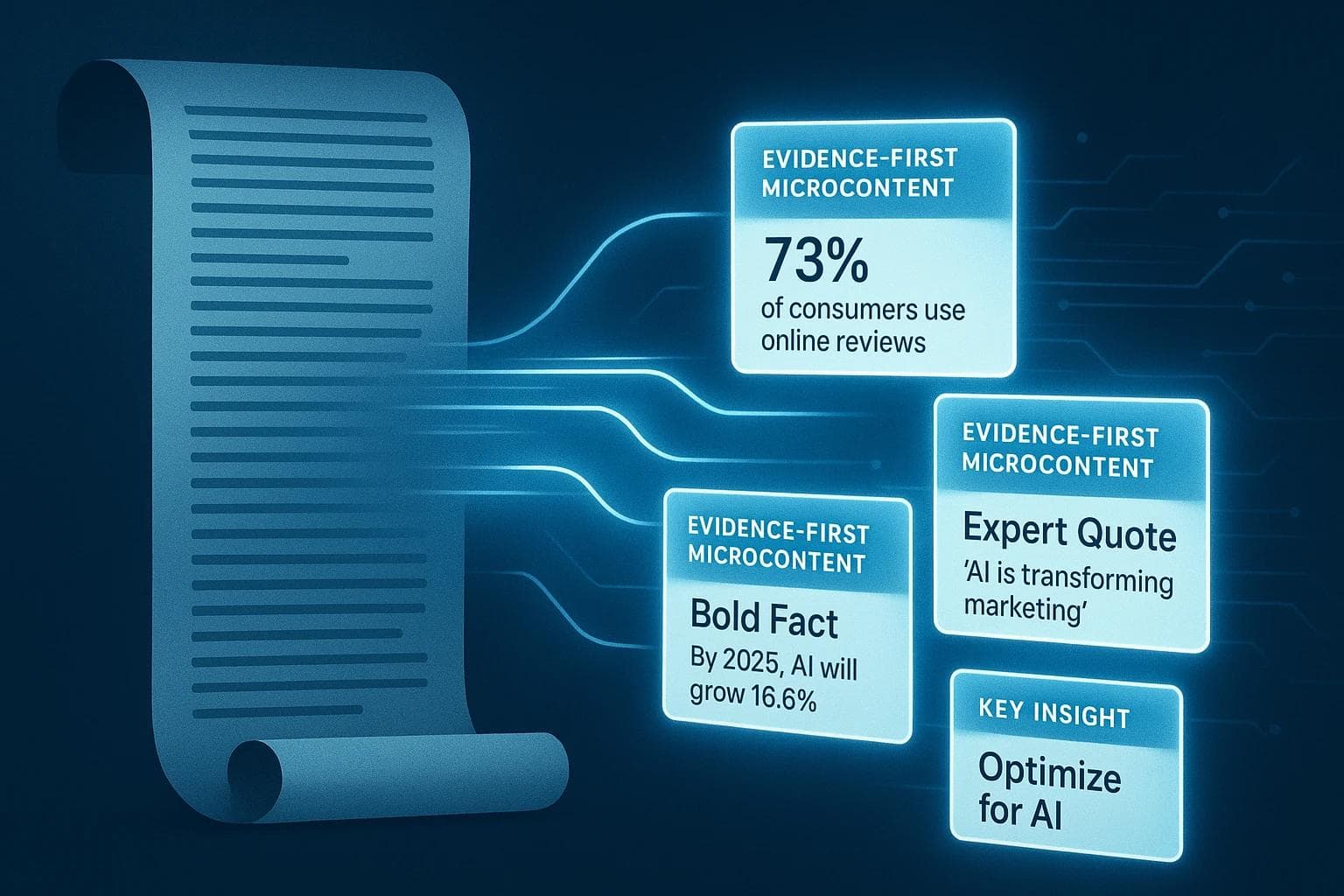
Evidence-first microcontent is a concise, standalone snippet of information deliberately crafted to highlight a key piece of factual proof—like data, statistics, expert quotes, or research findings.
Its primary purpose isn't just to get a click; it's to build immediate credibility and be easily extractable for AI summary tools and answer engines.
Think of it this way:
- Standard Microcontent: "Learn how to improve your SEO." (Vague, offers little value on its own).
- Evidence-First Microcontent: "Companies that blog get 97% more links to their websites." (Specific, credible, and instantly valuable).
This shift in focus is critical. AI models, like the ones powering Google's AI Overviews, are designed to find and surface direct, authoritative answers. By formatting your proof as clear, self-contained statements, you are essentially pre-packaging your content to be chosen as a definitive source.
The "Evidence-First" Framework: A 3-Step Guide
Transforming your existing content isn't complicated, but it requires a new lens. Instead of asking "How can I chop this up?", ask "What is the most compelling proof in here, and how can I make it shine on its own?"
Step 1: Identify Your "Golden Nuggets" of Evidence
Comb through your long-form articles, webinars, or case studies with a specific mission: find the proof. You're not looking for general concepts; you're hunting for undeniable facts.
Look for these types of evidence:
- Quantitative Data: Hard numbers, percentages, and statistics (e.g., "Achieved a 150% increase in organic traffic").
- Expert Quotes: Direct quotes from industry leaders or subject matter experts.
- Research Findings: Key takeaways from studies, surveys, or reports (yours or a third-party's).
- Case Study Results: Specific, measurable outcomes from a project or client work.
- Key Definitions: Clear, concise explanations of core industry terms.
Step 2: Extract and Reframe the Evidence
Once you've found a golden nugget, your job is to lift it from its surrounding text and frame it as a standalone statement.
Before: The Dense Paragraph"In our comprehensive 2023 market analysis, we surveyed over 500 small business owners and discovered a significant trend. The data showed that businesses investing in automated content solutions were able to increase their publishing frequency by an average of 300%, which correlated with a nearly twofold increase in inbound lead generation over a six-month period compared to those using manual processes."
After: Evidence-First Microcontent
- Statistic: "Our 2023 study found that automated content tools can boost publishing frequency by 300%."
- Finding: "For small businesses, a 300% increase in publishing frequency correlated with a 2x rise in inbound leads over six months."
Notice how the "After" versions are direct, verifiable, and easy to quote.
***![A visual "Before & After" diagram showing a dense paragraph of text on the left, with arrows pointing to three separate microcontent pieces on the right: a tweet, an image quote, and a simple lead sentence.]***
Step 3: Craft for AI and Human Readers
How you present your evidence matters. The goal is to make it easy for both a scanning human and a data-scraping algorithm to understand.
- Lead with the Evidence: Don't bury the statistic at the end of a sentence. Start with it.
- Keep it Simple and Direct: Write a sentence that directly answers a potential question.
- Use Clear Formatting: Use bullet points, bolded text, and blockquotes to make your evidence visually distinct from the surrounding text. The way you structure your content has a huge impact. In fact, if you're wondering what’s the impact of heading structure on ai extractability?, you'll find that clean formatting is one of the most powerful signals you can send to search algorithms.
By presenting your proof this way, you're not just creating social media posts—you're building a library of AI-ready answers that establish your authority across the digital ecosystem.
Frequently Asked Questions (FAQ)
How is this different from just cross-posting my blog link?
Cross-posting is sharing the same message and link across different platforms. Repurposing into evidence-first microcontent involves extracting a specific idea or data point from your content and adapting it natively for a new platform. It’s about adding value upfront, not just asking for a click.
What type of long-form content is best for this?
Any content that is rich with data, research, or expert insights is a perfect candidate. Think whitepapers, case studies, data-driven blog posts, research reports, and expert interviews or webinars.
Won't this stop people from clicking through to my main article?
Quite the opposite. Evidence-first microcontent acts as a powerful, credible hook. By providing a valuable piece of information upfront, you build trust and intrigue, making users more likely to click through to understand the full context behind the data you shared. It creates new, highly-qualified entry points to your core content.
How do I avoid making my content feel repetitive?
The key is to extract different types of evidence from a single article. One long-form piece can yield a statistic for Twitter, an expert quote for a LinkedIn image, a key finding for an email newsletter, and a definition for your website's FAQ section. Each piece stands alone and serves a different purpose.
Your Next Step: From Learning to Doing
The way we consume information has fundamentally changed. Your audience—and the AI that guides them—is looking for clear, credible, and immediate answers. Burying your best proof inside long-form content is no longer enough.
Start today. Pick one of your best-performing, data-rich articles. Read through it with this new "evidence-first" lens and pull out just three golden nuggets. Frame them as simple, standalone statements. You've just taken the first step toward making your content more visible, valuable, and authoritative in the AI era.
Roald
Founder Fonzy — Obsessed with scaling organic traffic. Writing about the intersection of SEO, AI, and product growth.
Stop writing content.
Start growing traffic.
You just read about the strategy. Now let Fonzy execute it for you. Get 30 SEO-optimized articles published to your site in the next 10 minutes.
No credit card required for demo. Cancel anytime.

How to Measure Visibility for AI Answers and Traditional Search
Learn key metrics to track your visibility in AI answers versus traditional search results and why old SEO metrics no longer suffice.

Common myths about AI search and content explained
Discover key misconceptions about AI in search and content creation to avoid wasting time and improve your strategy.

AI SEO for Marketers From Manual Grind to Strategic Impact
Discover how AI boosts SEO productivity and quality. Learn to automate research, content creation, and optimization with human oversight.