Can't Publish Everything Use a Matrix to Prioritize Topics

Can't Publish Everything? A 4-Step Matrix to Find Your Most Valuable Content Topics
You have a dozen great ideas in your content backlog, a passionate team ready to write, and a CEO who just sent over a "quick blog post idea" inspired by something they read. The problem? You only have the capacity to publish one or two articles a week.
Every content marketer knows this feeling. It’s a constant tug-of-war between what feels urgent, what seems interesting, and what will actually grow the business. Choosing the wrong topic means wasted hours and missed opportunities. Choosing the right one can unlock a new stream of organic traffic and leads.
So, how do you decide? Do you go with the topic that’s easiest to write? The one with the highest search volume? The one your boss is most excited about?
The truth is, relying on gut feelings or single metrics is a recipe for inconsistent results. What you need is a simple, repeatable system to separate the "nice-to-have" ideas from the "must-publish" winners. This is where a prioritization matrix, designed specifically for content teams with limited resources, becomes your most valuable tool.

Moving Beyond "Impact vs. Effort"
Many teams use a simple "Impact vs. Effort" matrix. While it's a good start, it often fails content marketers because the terms are too vague. What exactly is "impact"? Is it traffic? Leads? Brand awareness? How do you quantify "effort" when one article requires a custom graphic and another needs three expert interviews?
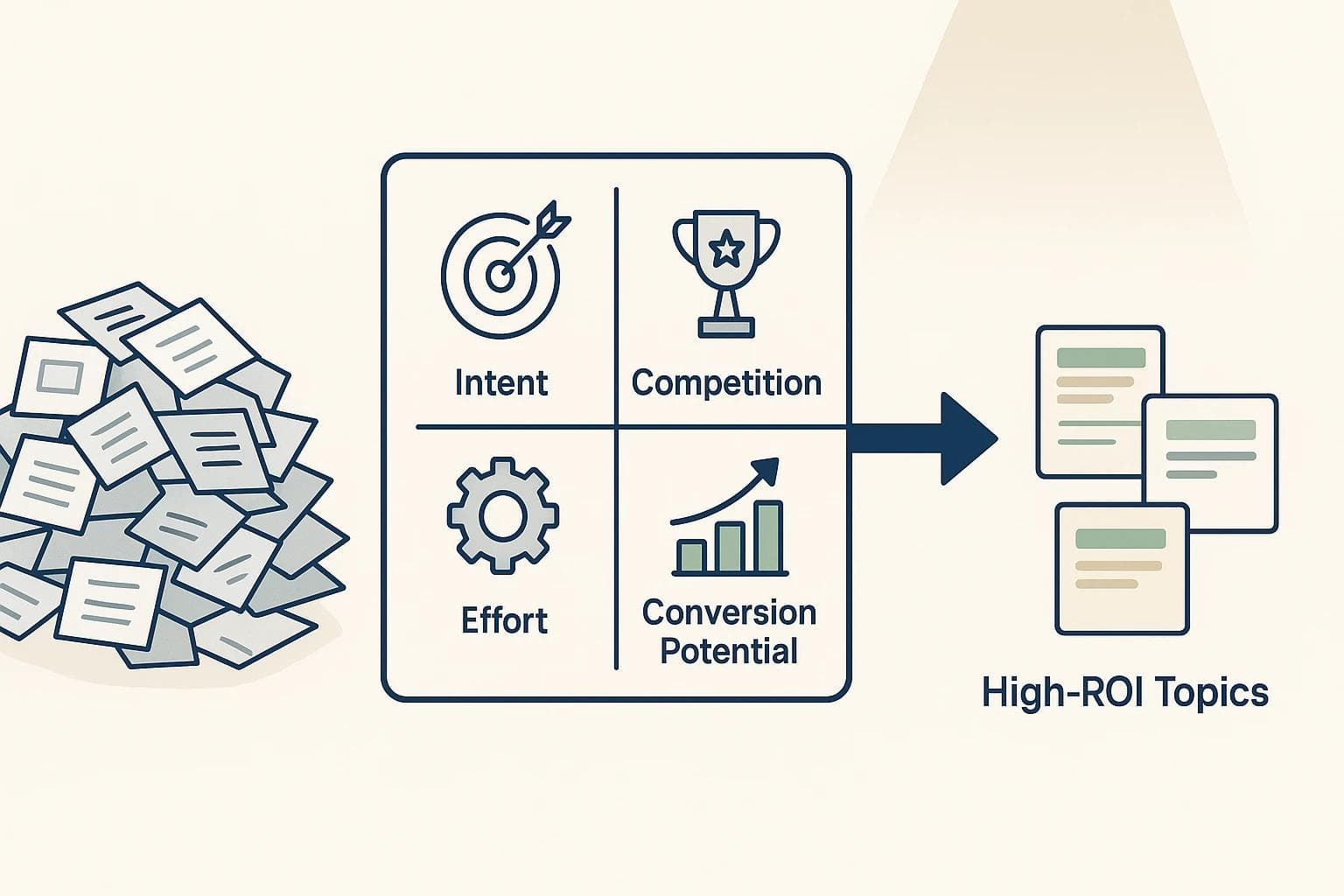
To make truly smart decisions, we need to break these concepts down into four specific, scoreable pillars:
- Intent: How well does this topic align with what your audience is searching for and your business goals?
- Competition: How difficult will it be to rank and stand out from what’s already out there?
- Effort: What are the total resources required to create and promote a high-quality piece?
- Conversion Potential: How effectively can this piece guide a reader to take a meaningful next step?
By scoring your content ideas against these four pillars, you can replace guesswork with a data-informed strategy that maximizes your return on investment (ROI).
The Four Pillars of High-ROI Content Prioritization
Let's explore how to score each pillar. A simple 1-5 scale works perfectly, where 1 is low and 5 is high.
Pillar 1: Intent (User & Business)
This isn't just about keywords; it's about the deep-seated problem a user is trying to solve. Does your topic idea directly address a question or pain point for your ideal customer? And just as importantly, does that pain point relate to the solution your business provides?
How to Score It:
- 1 (Low Intent): A vague topic that isn't tied to a specific problem or user question (e.g., "The Future of Marketing"). It has no clear connection to your product.
- 3 (Medium Intent): Addresses a known pain point, but it's broad (e.g., "How to Get More Website Traffic"). The connection to your business solution is indirect.
- 5 (High Intent): Answers a very specific question your ideal customer asks right before they look for a solution like yours (e.g., "How to Choose SEO Topics with a Small Team").
Pillar 2: Competition
Before you write a word, you need to understand the existing landscape. A quick Google search is essential. Who is currently on page one? Are they authoritative sites like Forbes or niche blogs you could realistically outperform? Are the top results videos, long-form guides, or simple listicles?
How to Score It:
- 1 (High Competition): The search results are dominated by huge, established brands. Every result is a 5,000-word ultimate guide. It would be incredibly difficult to rank.
- 3 (Medium Competition): The results are a mix of well-known sites and smaller blogs. There's an opportunity to create something better or with a unique angle, but it will take work.
- 5 (Low Competition): The top results are outdated, thin on content, or don't fully answer the user's question. You see a clear opportunity to create the definitive resource on the topic.
Pillar 3: Effort
Effort is more than just word count. It's the total time and resources needed to create a piece that is better than the competition. This includes research, writing, editing, custom visuals, expert interviews, and initial promotion.
How to Score It:
Note: For Effort, we reverse the score. A high-effort piece gets a low score because it consumes more resources.
- 1 (High Effort): Requires extensive research, multiple interviews, custom graphics or video, and a significant promotional budget. (Score = 1)
- 3 (Medium Effort): Requires solid research, a stock photo or simple graphic, and standard promotion. This is your typical well-researched blog post. (Score = 3)
- 5 (Low Effort): You are already an expert on the topic, it requires minimal research, and can be written and published quickly. (Score = 5)
Pillar 4: Conversion Potential
Top-of-funnel content isn't usually about making a direct sale. Instead, its "conversion potential" lies in its ability to move a reader from a casual browser to an engaged member of your audience. This could mean signing up for a newsletter, downloading a checklist, or simply seeing your brand as a trusted resource.
How to Score It:
- 1 (Low Potential): The topic is purely informational and doesn't naturally lead to any next step related to your business.
- 3 (Medium Potential): The topic allows for a natural call-to-action (CTA), like downloading a related resource or joining a webinar.
- 5 (High Potential): The topic directly addresses a problem that your product or service solves, making a "learn more" or "see how it works" CTA feel like the logical next step for the reader.

Putting It All Together: Your Content Priority Score
Now, simply add up the scores for each topic idea.
Priority Score = Intent Score + Competition Score + Effort Score + Conversion Potential Score
Let's score two hypothetical topics for a small business consultant:
Topic A: "5 Leadership Styles Explained"
- Intent: 3 (General interest)
- Competition: 1 (Very high, dominated by universities and major publications)
- Effort: 3 (Medium, requires solid research)
- Conversion Potential: 2 (Hard to tie back to a specific service)
- Total Score: 9
Topic B: "How Solo Consultants Can Find Their First 3 Clients"
- Intent: 5 (Highly specific to the ideal customer's pain point)
- Competition: 4 (More niche, easier to stand out)
- Effort: 3 (Medium, can be written from experience)
- Conversion Potential: 5 (Directly leads to a CTA for a coaching service)
- Total Score: 17
The winner is clear. While Topic A might get some traffic, Topic B is far more likely to attract the right audience and contribute directly to business goals.
The Hidden Challenge: The Limits of Manual Prioritization
This matrix is a powerful tool, but if you have hundreds of content ideas, the manual research process itself can become a bottleneck. Digging into the SERPs, analyzing competitors, and honestly assessing effort for every single idea is time-consuming and can be subjective.
This is where teams run into common roadblocks:
- The "HiPPO" Effect: The Highest Paid Person's Opinion can override data, pushing pet projects to the top of the list.
- Analysis Paralysis: Teams spend so much time debating scores that they don't get around to actually creating content.
- Inconsistent Scoring: Different team members might score the same topic differently based on their own biases or knowledge gaps.
The Next Level: Why Automated Opportunity Scoring Wins
What if you could automate the most time-consuming parts of this process? This is the core value of modern AI SEO platforms. They are designed to do the heavy lifting of opportunity scoring for you.
An AI-driven tool can analyze thousands of potential topics in minutes, automatically scoring them based on factors like:
- Search intent and user questions.
- The competitive landscape and your site's authority.
- Content gaps you have a high probability of winning.
By leveraging AI, you can move from manually scoring a handful of ideas to instantly identifying the highest-potential topics across your entire market. Modern tools can even factor in emerging trends in search, like the relationship between geo and seo, ensuring your content strategy is not just effective today but prepared for tomorrow.

This automated approach doesn't replace strategic thinking; it enhances it. It frees you from the drudgery of manual data collection, allowing you to focus on creating best-in-class content for the opportunities the AI has already vetted.
FAQ: Your Content Prioritization Questions Answered
How do I score "conversion potential" for a top-of-funnel blog post?
Think about the most logical next step for a reader. A good proxy for ROI is a micro-conversion. Can the article naturally lead to a newsletter subscription, a downloadable template, or a case study? If the topic makes that next step feel helpful and intuitive, it has high conversion potential.
What if my boss insists on a low-scoring topic?
This matrix is a great tool for managing stakeholder expectations. Instead of saying "that's a bad idea," you can say, "Great idea! I've run it through our prioritization framework, and it scored a 9. Meanwhile, this other topic scored a 17 because it has lower competition and higher conversion potential. Can we tackle that one first to get a bigger impact from our limited resources?" This reframes the conversation around data, not opinions.
How often should I re-prioritize my content plan?
It's a good practice to review and re-prioritize your backlog quarterly. The competitive landscape can change, and your business goals may evolve. However, try to lock in your content plan for at least a month at a time to give your team stability and focus.
Is this matrix only for new content?
Not at all! You can and should use the same framework to prioritize content updates. An old post with high intent but low-quality content is often a high-ROI candidate for a refresh, as it's typically lower effort than creating something from scratch.
Your Path to a Smarter Content Strategy
In the end, effective content marketing isn't about publishing more; it's about publishing smarter. By shifting from random acts of content to a deliberate prioritization process, you ensure that every article you create serves a purpose.
Start today. Take five ideas from your backlog and run them through the four-pillar matrix. The clarity you gain will be immediate. Whether you do it manually in a spreadsheet or eventually use an AI platform to automate the process, you'll be taking the single most important step toward building a content engine that drives predictable, sustainable growth.
Roald
Founder Fonzy — Obsessed with scaling organic traffic. Writing about the intersection of SEO, AI, and product growth.
Stop writing content.
Start growing traffic.
You just read about the strategy. Now let Fonzy execute it for you. Get 30 SEO-optimized articles published to your site in the next 10 minutes.
No credit card required for demo. Cancel anytime.
How Content Frequency Affects SEO Rankings and What to Prioritize
Explore how balancing content speed and quality impacts SEO and learn when to focus on velocity or perfection.
5 Signs Your Content Strategy is Losing Customers
Discover key signs your content strategy is stuck and quietly losing customers before it impacts your growth.

How to Measure SEO ROI with Business Metrics
Learn simple ways to measure SEO ROI focusing on leads, conversions, cost, and customer value beyond keywords and rankings.