Operational playbook for ai content roles review and governance

The AI Content Playbook Your Team is Missing: Roles, Reviews, and Rules for Scaling Without Chaos
You’ve seen the magic. With a few prompts, an AI tool generates a blog post in minutes, an email sequence in seconds, and social media captions in a blink. The initial rush is exhilarating—content production is suddenly faster than ever.
But a few months in, the magic starts to fade. You notice the cracks. One article sounds like a friendly expert, the next like a sterile robot. A statistic from a month-old AI draft is now outdated but live on your site. Your brand voice is becoming fragmented, and a subtle but corrosive problem is setting in: content rot. This is the slow decay of your content's quality, accuracy, and consistency, accelerated by the sheer volume of AI generation.
If this sounds familiar, you're not alone. Many businesses are moving past the initial excitement of AI and into the complex reality of using it at scale. The big question is no longer "Can AI write?" but "How do we manage AI-powered content creation without creating chaos?"
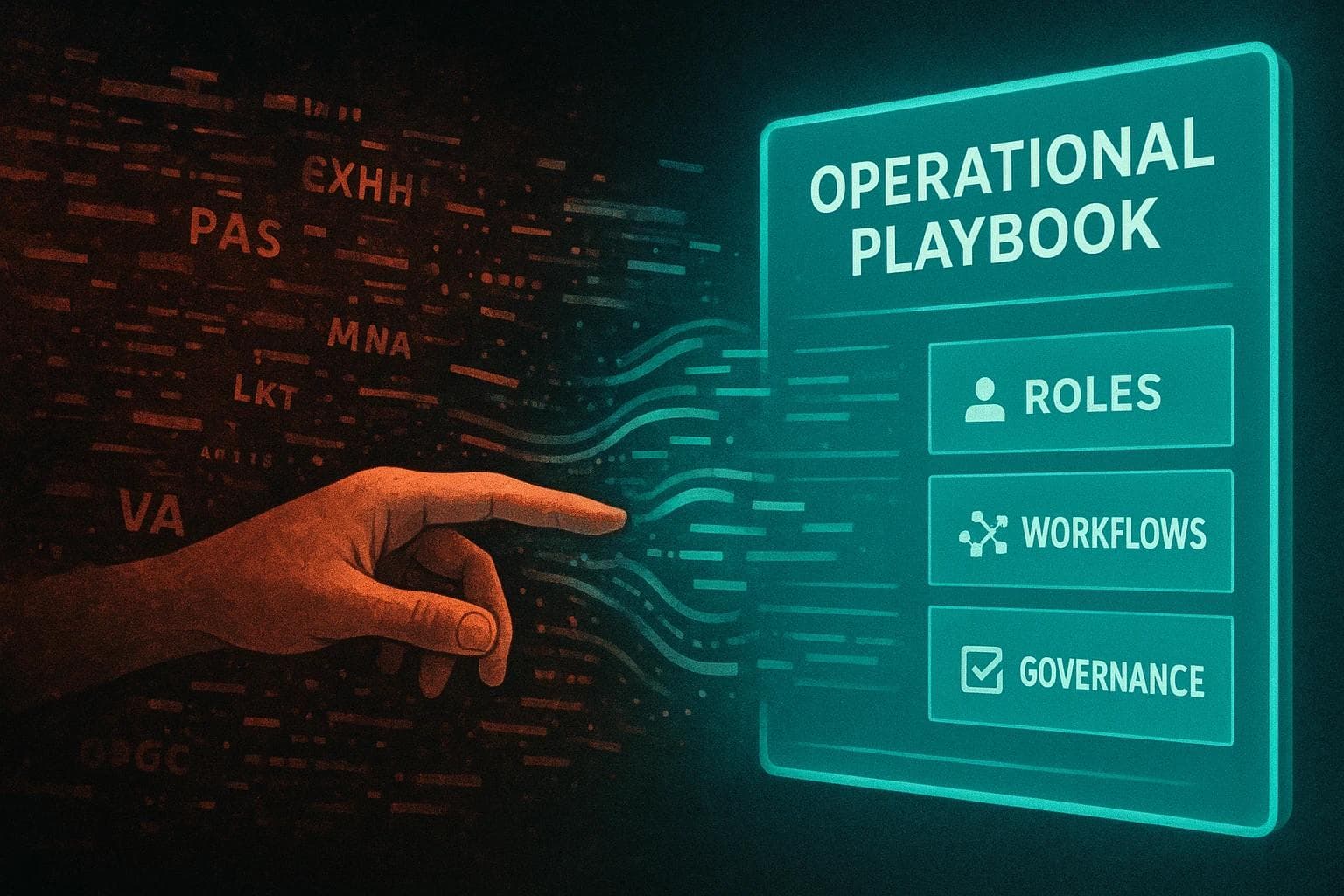
The answer isn't another tool or a better set of prompts. It’s an organizational shift. You need an operational playbook—a clear, documented strategy that defines your team structure, review processes, and governance rules. This is the framework that turns AI from a volatile creative partner into a reliable engine for growth.
Part 1: Assembling Your Human-AI Content Team
The first step in taming AI-driven content is realizing it doesn't replace your team; it reshapes it. Your goal is to foster a "human-in-the-loop" environment where people provide the strategy, critical thinking, and ethical oversight that AI lacks. As current research shows, many companies are trying to figure this out, with experts at places like Social Media Examiner exploring new team structures built around AI.
Your playbook must define roles and responsibilities to prevent confusion and ensure accountability. Here are the core roles emerging in forward-thinking content teams:
Key Roles for an AI-Ready Content Team
- AI Content Strategist: This person is the architect. They don't just create a content calendar; they align AI initiatives with core business goals. They identify opportunities where AI can improve Answer Engine Optimization (AEO) and decide which content should be AI-assisted and why.
- Prompt Engineer/Manager: Think of this role as the AI whisperer. They are masters of crafting detailed prompts that guide the AI to produce content that is on-brand, factually grounded, and stylistically consistent. They also create and manage a library of prompts for the rest of the team to use.
- AI Content Editor: This is arguably the most critical human checkpoint. This role goes far beyond a simple proofread. The AI Content Editor fact-checks every claim, refines the tone to match the brand voice, checks for plagiarism or AI "hallucinations" (made-up facts), and ensures the final piece offers genuine value to the reader.
- AI Governance Lead / Data Ethicist: As you scale, this role becomes essential. This person is the guardian of your content standards. They establish the rules for AI usage, ensure compliance with legal standards (like copyright and disclosures), and monitor for biases in AI output. They own the playbook and ensure it evolves with the technology.
- Subject Matter Expert (SME): AI can synthesize information that already exists online, but it cannot generate novel insights or share firsthand experience. Your SMEs remain irreplaceable. Their role is to review content for accuracy, add unique perspectives, and provide the credibility and authority that builds trust with your audience.

Part 2: A Bulletproof Review Workflow to Ensure Quality
Speed is AI's greatest advantage, but without a robust review process, it can quickly become your biggest liability. A single piece of inaccurate or off-brand content can damage the trust you've worked so hard to build.
Inspired by frameworks from content quality leaders like Filestage, a strong AI review workflow isn't a single step but a series of "gates," each with a specific purpose. This multi-stage approach ensures nothing slips through the cracks.
The Multi-Stage AI Content Review Process
- Gate 1: Initial AI-Assisted Scan: The AI-generated draft first undergoes a technical check. Use tools to scan for plagiarism and obvious AI-detection flags. This isn't about fooling detectors but ensuring originality and identifying passages that may need significant human rewriting.
- Gate 2: Human Fact-Checking & Accuracy Review: The AI Content Editor takes over. Every statistic, claim, and quote is verified against a reliable source. This is non-negotiable. AI models are known to "hallucinate," and your team's critical judgment is the only safeguard.
- Gate 3: Brand Voice & Style Alignment: Does the content sound like you? The editor refines the tone, word choice, and sentence structure to align with your brand's style guide. This step transforms generic AI output into authentic brand communication.
- Gate 4: SME Review for Depth & Nuance: The draft is passed to a Subject Matter Expert. They check for technical accuracy and, more importantly, add the unique insights, real-world examples, and expert opinions that AI cannot create. This is where your content gains true authority.
- Gate 5: Final Compliance & SEO Polish: Before publishing, a final check ensures the content adheres to all legal guidelines (disclosures, copyright) and is optimized for search. This includes checking for target keywords, internal links, and proper formatting.

Part 3: Governance: Your Guardrails Against Content Rot
If roles define who does what and workflows define how they do it, governance defines the rules everyone must follow. Content governance is the high-level framework of policies and standards that ensures your content remains a valuable asset over time, rather than degrading into a liability.
Without governance, content rot is inevitable. You'll end up with:
- Factual Decay: Outdated information and broken links.
- Style Drift: An inconsistent brand voice across your site.
- Compliance Risks: Failure to disclose AI use or accidental copyright infringement.
- Content Bloat: A massive library of low-quality, unmanaged content that hurts your SEO.
Your playbook needs a dedicated governance section that establishes clear principles. Experts at Bigtincan suggest a structured framework that includes auditing, workflow design, and clear role definitions using tools like the RACI matrix.
Core Principles of AI Content Governance
- Transparency & Disclosure: Create a clear policy on when and how you will disclose the use of AI in your content. This builds trust with your audience and is becoming a requirement on many platforms.
- Ethical Use Guidelines: Your policy should explicitly forbid using AI to create harmful, deceptive, or biased content. It should outline your commitment to fairness and accountability.
- Version Control & Content Lineage: When a piece of content is edited by multiple people and AI tools, how do you track changes? Implementing a simple version control system is crucial for understanding what was changed, by whom, and when. This helps you revert to previous versions and prevents accidental loss of good content.
- Regular Audits & Content Refreshing: Governance isn't a one-time setup. Schedule regular content audits (quarterly or bi-annually) to identify underperforming or outdated content. Use AI tools to help identify content that can be refreshed and updated, combating content rot proactively.
- A Centralized System: Managing these processes manually across spreadsheets and documents is a recipe for failure. While these principles provide the framework, executing them at scale often requires a unified platform. An end-to-end solution like fonzy ai is designed to automate many of these governance and optimization steps, embedding them directly into the content lifecycle.

FAQ: Your AI Playbook Questions, Answered
What is an operational playbook for AI content?
It's a centralized document that outlines your organization's strategy for using AI in content creation. It defines team roles and responsibilities, details the step-by-step review and approval workflows, and establishes governance policies to ensure quality, consistency, and compliance.
What new roles are needed for an AI content team?
Key new or evolved roles include an AI Content Strategist (to guide the overall vision), a Prompt Engineer (to optimize AI inputs), an AI Content Editor (to perform rigorous human review), and an AI Governance Lead (to manage policies and ethics).
How do we review AI-generated content effectively?
A multi-stage review process is best. It should include an initial technical scan (plagiarism), a human fact-check, a brand voice and style alignment, a subject matter expert review for depth and accuracy, and a final compliance and SEO check before publishing.
What is AI content governance?
AI content governance is the set of rules, policies, and standards that control how AI is used in your content lifecycle. It covers ethical guidelines, disclosure policies, version control, and regular audits to prevent "content rot" and ensure all content remains a high-quality asset.
Your Next Move: From Experiment to Excellence
AI-powered content creation is more than a trend; it's a fundamental shift in how we build our digital presence. But scaling this capability requires moving beyond experimentation and embracing structured operations.
By creating an AI content playbook, you build the foundation for sustainable growth. You empower your team with clear roles, protect your brand with rigorous review workflows, and preserve the long-term value of your content with smart governance. This is how you harness the power of AI without succumbing to the chaos, ensuring every piece of content you publish is an asset that builds your authority and connects with your audience.
Roald
Founder Fonzy — Obsessed with scaling organic traffic. Writing about the intersection of SEO, AI, and product growth.
Stop writing content.
Start growing traffic.
You just read about the strategy. Now let Fonzy execute it for you. Get 30 SEO-optimized articles published to your site in the next 10 minutes.
No credit card required for demo. Cancel anytime.

How Schema Markup Helps AI Understand Your Content
Learn how schema markup boosts AI visibility and trust without needing developer skills to optimize your content.

Technical Foundations of Crawlability Schema and AI Page Signals
Learn how crawlability schema and page signals impact AI understanding and trust of your website content.

Why AI Needs Linked Sources and Primary Data for Citations
Learn why original data and clear attribution are vital for AI to trust and cite your information correctly.