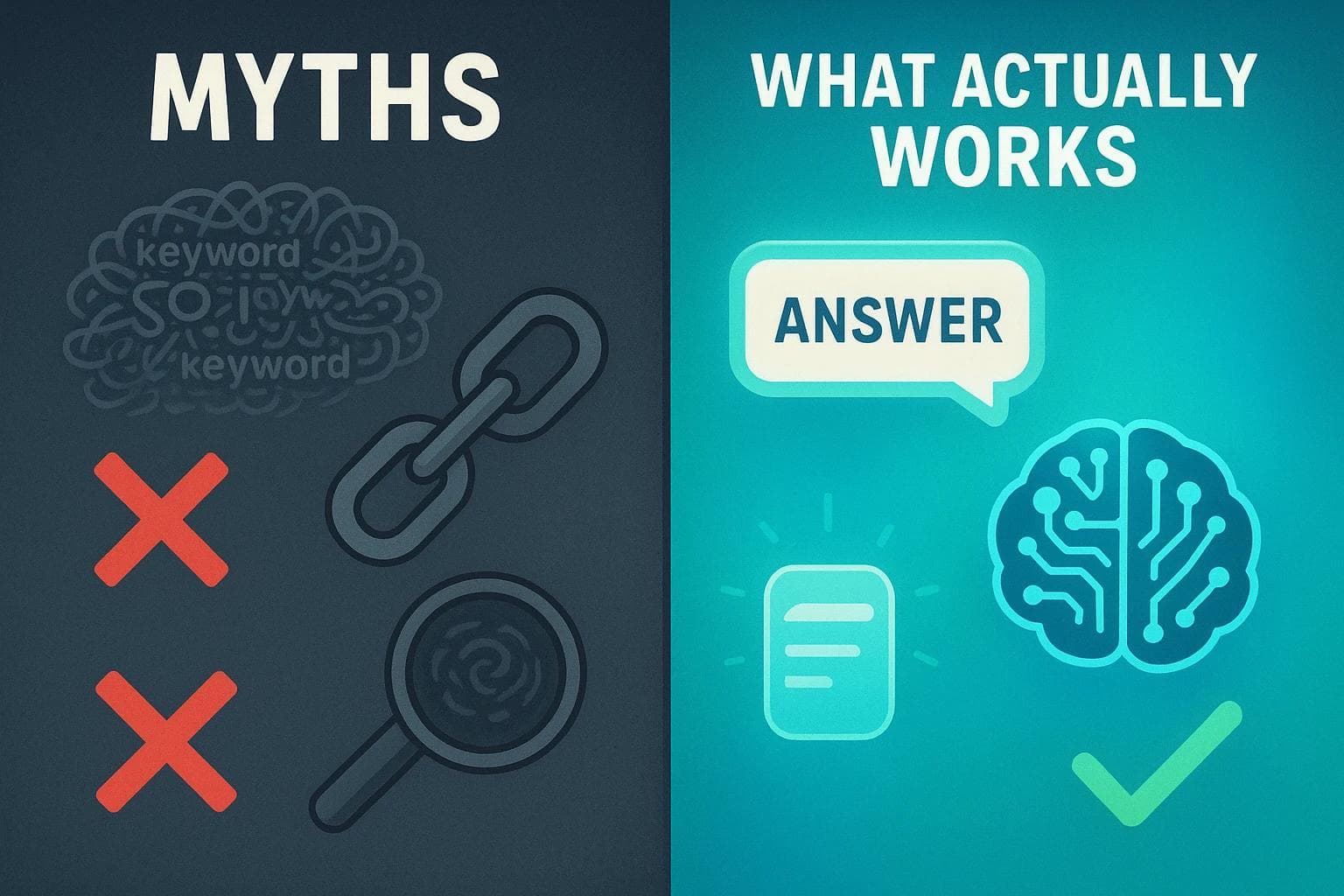
The Surprising Truth About Getting Cited by ChatGPT (and Why Your SEO Rules Don't Apply)
You’ve done everything right. You’ve researched keywords, crafted a compelling article, and hit “publish.” You even ask ChatGPT a question you know your article answers perfectly.
Instead of citing your brilliant work, it quotes a competitor. Or worse, it confidently provides an answer and attributes it to a source that doesn’t exist.
If this sounds familiar, you’re not alone. Welcome to the new frontier of online visibility, where the rules of traditional SEO are being rewritten. Getting your content noticed by AI like ChatGPT isn’t about tricking an algorithm; it’s about understanding a completely different kind of intelligence.
Forget what you think you know about ranking. Let’s explore the common myths holding content back and uncover what actually works.

First, Let's Understand ChatGPT's "Brain"
The biggest "aha moment" for anyone trying to get cited by AI is realizing this: ChatGPT is not a search engine.
A search engine like Google crawls the web, indexes pages, and retrieves links from its database to answer your query. It’s a librarian, finding the exact book you need.
ChatGPT is a Large Language Model (LLM). It’s more like a brilliant student who has read every book in the library and is now synthesizing an answer based on the patterns, connections, and language it absorbed. It doesn't "look up" facts in real-time; it predicts the next most likely word in a sequence to form a coherent sentence.
This is why it sometimes "hallucinates" or fabricates citations. It’s creating a source that looks plausible based on the patterns it learned, even if that source never existed. Understanding this core difference is the key to shifting your content strategy from simply ranking to truly resonating with AI.

Debunking the Myths: What Doesn't Work for AI Visibility
Many creators apply old SEO tactics to this new challenge, only to be met with silence. Let's bust a few of the most common myths.
Myth 1: Keyword stuffing will get me noticed.
The old practice of cramming a keyword into your text as many times as possible is not only bad for human readers—it’s ineffective for AI. Language models prioritize clarity and natural language. Awkward, keyword-stuffed sentences are confusing patterns that the AI is more likely to ignore in favor of a clearer source.
Reality: AI values concise, direct answers. Your focus should shift from keyword density to clarity of information. This is the core of a new field emerging called Generative Engine Optimization (GEO), where the goal is to be the source for AI-generated answers.
Myth 2: The more internal and external links, the better.
Links are a cornerstone of traditional SEO, signaling authority to search engines. However, when an LLM is trying to extract a clean, simple answer, links create noise. A study by Search Engine Land found that content with minimal to no links within the direct answer text was more likely to be cited.
Reality: Keep your core answers clean and self-contained. Place your valuable links in the surrounding paragraphs to provide context for human readers and search crawlers, but let the specific answer stand on its own.
Myth 3: I should use AI to write all my content.
While AI can help brainstorm and outline, content that is merely a rehash of existing information on the internet is unlikely to be treated as a primary source. LLMs are trained on vast datasets; they are designed to recognize and value novel information.
Reality: Originality is your most powerful asset. Unique data, proprietary research, and firsthand insights are citation magnets because they introduce new information into the ecosystem.

What Actually Works: A Blueprint for Getting Cited by AI
Now that we've cleared away the misconceptions, let's focus on the practical, repeatable tactics that will turn your content into a go-to source for AI.
1. Master the "Answer Capsule"
This is the single most effective tactic you can implement today. An answer capsule is a short, self-contained, and highly factual paragraph that directly answers a specific question.
The Blueprint:
- Length: Aim for 20-25 words.
- Placement: Put it right at the beginning of the relevant section of your article, directly under the heading.
- Clarity: Write in simple, direct language. No fluff, no jargon.
Example:
- Instead of: "When considering the multifaceted world of digital marketing, it becomes apparent that the practice of Generative Engine Optimization, or GEO, is an emerging discipline that focuses on…"
- Try This: "Generative Engine Optimization (GEO) is the practice of creating and optimizing content to be easily found, understood, and cited by AI language models."
2. Champion Originality and Owned Insights
The internet is flooded with derivative content. To stand out, you need to be the source of truth.
- Publish Original Data: Conduct a small survey of your audience, analyze your own business data, or compile statistics from multiple sources into a new, unique report.
- Create "Owned Insights": Frame your advice with a branded term. For example, instead of "our recommendation," call it "The Fonzy.ai Framework for AI Visibility." This makes your specific insight citable.
3. Build Broader Trust Signals
While direct tactics like answer capsules are crucial, the overall authority of your website still matters. AI models, much like search engines, use wider signals to determine if a source is credible. Continue focusing on foundational SEO best practices that build trust signals, such as:
- Demonstrating expertise and authoritativeness (E-E-A-T).
- Ensuring your content is up-to-date and factually accurate.
- Building a healthy backlink profile from other reputable sites.
A Note for Responsible AI Users: How to Cite ChatGPT
While we’re focused on getting cited, it’s equally important to be a responsible user of AI. If you use content generated by ChatGPT in your work, you must cite it.
Most academic style guides, like APA and MLA, treat AI-generated text as a form of personal communication or output from a software algorithm. The general rule is to be transparent. Acknowledge the tool you used (e.g., ChatGPT-4), the publisher (OpenAI), the date you received the information, and the prompt you used.
And remember the golden rule: Verify, Verify, Verify. Always fact-check any information, data, or sources provided by an AI before including them in your work.
Your Questions Answered: AI Citation FAQ
Why does ChatGPT make up citations?
Because it's a language model, not a search engine. It's generating a text sequence that looks like a real citation based on patterns it has learned, rather than retrieving data from a verified database.
How is getting cited by AI different from ranking on Google?
Google values comprehensive content, user experience, and backlinks. AI models prioritize concise, factual, and easily extractable "answer capsules." While there's overlap in overall site authority, the content formatting strategy is different.
Can I track if ChatGPT is citing my content?
Currently, there is no direct analytics tool to measure this reliably. The best approach is to focus on implementing best practices and observing the indirect benefits, such as increased organic traffic from users who discover you through AI-powered search experiences.
The Path Forward: From Content Creator to Answer Engineer
The rise of AI isn't the end of SEO; it's an evolution. Success in this new era requires a mental shift—from just creating content to engineering clear, authoritative answers. By debunking old myths and embracing strategies that value clarity, originality, and authority, you can position your content to be the definitive source for humans and AI alike.
Consistently applying these principles across your entire website is the key to building lasting visibility. By creating a library of high-quality, AI-optimized content, you’re not just chasing rankings; you’re building an engine for sustainable organic growth.

Roald
Founder Fonzy — Obsessed with scaling organic traffic. Writing about the intersection of SEO, AI, and product growth.
Stop writing content.
Start growing traffic.
You just read about the strategy. Now let Fonzy execute it for you. Get 30 SEO-optimized articles published to your site in the next 10 minutes.
No credit card required for demo. Cancel anytime.

How Schema Markup Helps AI Understand Your Content
Learn how schema markup boosts AI visibility and trust without needing developer skills to optimize your content.

Technical Foundations of Crawlability Schema and AI Page Signals
Learn how crawlability schema and page signals impact AI understanding and trust of your website content.

Why AI Needs Linked Sources and Primary Data for Citations
Learn why original data and clear attribution are vital for AI to trust and cite your information correctly.