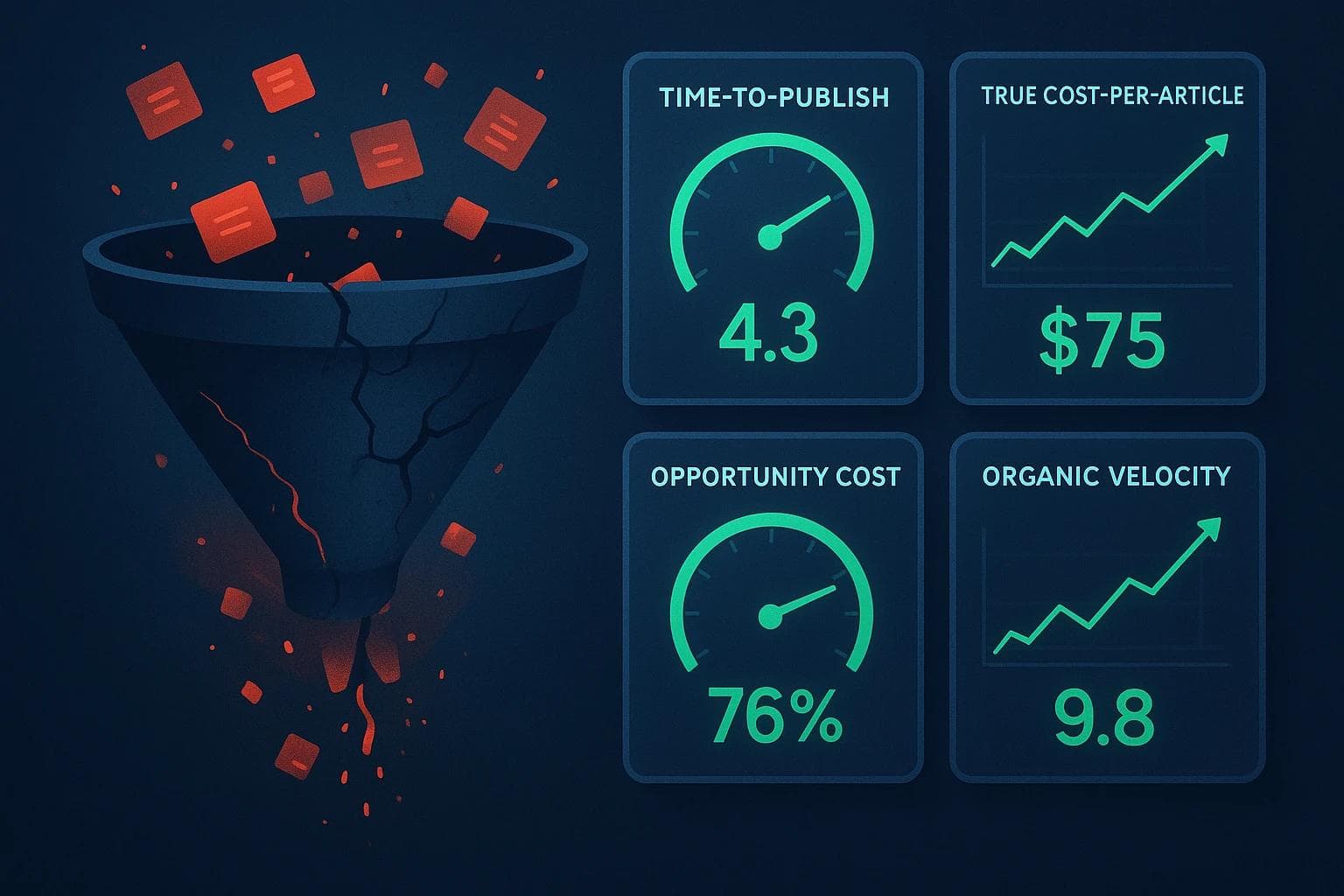
Beyond ROI: The Content Efficiency KPIs Your Agency Is Ignoring
Does your agency's content process feel like a leaky bucket? You're pouring in time, talent, and resources, but the output feels slow, expensive, and disconnected from the results you promised your clients. You're not alone. Many agencies are so focused on measuring the effectiveness of their content (traffic, leads, conversions) that they overlook the massive "invisible waste" happening right in their production line.
This waste isn't just about a missed deadline or a blog post that costs a bit more than expected. It's the silent killer of profitability and scalability. It's the high-value client project that gets delayed because your team is bogged down in endless revisions for a low-impact article. It's the brilliant idea that loses its competitive edge because it took six weeks to get from brief to publish.
The good news? You can plug the leaks. But first, you have to find them. It's time to look beyond traditional marketing metrics and embrace a new set of KPIs designed to measure one thing: content efficiency. These are the numbers that reveal exactly where your process is breaking down, giving you the data you need to fix it.

Demystifying the 4 KPIs That Reveal Content Waste
Before we dive in, let's clarify one thing. Content effectiveness asks, "Did this content achieve its marketing goal?" Content efficiency asks, "How much time, effort, and resources did it take to get there?" You need both, but most agencies only measure the first, leaving profitability to chance.
Here are the four essential efficiency KPIs that will give you an x-ray of your content operations.
1. Time-to-Publish
This is the most straightforward efficiency metric. It measures the total time elapsed from the moment a content idea is approved to the moment it goes live.
- Why it Matters: A long Time-to-Publish is a red flag for bottlenecks. It could be slow writing, endless revision cycles, complex client approvals, or technical publishing delays. A high number here means you’re slow to react to market trends and your team’s capacity is tied up, preventing them from moving on to the next valuable project.
- How to Calculate It:
Time-to-Publish = (Publish Date) - (Brief Approval Date) - Track this in days for each piece of content. After a month or two, calculate your average to find your baseline.
2. True Cost-per-Article
This goes beyond the freelancer's invoice. It’s the fully-loaded cost of producing a single piece of content, accounting for every minute of your team's involvement.
- Why it Matters: Many agencies underestimate the true cost of content. When you realize a "simple" blog post actually cost $1,500 in total team time and overhead, you start questioning if it delivered $1,500 in value. This KPI exposes gold-plated processes and helps you align your production investment with the strategic value of each content piece.
- How to Calculate It:
Cost-per-Article = (Direct Costs) + (Time Costs) + (Tool/Overhead Costs) - Direct Costs: Freelancer fees, stock photo purchases.
- Time Costs: Sum of
(Hourly Rate * Hours Spent)for every team member involved (strategist, writer, editor, designer, project manager). Remember to use a blended internal rate for salaried employees. - Tool/Overhead Costs: A small, prorated portion of your monthly software subscriptions (SEO tools, project management software) and office overhead.
3. Opportunity Cost
This isn't a hard number you'll find in a spreadsheet, but a strategic metric that measures the potential gains you lost by choosing to work on one project over another.
- Why it Matters: This is the hidden cost of inefficiency. When your best strategist spends 10 hours nursing a low-value blog post through approvals, that’s 10 hours they didn't spend developing a high-impact campaign for your top client. The waste isn't just the strategist's salary for that time; it's the potential revenue from the campaign they couldn't build. Delays also have an opportunity cost—publishing a trend-focused article a month after the trend has peaked means you've missed the primary window of engagement.
- How to Estimate It:After a project, ask: "What other, potentially higher-value activities did this project prevent us from doing?"
- When a piece of content underperforms, calculate its True Cost-per-Article and ask, "Could that $1,500 have been better spent on updating a high-performing old post or running a small ad campaign?"
4. Organic Velocity
This metric measures how quickly a new piece of content gains organic visibility and starts ranking for its target keywords after being published.
- Why it Matters: Some content delivers value almost immediately, while other pieces sit for months, draining resources without contributing to organic growth. Low organic velocity is a form of waste. It could signal a poor topic choice, weak SEO optimization, or a flawed promotion strategy. By tracking this, you can learn what types of content resonate quickly with search engines and your audience, allowing you to double down on winners and stop creating content that becomes a long-term drain.
- How to Measure It:Using an SEO rank tracking tool, monitor the primary keyword(s) for a new article.
- Measure the time it takes to reach the first page (top 10) or achieve a certain threshold of organic impressions.
- A piece that hits page one in three weeks has a much higher velocity than one that takes six months.
From Metrics to Measurement: Finding Your Efficiency Baseline
Knowing the KPIs is one thing; using them is another. Your goal is to establish a baseline—your agency's current "normal"—so you can spot problems and measure improvement over time.

Here’s how to get started:
- Approval Bottlenecks: Content gets stuck waiting for internal or client review.
- Scope Creep: A "simple" blog post balloons into a massive research project.
- Content Graveyard: Articles that are published but receive no traffic or engagement, representing a total loss on the production investment.
- Redundant Production: Creating new content on a topic where you already have an existing, high-performing piece that could have been updated for a fraction of the cost.
Turning Insights into Action: Using Efficiency Data to Drive Growth
Once you have your baseline, you have power. You're no longer just feeling like the process is broken; you have the numbers to prove it and the insights to fix it.
This is where you can build a powerful business case for change. When you can walk into a client meeting or an internal strategy session and say, "Our average Time-to-Publish is 28 days, primarily due to review delays. By streamlining our approval process, we can get that down to 10 days, allowing us to publish content 3x faster and react to market trends," you change the conversation.
This data is your foundation for justifying investments in new processes, better project management, or automation tools. Instead of saying, "We need a tool to make things faster," you can say, "Our average Cost-per-Article is $950. A content automation platform that can reduce that cost by 40% would save us $380 per article, leading to over $11,000 in savings per month on our current volume."
Suddenly, the investment isn't a cost—it's a clear path to higher profitability and better client results.

An Efficiency-First Content Framework for Your Agency
Ready to stop the leaks? Adopt an efficiency-first mindset with this simple framework:
- Measure First: Commit to tracking your Time-to-Publish and True Cost-per-Article for the next quarter. You can't improve what you don't measure.
- Identify One Bottleneck: Don't try to fix everything at once. Find the single biggest source of delay or cost in your process and focus all your energy on solving it.
- Prioritize Velocity: When planning your content calendar, ask which topics are most likely to have high Organic Velocity. Prioritize content that can deliver value faster.
- Review and Refine: Make these efficiency KPIs a standard part of your monthly and quarterly agency reports. Track your progress and celebrate the wins as you drive your waste-revealing numbers down.
By focusing on how your content gets made, not just how it performs, you’ll build a more resilient, scalable, and profitable agency.
Frequently Asked Questions (FAQ)
What's the difference between content efficiency and content effectiveness?
Think of it like building a car. Effectiveness is whether the car gets you safely to your destination (e.g., did the content generate leads?). Efficiency is how much fuel, time, and money it took to build the car and make the trip (e.g., how much did it cost and how long did it take to produce and publish the content?). You need both to run a profitable operation.
How often should we track these efficiency KPIs?
You should capture the data for every single piece of content you produce. However, it's most useful to analyze the averages and trends on a monthly or quarterly basis. This helps you see the bigger picture and avoid overreacting to a single outlier project.
We aren't tracking any of this. Where do we even start?
Start small. Pick one metric—Time-to-Publish is often the easiest. For the next month, just log the brief approval date and the publish date for every article in a spreadsheet. The simple act of measuring will start to reveal patterns and give you the momentum to track more.
Are these efficiency KPIs more important than traditional ones like traffic or leads?
They aren't more important, but they are the missing piece of the puzzle. Traffic and leads (effectiveness) tell you if your strategy is working for your client. Efficiency KPIs tell you if your operations are working for your agency. To be truly successful, you must have a clear view of both.

Roald
Founder Fonzy — Obsessed with scaling organic traffic. Writing about the intersection of SEO, AI, and product growth.
Stop writing content.
Start growing traffic.
You just read about the strategy. Now let Fonzy execute it for you. Get 30 SEO-optimized articles published to your site in the next 10 minutes.
No credit card required for demo. Cancel anytime.
How Content Frequency Affects SEO Rankings and What to Prioritize
Explore how balancing content speed and quality impacts SEO and learn when to focus on velocity or perfection.
5 Signs Your Content Strategy is Losing Customers
Discover key signs your content strategy is stuck and quietly losing customers before it impacts your growth.
How to Measure SEO ROI with Business Metrics
Learn simple ways to measure SEO ROI focusing on leads, conversions, cost, and customer value beyond keywords and rankings.