How to Measure the ROI of Agency Self-Marketing: Metrics That Matter
You've been there. You’ve just published a brilliant blog post, poured hours into a new case study, or launched a slick social media campaign for your own agency. You feel good about it. But then, your business partner walks over and asks the dreaded question: "Is this stuff actually working? What's the ROI on this?"
For most agency owners, that question triggers a moment of panic. While you’re a pro at proving ROI for your clients, turning that analytical lens on your own marketing efforts can feel like trying to read a map in the dark.
The truth is, the standard ROI formula—(Net Profit / Marketing Cost) * 100—often falls flat for agencies. Why? Because your "product" is a high-value, trust-based service with a long sales cycle. A client might read your blog for six months before ever sending an email. How does a simple formula capture that complex, slow-burn journey?
It doesn’t. It’s time for a better framework. Instead of relying on a single, often misleading number, you need to track a collection of metrics that tell the complete story of your self-marketing performance.

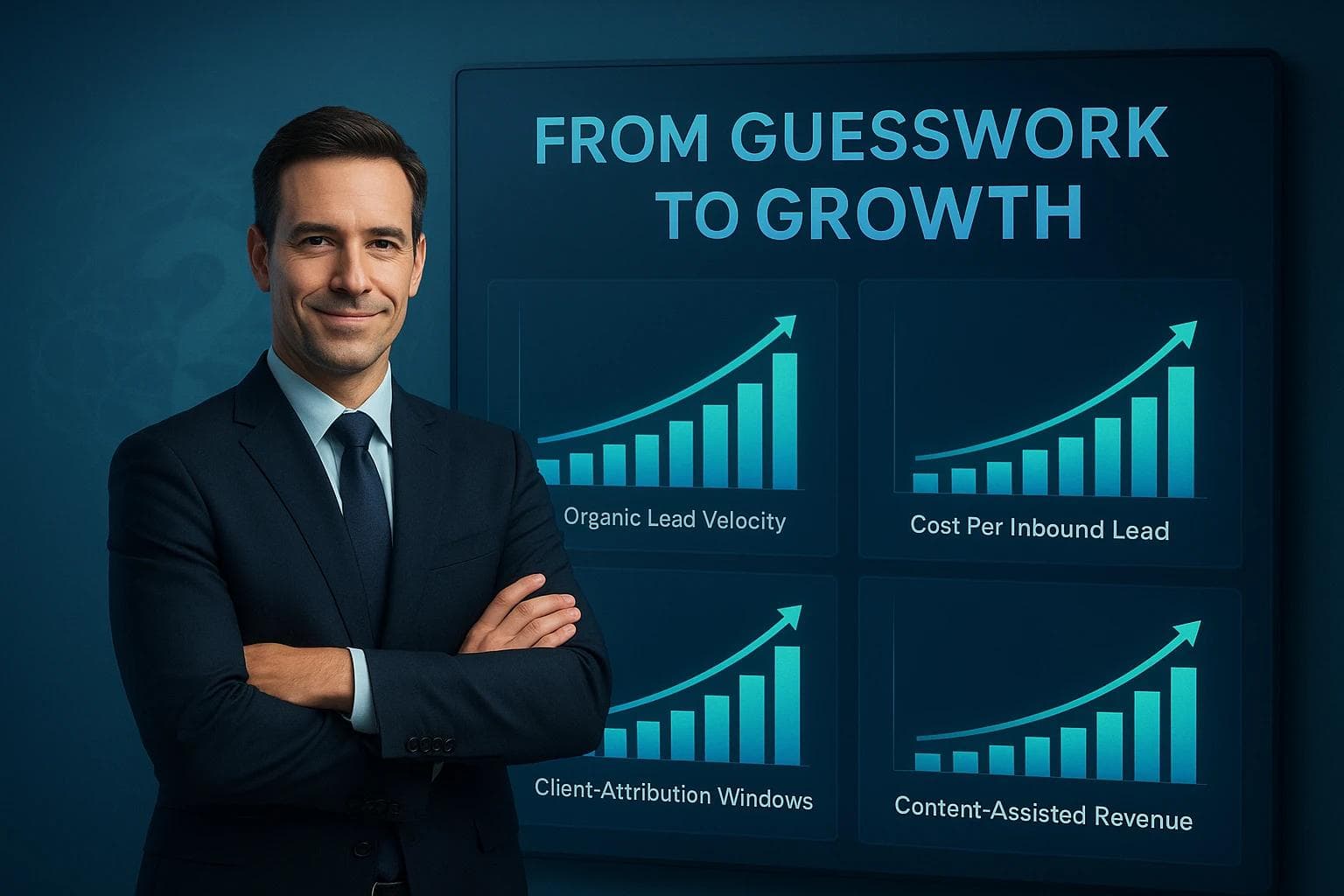
The Four Pillars of Agency Self-Marketing ROI
Forget vanity metrics like page views and social media likes. To truly understand the impact of your marketing, you need to focus on four key performance indicators (KPIs) that connect your efforts to actual business growth.
1. Organic Lead Velocity: Measuring Your Growth Momentum
Imagine you’re pushing a flywheel. At first, it takes a lot of effort for very little movement. But as you keep pushing, it builds momentum and starts spinning faster and faster. That momentum is your Organic Lead Velocity.
What it is: Organic Lead Velocity measures the month-over-month growth rate of your organic leads. It’s not just about how many leads you got this month, but how much faster you’re generating them compared to last month.
Why it matters: This is a forward-looking metric that shows if your content program is gaining traction. A rising lead velocity means your content is resonating, your SEO is improving, and your pipeline is getting healthier. It’s the earliest indicator that your investment is starting to pay off.
How to track it:(Current Month's Organic Leads - Previous Month's Organic Leads) / Previous Month's Organic Leads * 100%
For example, if you got 10 leads last month and 13 this month, your velocity is (13-10)/10 = 30%.
2. Cost Per Inbound Lead (CPL): Understanding Your Efficiency
While lead velocity tells you about momentum, Cost Per Inbound Lead tells you about efficiency. Are you building that momentum in a cost-effective way?
What it is: A simple calculation of your total self-marketing costs divided by the number of inbound leads you generated in a given period.
Why it matters: This metric forces you to be honest about your investment. When calculating costs, be sure to include:
- Content Creation: The cost of writers (or your own time valued at an hourly rate).
- Tools & Software: Your SEO platforms, schedulers, and analytics subscriptions.
- Promotion: Any ad spend used to boost your content.
Tracking your CPL helps you make smarter budget decisions and identify which channels are delivering the most bang for your buck.
3. Client-Attribution Windows: Giving Your Content Time to Work
Here’s where most agencies get it wrong. A potential client isn’t buying a t-shirt; they’re considering a multi-thousand-dollar partnership. That decision takes time. A standard 30-day attribution window, common in e-commerce, is far too short.
What it is: The specific timeframe after a prospect first interacts with your marketing during which a conversion can be credited to that touchpoint.
Why it matters: For high-value agency services, the sales cycle can easily be 90, 180, or even 365 days. If you're only looking at the last 30 days, you’re missing the fact that the client who signed today actually downloaded your whitepaper six months ago. Adopting a longer attribution window gives you a much more accurate picture of how your early-funnel content contributes to long-term revenue.
4. Content-Assisted Revenue: Crediting the Entire Journey
Was it the blog post they read first? The webinar they attended three months later? Or the case study they viewed right before requesting a proposal? The answer is likely: all of the above.
What it is: The total revenue from clients who interacted with your content at any point in their journey, not just the final click.
Why it matters: Last-click attribution is like giving all the credit for a championship win to the person who scored the final point, ignoring the assists, defense, and coaching that made it possible. Content-assisted revenue acknowledges that your marketing is a team effort. It helps you see the value in top-of-funnel educational pieces that don't directly lead to a conversion but play a crucial role in building trust and awareness over time.
Putting It All Together: A Simple ROI Test for Your Agency's Content
Theory is great, but how do you apply this in the real world? Here’s a simple, four-step test you can run on your next piece of content to get a clear picture of its ROI.

Step 1: Set a Specific Goal. Before you write a single word, define what success looks like. Your goal should be specific and time-bound.
- Weak Goal: "Get more leads."
- Strong Goal: "This blog post will generate 5 marketing-qualified leads (MQLs) within 90 days of publication."
Step 2: Track Your Inputs (Costs). Calculate the total investment for the content piece.
- Example: 6 hours of your strategist’s time at $150/hr = $900. Total cost = $900.
Step 3: Track Your Outputs (The Metrics). Use analytics to monitor the results. Make sure you have tracking in place, such as a unique call-to-action (CTA) on the page or UTM parameters for any links you share. You'll want to track how many people fill out the form associated with that post.
Step 4: Analyze the Results. After your 90-day window, review the data. Did you hit your goal of 5 MQLs?
- If yes: Your CPL for this piece is $900 / 5 = $180. If your average client value makes this a profitable number, you have a positive ROI.
- If no: You only got 2 MGLs. Your CPL is $450. This isn't a failure; it's a learning opportunity. Was the topic wrong? Was the CTA unclear? Use this data to refine your next piece.
How AI Supercharges Your Self-Marketing ROI Measurement
Tracking all these metrics manually can feel overwhelming. This is where modern marketing platforms come into play, especially those powered by AI. As the digital landscape shifts to incorporate both GEO and SEO, having a robust system to measure what works is no longer a luxury—it's a necessity.
AI-driven platforms can automate the heavy lifting of ROI measurement by:
- Automating Data Collection: Instead of manually pulling reports, AI can automatically track your organic lead velocity and monitor how it changes over time.
- Improving Attribution Modeling: AI can analyze thousands of customer touchpoints to build sophisticated, data-driven attribution models, giving you a crystal-clear view of your content-assisted revenue.
- Optimizing Content Spend: By identifying which topics and formats deliver the lowest CPL and highest engagement, AI helps you invest your marketing budget where it will have the greatest impact.
A platform like Fonzy AI is designed to streamline this entire process, helping agencies automatically generate and publish content that is optimized for organic growth, while providing the insights needed to prove its value.

Frequently Asked Questions About Agency Self-Marketing ROI
What is a "good" marketing ROI for an agency?
While it varies by niche and service price, a common benchmark is a 5:1 ratio (a $5 return for every $1 spent). However, a single number can be misleading. A better approach is to focus on improving your own metrics over time—increasing your lead velocity and lowering your CPL month after month.
How do I track leads from my agency's blog?
The key is to have a clear conversion path. Use compelling CTAs within your posts (e.g., "Download the Free Checklist," "Book a Strategy Call") that lead to a dedicated landing page with a form. Use a CRM to track where these leads came from and monitor their journey.
My sales cycle is over 6 months. How can I possibly track ROI?
This is precisely why you need to use a long Client-Attribution Window (180+ days) and track Content-Assisted Revenue. Your CRM is your best friend here. Log every touchpoint—every downloaded guide, every webinar attended. Over time, you'll see a clear pattern of how your content nurtures prospects from initial awareness to a signed contract.
What's the difference between ROI and ROAS?
ROAS stands for Return on Ad Spend and only measures the revenue generated from paid advertising campaigns. ROI (Return on Investment) is a much broader metric that looks at the overall profitability of your marketing, including all costs like salaries, tools, and content creation. For self-marketing, ROI is the more meaningful metric.
From Guesswork to Growth: Your Next Step
Measuring the ROI of your agency's marketing doesn't have to be a mystery. By moving beyond a simplistic formula and embracing a framework built on velocity, efficiency, and a realistic view of your sales cycle, you can finally answer that dreaded question with confidence.
You now have the tools to not only prove the value of your work but also to make smarter, data-driven decisions that fuel sustainable growth. The next step is to put them into practice. Pick one piece of content, run the simple ROI test, and start your journey from guesswork to growth.

Roald
Founder Fonzy — Obsessed with scaling organic traffic. Writing about the intersection of SEO, AI, and product growth.
Stop writing content.
Start growing traffic.
You just read about the strategy. Now let Fonzy execute it for you. Get 30 SEO-optimized articles published to your site in the next 10 minutes.
No credit card required for demo. Cancel anytime.

5 Signs Your Content Strategy is Losing Customers
Discover key signs your content strategy is stuck and quietly losing customers before it impacts your growth.
How to Measure SEO ROI with Business Metrics
Learn simple ways to measure SEO ROI focusing on leads, conversions, cost, and customer value beyond keywords and rankings.

The Role of Human Oversight in AI-Driven Content
Learn how human oversight ensures quality and brand voice in AI-generated content for agencies.