The Evolution of Authority From SEO Ranking to AI Citation

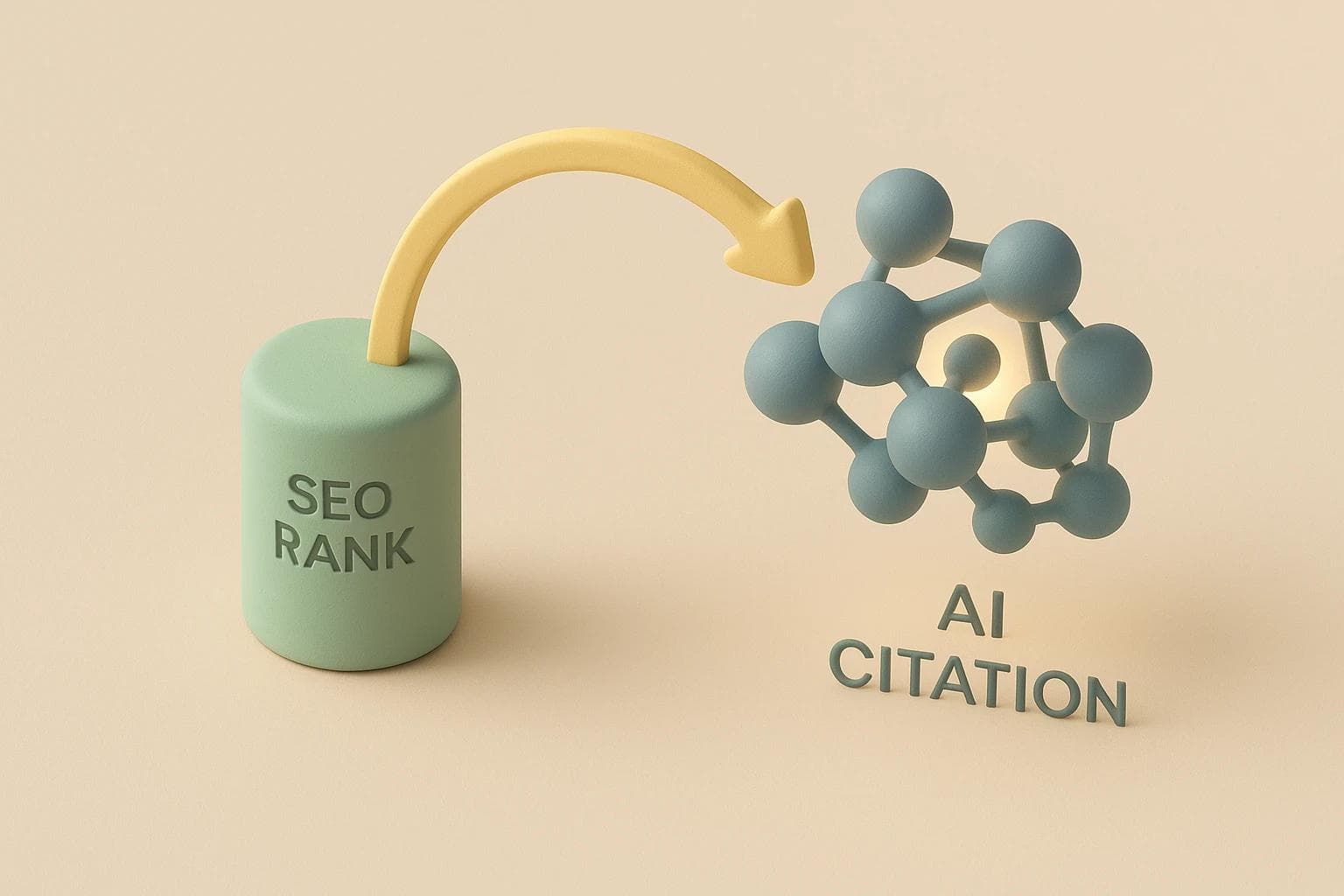
The Evolution of Authority: From SEO Ranking to AI Citation
You've spent years mastering the rules of SEO. You built links, targeted keywords, and climbed the SERPs. Ranking on page one was the ultimate mark of authority. But now, you check the search results and see an AI-generated summary sitting above the #1 spot, citing sources you’ve never even considered competitors.
Suddenly, the game has changed.
The traditional playbook for building online authority is being rewritten in real-time. Ranking is still important, but a new, more powerful signal is emerging: AI citation. The fundamental question is no longer just "How do I rank?" but "How do I become a trusted source for AI?" This is the new frontier of digital authority, and navigating it requires a shift in both strategy and tooling.
Phase 1: The Foundation - How We Understood SEO Authority
For years, authority was a relatively straightforward concept. It was built on a foundation of tangible signals:
- Backlinks: The digital equivalent of a vote of confidence from other sites.
- Domain Authority: A cumulative score reflecting your site's overall credibility.
- Keyword Relevance: How well your content matched the queries people were typing into search bars.
Even before the recent generative AI boom, machine learning was already subtly changing these factors. Google’s algorithms grew more sophisticated, focusing on semantic search and user intent rather than just keywords. But these were incremental changes. The core principles of authority remained intact.
Phase 2: The New Frontier - The Rise of AI Citation
AI citation is fundamentally different. It's not just about a machine ranking your content; it's about a machine understanding, synthesizing, and presenting your information as fact. When Google's AI Overviews, ChatGPT, or Perplexity answer a user's question, they are actively selecting and attributing sources. Being one of those sources is the new pinnacle of authority.
So, how do these models choose who to cite? It's not a mystery—it's an evolution. Research shows that AI models lean heavily on established signals. A Semrush study found that Perplexity.ai matches Google's top 10 domains in over 91% of its answers. This tells us that strong traditional SEO is the price of admission.
But it’s not the whole story. AI is also evaluating content on a deeper level, looking for signals that mirror human trust. It's looking for demonstrable Expertise, Experience, Authoritativeness, and Trustworthiness (E-E-A-T). The challenge is that these signals are more nuanced than a simple backlink count.

To win in this new landscape, you need a framework that optimizes for both ranking and citation simultaneously.
The AI Authority Matrix: Your Framework for Dual Optimization
Treating SEO and AI citation as separate goals is a mistake. The future belongs to those who can build a unified strategy. The AI Authority Matrix is a framework for doing just that—mapping the core tenets of E-E-A-T directly to the tactics that influence both search engines and generative AI.

This matrix isn't just theory; it's a strategic blueprint. By focusing on these four pillars, you create content that doesn't just answer queries but demonstrates true authority that AI algorithms are designed to recognize. This requires a deep focus on your content and the technical signals that prove your E-E-A-T to both users and machines.
Strategic Pillars for Building AI Citation Authority
Translating the matrix into action requires focusing on three core areas of your SEO strategy.
Content Strategy: From Keywords to Concepts
AI thinks in concepts and entities, not just keywords. Your content strategy must evolve to match.
- Optimize for Direct Answers: Structure content with clear headings, concise paragraphs, and definitive statements that can be easily extracted for AI summaries.
- Embrace Entity-Based SEO: Focus on building deep, interconnected content clusters around specific topics (entities). This signals comprehensive expertise that AI values more than a single, keyword-stuffed page.
- Leverage Conversational Queries: Create content that directly answers the questions people ask, mirroring the conversational nature of interacting with generative AI.
Technical SEO: Making Your Content AI-Readable
Your technical foundation must be flawless for AI to discover, crawl, and understand your expertise.
- Implement Structured Data: Use schema markup to explicitly tell AI what your content is about—who wrote it, what organization it represents, and what key facts it contains.
- Prioritize Content Clarity: Use simple HTML and a clean site architecture. Complex layouts can confuse AI parsers, preventing your best information from being indexed correctly.
- Strengthen Internal Linking: A logical internal linking structure helps AI understand the relationships between your content, reinforcing your topical authority.
Off-Page Authority: Why Contextual Mentions Matter More Than Ever
AI is learning to value context over simple links. Generic guest post links are losing currency. What matters now are brand mentions and links from thematically relevant, authoritative sources that validate your expertise. This includes unconventional sources; research shows Reddit appears in over 40% of AI-generated answers, often outranking brand websites because it provides authentic, experience-based context.
AI Tools in Action: Building Your Authority Stack
Manually executing this dual strategy is nearly impossible. The scale and speed required demand a new class of tools. Competitors are already using AI for keyword research, content briefs, and on-page optimization. But a fragmented toolset creates complexity and drains resources.
The real advantage comes from an integrated platform that manages the entire authority-building lifecycle. An autonomous system can analyze your market, build a content strategy based on AI citation principles, produce expert-level articles, and publish them consistently. This is where a solution like Fonzy AI transforms your approach, acting as a fully autonomous SEO team dedicated to building your authority in this new era.
Ethical AI and Human Oversight: The Key to Long-Term Trust
A common concern is whether using AI for content creation can lead to penalties. The data suggests otherwise. An Ahrefs study of 600,000 pages found that AI-generated content doesn't harm Google rankings—as long as it's high-quality, helpful, and factually accurate.
The key is not to eliminate human involvement but to elevate it. Use AI for scale and efficiency, but rely on human expertise for strategy, fact-checking, and ensuring the final product genuinely demonstrates your unique experience and perspective. This human-in-the-loop approach is the cornerstone of building lasting trust with both your audience and the AI systems that serve them.
Your Implementation Playbook: From Quick Wins to Long-Term Dominance
Shifting your strategy can feel overwhelming. Here's how to turn this framework into an actionable plan.

Success in this new paradigm isn't measured by rank alone. It's about tracking your visibility within AI-driven features and your share of voice in AI-generated answers.

The Road Ahead: Authority is Redefined. Are You Ready?
The shift from ranking to citation is the most significant evolution in search in over a decade. It's a move away from gaming algorithms and toward building genuine, demonstrable authority that both humans and AI can recognize.
The businesses that thrive will be those that embrace this change, adopt a unified strategy, and leverage automation to execute at scale. The old rules provided a clear but crowded path to visibility. The new rules offer a once-in-a-generation opportunity to become the definitive authority in your space. The choice is yours.
Frequently Asked Questions (FAQs)
Will AI completely replace traditional SEO?
No, AI will transform it. Traditional SEO practices like keyword research, on-page optimization, and building a strong technical foundation are now the prerequisites for being considered by AI. As research indicates, LLMs heavily rely on Google's top 10 results, so you still need strong SEO to get into the consideration set for AI citation.
Can I get penalized for using AI-generated content?
Google's official stance is that high-quality content is rewarded, regardless of how it's produced. Low-quality, spammy content will be penalized whether it's written by a human or AI. The key is to use AI as a tool to enhance your expertise and scale production, always with human oversight to ensure accuracy, originality, and helpfulness.
How is building authority for AI different from just building E-E-A-T?
Building authority for AI is an amplification of E-E-A-T. While traditional E-E-A-T focused on signals for human users and Google's human raters, optimizing for AI requires making those signals machine-readable. This means a heavier emphasis on structured data, clear content architecture, and entity-based optimization so an algorithm can easily parse and verify your expertise.
What's the first step I should take to optimize for AI citation?
Start with a content audit focused on clarity and directness. Identify your highest-performing pages and revise them to answer specific questions concisely. Add FAQ sections, use clear headings, and ensure every claim is supported by data. This "quick win" makes your best content immediately more attractive for AI summarization and citation.
Roald
Founder Fonzy — Obsessed with scaling organic traffic. Writing about the intersection of SEO, AI, and product growth.
Stop writing content.
Start growing traffic.
You just read about the strategy. Now let Fonzy execute it for you. Get 30 SEO-optimized articles published to your site in the next 10 minutes.
No credit card required for demo. Cancel anytime.

The First-Mover Advantage Why Early AI Citation is Your Next Competitive Moat
Gain lasting market share and brand authority by adopting AI citation early. Secure your competitive moat before the window closes.

Beyond Keywords How to Make Your Brand an AI-Trusted Entity
Build trust with AI systems by defining your brand, creating authoritative content, and earning citations for lasting entity recognition.

Beyond the Hype A Practical Framework for Measuring AI Citation ROI
Discover a multi-layered framework to measure and prove AI citation ROI, connecting AI visibility to real business and financial results.