Writing for Robots? How to Structure Content AI Actually Understands and Uses
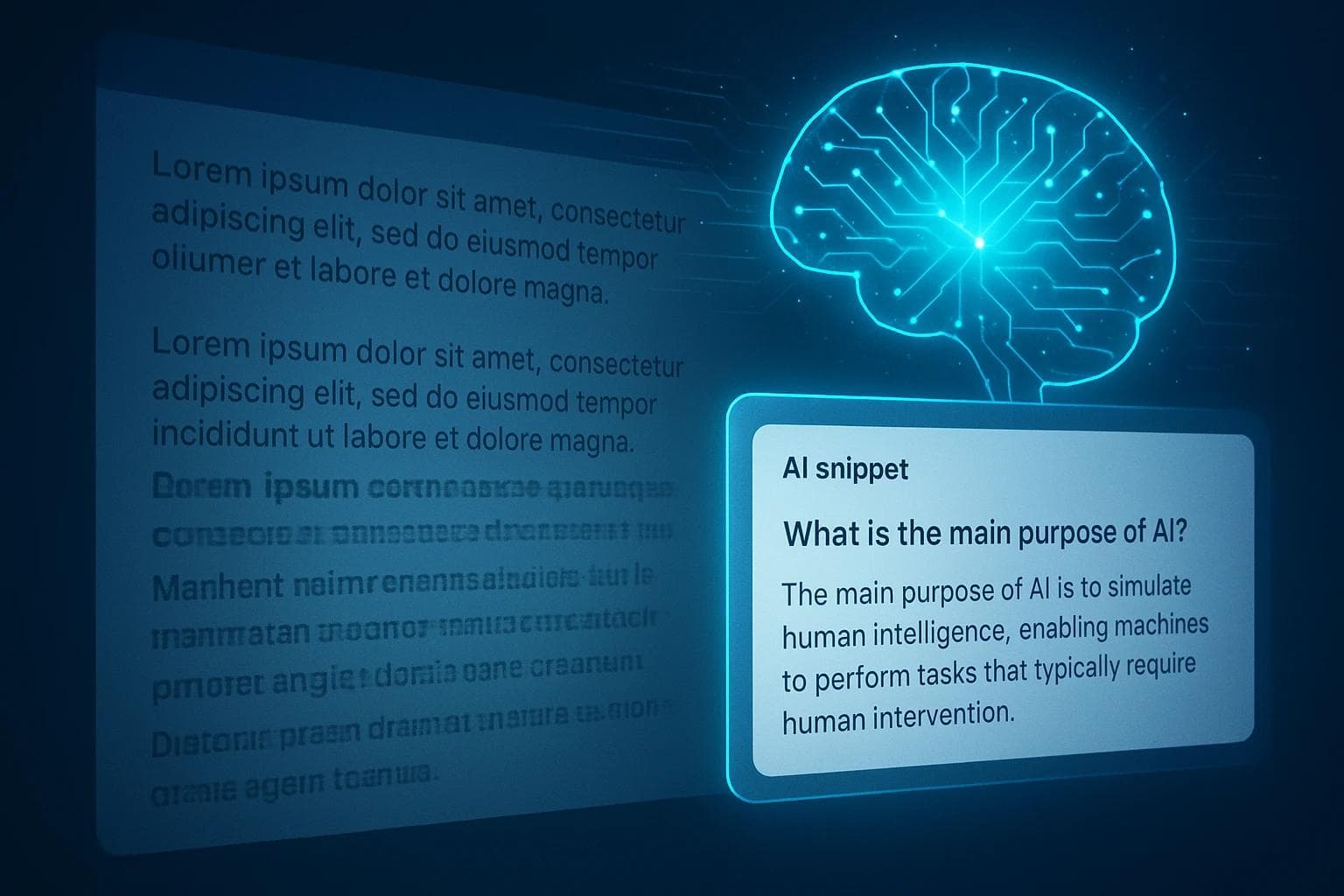
Have you ever asked Google a question and received a perfect, concise answer boxed up at the very top of the page? It feels a bit like magic. But it’s not magic—it's a sign that someone, somewhere, structured their content so brilliantly that an AI could instantly understand it, extract the key information, and serve it up to you.
This is the new reality of the internet. The audience for your content is no longer just human; it's also the army of AI systems, crawlers, and large language models (LLMs) that power everything from Google's AI Overviews to voice assistants.
If your content isn't formatted for them, you're becoming invisible. The good news? Teaching your content to "speak AI" is less about complex code and more about embracing a new kind of clarity.

The New Gatekeepers: Why Your Content Needs to Speak "AI"
For years, Search Engine Optimization (SEO) was a game of keywords and backlinks. Today, a new player has joined the field: Answer Engine Optimization (AEO). This is the practice of optimizing your content to be the direct source for answers provided by AI systems.
Think about it from the AI's perspective. An AI doesn't "read" an article over a cup of coffee, enjoying the narrative flow. It scans for patterns, looking for the most efficient path to reliable information. It’s on a mission, and its primary goal is to find and extract a clear, correct answer to a user's query.
This is the concept of AI extractability. How easily can an AI parse your page, identify the core answer to a question, and confidently present it as a factual summary? When you make your content highly extractable, you're not just helping the AI; you're directly increasing your chances of being featured in high-visibility formats like AI Overviews and voice search results.
The "Answer-First" Principle: Flipping the Writing Pyramid
In journalism, we learn about the "inverted pyramid"—placing the most critical information at the top of the article. For AI, we need to take this a step further with the "Answer-First" Principle.
This means structuring your paragraphs to deliver the direct answer to a likely user question in the very first sentence. The rest of the paragraph can then provide context, elaboration, and supporting details. This pattern mirrors how AI itself presents information, making your content a perfect source.
Let’s look at an example.
***
Before Optimization (Human-Centric):
Many businesses are looking to improve their online presence and often turn to content marketing. This strategy involves creating valuable articles, videos, and other media to attract an audience. One of the newer approaches within this field is Answer Engine Optimization, which has become increasingly important with the rise of AI-powered search results that aim to provide direct answers to user queries.
After Optimization (AI-Extractable):
Answer Engine Optimization (AEO) is the practice of optimizing web content to be the direct source for answers provided by AI systems like Google's AI Overviews. This strategy focuses on creating clear, structured, and easily extractable information that directly addresses user queries, which is crucial for visibility in modern search engines.
***
See the difference? The second version immediately defines the term. An AI scanning for "What is AEO?" can grab that first sentence and be 100% confident it has the right answer.

Mastering the Q&A Block: Your Direct Line to AI Overviews
If answer-first paragraphs are the building blocks, then dedicated Q&A sections are the superhighways to AI visibility. FAQ pages or Q&A blocks within articles are goldmines for AEO because they perfectly match the AI's "problem/solution" worldview.
However, not all Q&A blocks are created equal. To make them truly AI-friendly, they need a specific anatomy.
The Anatomy of an AI-Ready Q&A Block
- The Question (Heading): The question should be a heading (like an H2 or H3) and phrased in natural language. Use the exact words a real person would type into a search bar, not keyword-stuffed jargon.
- The Direct Answer (First Paragraph): The paragraph immediately following the question heading should deliver a concise, self-contained answer. The AI should be able to lift this text block verbatim without losing any critical context.
- The Elaboration (Supporting Details): Subsequent paragraphs, bullet points, or images can provide additional context, examples, or deeper explanations.

By structuring your Q&A blocks this way, you're essentially handing the AI a perfectly packaged answer on a silver platter.
Formatting as Signposts: Guiding AI to the Good Stuff
Beyond paragraphs and Q&A blocks, simple formatting choices act as powerful signposts that guide AI systems to your most important information.
- Headings as Questions: As we covered, turning your H2s and H3s into common user questions is one of the most effective AEO tactics. Understanding what’s the impact of heading structure on ai extractability? is the first step toward building a scannable, AI-friendly content hierarchy.
- Bold for Emphasis: Bolding key terms or phrases helps AI identify the most significant concepts within a block of text. Think of it as telling the AI, "Hey, this part is really important!"
- Bulleted and Numbered Lists: Lists are fantastic for AI extractability. They break down complex information into digestible, itemized points that are easy for an AI to parse and repurpose as a summarized list in a search result.
Putting It All Together: A Simple Content Audit
Ready to get started? Grab one of your existing blog posts and review it with this simple checklist:
- The Answer-First Test: Does the very first sentence of the article (and key paragraphs) directly answer a likely question?
- The Heading Check: Are your headings phrased as clear, natural-language questions?
- The Q&A Opportunity: Is there a section of your article that could be reformatted into a more explicit Q&A block?
- The Skim Test: Can you identify the key takeaways in under 15 seconds just by looking at headings, bolded text, and lists? If you can, an AI can too.
Frequently Asked Questions about Conversational Content
What are conversational content patterns?
This term can be confusing. It refers to two things: 1) Writing in a natural, human-friendly tone. 2) Structuring your content in predictable patterns (like Answer-First paragraphs and Q&A blocks) that conversational AI can easily understand and extract. For AEO, the second definition is the most critical.
Will writing for AI make my content sound robotic?
Not at all! In fact, the opposite is often true. Writing clearly and directly, using simple language, and answering questions upfront benefits both human readers and AI systems. The goal isn't to remove personality; it's to add structure and clarity.
Is this different from traditional SEO?
Think of AEO as the next evolution of SEO. Traditional SEO fundamentals like keywords, site authority, and user experience still matter immensely. AEO adds a new layer on top, focusing specifically on the structural and formatting choices that make your content ready for AI-powered search features.
How do I know if it's working?
The ultimate proof is seeing your content featured in Google's AI Overviews, "People Also Ask" boxes, or as a source for chatbot responses. You can also monitor your search performance for long-tail question-based queries to see if your rankings improve after implementing these patterns.
Your Next Step in Mastering AI-Ready Content
Shifting your mindset from just writing for people to writing for people and AI is the single most important step you can take to future-proof your content strategy. It’s not about gaming an algorithm; it’s about providing value with such clarity and precision that any reader—human or machine—can instantly grasp it.
Start small. Pick one article. Rework the introduction to be answer-first. Rephrase a few headings as questions. The journey to becoming a primary source for the AI-powered web begins with that first, perfectly structured paragraph.

Roald
Founder Fonzy — Obsessed with scaling organic traffic. Writing about the intersection of SEO, AI, and product growth.
Stop writing content.
Start growing traffic.
You just read about the strategy. Now let Fonzy execute it for you. Get 30 SEO-optimized articles published to your site in the next 10 minutes.
No credit card required for demo. Cancel anytime.

Content freshness and update cadence for AI answer selection
Discover how content recency and update frequency impact AI answer rankings and why freshness is crucial for visibility.

Measuring Metrics That Predict AI Visibility Before Content Updates
Discover key signals in your analytics that show how ready your content is for AI visibility before optimizing.

Topical Depth Versus Shallow Pages for Better AI Answers
Learn why deep, comprehensive content improves your chances of being featured in AI-generated answers and how to build strong content clusters.