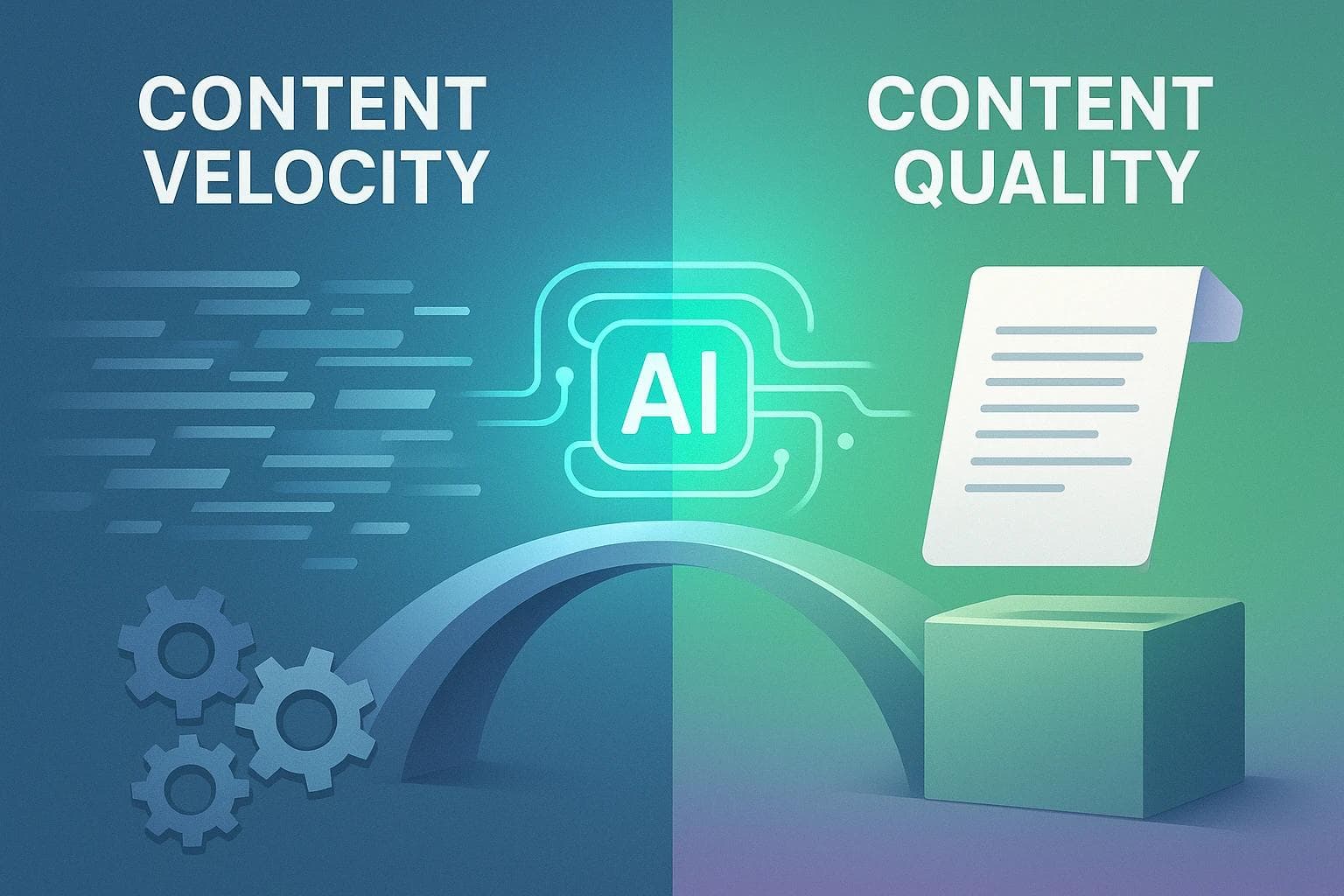
Content Velocity vs. Quality: How to Stop Choosing and Start Winning
Your content calendar feels like a battlefield. On one side, the relentless pressure to publish more. More blog posts, more updates, more social media noise. On the other, the purist's demand for perfection: every article a masterpiece, every sentence a work of art.
For agencies and businesses, this isn't just a debate—it's a daily operational crisis. Do you feed the content beast to stay relevant, risking shallow, forgettable posts? Or do you spend weeks crafting a magnum opus that gets published to an audience of crickets because you’ve been silent for too long?
This feels like an impossible trade-off. But what if it isn't? What if the "velocity vs. quality" debate is based on a false premise? The truth is, modern search engines and AI-driven answer engines don't reward one or the other. They reward consistency and excellence. The secret isn't choosing a side; it's building a system where velocity fuels quality, and quality makes your velocity worthwhile. This is the mental bridge that transforms struggling content teams into strategic powerhouses.

Demystifying the Debate: What Are We Really Talking About?
Before we can solve the puzzle, we need to understand the pieces. The terms "velocity" and "quality" are thrown around a lot, but their definitions are often blurry. Let's clear things up.
What is Content Velocity?
At its core, content velocity is the rate at which you publish content. It’s the rhythm of your content engine. You can measure it in articles per week, videos per month, or social posts per day.
High velocity isn't about spamming your audience. It's about maintaining a consistent presence that signals to search engines like Google that you are a fresh, active, and authoritative source of information in your niche. Think of TechCrunch. They publish dozens of articles a day, building immense topical authority in the tech world. That steady drumbeat keeps readers coming back and tells Google they are the go-to source for the latest news.
Why Velocity Matters:
- Topical Authority: Frequent publishing on related topics establishes your brand as an expert.
- Search Engine Signals: Consistency and freshness are key ranking factors.
- Audience Engagement: A predictable publishing schedule keeps your audience engaged and coming back for more.
What is Content Quality?
Content quality is the measure of how well your content meets the needs of your audience and the standards of search engines. It’s not just about good grammar; it's about value. A high-quality piece is accurate, comprehensive, insightful, and provides a great user experience.
Google quantifies this with its E-E-A-T guidelines: Experience, Expertise, Authoritativeness, and Trustworthiness. A beautifully written article that's factually incorrect is low-quality. A short, 500-word post that perfectly answers a user's specific question can be incredibly high-quality. As the experts at Jasmine Directory note, quality is defined by its ability to "resonate with the target audience, provide genuine value, and achieve business objectives."
Why Quality Matters:
- Builds Trust: High-quality content establishes credibility and turns casual readers into loyal fans.
- Drives Real Results: In-depth, valuable content earns backlinks, shares, and ultimately, conversions.
- E-E-A-T and Rankings: Google explicitly prioritizes content that demonstrates expertise and trustworthiness.
Where Does Your Agency Stand? The Velocity-Quality Matrix
Most agencies fall into a specific quadrant in their content production without even realizing it. Identifying where you are is the first step toward moving to where you want to be.

The Four Quadrants of Content Production
- The Content Ghost Town (Low Velocity, Low Quality): You're not publishing much, and what you are publishing isn't hitting the mark. This is often the starting point, but it's a dangerous place to stay.
- The Perfectionist's Paralysis (Low Velocity, High Quality): You create brilliant, in-depth content, but it takes so long that you only publish once a quarter. Your work is amazing, but your impact is minimal because the cadence is too slow to build momentum.
- The High-Velocity Trap (High Velocity, Low Quality): You're churning out content daily, but it's thin, generic, and keyword-stuffed. This strategy might have worked in 2010, but today it actively damages your brand's reputation and E-E-A-T signals.
- The Sustainable Sweet Spot (High Velocity, High Quality): The holy grail. You're publishing a consistent stream of valuable, well-researched, and engaging content. This is where topical authority is built, audiences are grown, and businesses thrive.
The obvious question is: how do you get to the Sustainable Sweet Spot without an army of writers and a bottomless budget?
Beyond the Trade-Off: Building a Bridge with Automated Workflows
The old way of thinking forces you to sacrifice one for the other. The new way uses technology to achieve both. The bridge from the overworked quadrants to the "Sustainable Sweet Spot" is built with intelligent automation and AI-driven workflows.
This isn't about replacing human creativity; it's about augmenting it. It’s about automating the repetitive, time-consuming tasks so your human experts can focus on what they do best: strategy, deep insights, and connecting with your audience.
How AI and Automation Supercharge Your Workflow
Instead of a linear, manual process, an automated workflow integrates AI at key stages to boost speed without letting quality slip.

Here’s how it works:
- Research & Planning: AI analyzes your website, competitors, and market to generate a data-driven content plan with high-impact topics and keywords, saving dozens of hours of manual research.
- Drafting: AI can generate a structured, well-researched first draft in minutes. This isn't the final product, but it's a powerful starting point that eliminates the "blank page" problem.
- Optimization: The system automatically optimizes the draft for SEO, checking for keyword density, readability, internal linking opportunities, and schema markup.
- Human Expertise: This is where your team shines. They take the optimized draft and add their unique insights, stories, brand voice, and fact-checking. They transform a good draft into a great article.
- Publishing: The content is automatically scheduled and published to your CMS, ensuring a consistent cadence without manual intervention.
This system allows you to scale velocity dramatically while ensuring every single piece passes through a human quality-control checkpoint.
Preparing for What's Next: GEO and the Rise of Answer Engines
The need for a balanced approach is only going to intensify. The future of search isn't just about ranking on a results page; it's about becoming the source for AI-powered answer engines like Google's AI Overviews and Perplexity.
These systems thrive on a large corpus of high-quality, trustworthy, and interconnected content. A high-velocity, high-quality strategy is precisely what's needed to feed these new platforms. Understanding the evolving landscape of "geo and seo" (Generative Engine Optimization and Search Engine Optimization) is no longer optional—it's essential for future visibility. Your content needs to be there, be accurate, and be consistent to be chosen as a definitive answer.
Your Questions Answered: Content Velocity vs. Quality FAQ
What is content velocity?
Content velocity is the speed and frequency at which you publish new content. It's typically measured in the number of pieces (e.g., articles, videos) published over a specific period, like a week or a month.
What is content quality?
Content quality refers to how well a piece of content satisfies a user's needs and meets search engine standards for expertise, authoritativeness, and trustworthiness (E-E-A-T). It includes factors like accuracy, depth, clarity, originality, and user experience.
Should I prioritize content velocity or quality?
This is a false choice. In the beginning, you might lean slightly more towards quality to establish a strong foundation. However, the long-term goal for sustainable growth is to build a system that allows for both high velocity and high quality. Consistency (velocity) builds authority, while excellence (quality) builds trust. You need both.
How can I measure content velocity?
The simplest metric is output over time (e.g., "we published 15 articles this month"). More advanced metrics can include "time to publish" from idea to live post, helping you identify bottlenecks in your workflow.
How can I measure content quality?
Look beyond simple page views. True quality metrics include user engagement (time on page, bounce rate), conversion rates, number of ranking keywords per post, backlinks earned, and social shares. These indicate that your content isn't just being seen, but that it's actually resonating with and providing value to your audience.
From Dilemma to Dominance: Your Path Forward
Stop seeing content creation as a trade-off. The "velocity vs. quality" debate is a relic of a time before the powerful tools we have today. By embracing an AI-augmented approach, you can escape the trap of choosing one over the other.
Start by auditing your current workflow. Where are you losing time? Are your experts bogged down in tedious research or formatting? Could an AI-assisted first draft free them up to focus on high-impact strategic input?
Building a scalable content engine isn't about working harder; it's about working smarter. Platforms like Fonzy AI are designed to solve this exact challenge, automating the heavy lifting so you can focus on creating content that builds your brand, engages your audience, and drives measurable growth.
Ready to explore more strategies for scaling your content? Check out our other resources on our blog.

Roald
Founder Fonzy — Obsessed with scaling organic traffic. Writing about the intersection of SEO, AI, and product growth.
Stop writing content.
Start growing traffic.
You just read about the strategy. Now let Fonzy execute it for you. Get 30 SEO-optimized articles published to your site in the next 10 minutes.
No credit card required for demo. Cancel anytime.
How Content Frequency Affects SEO Rankings and What to Prioritize
Explore how balancing content speed and quality impacts SEO and learn when to focus on velocity or perfection.
5 Signs Your Content Strategy is Losing Customers
Discover key signs your content strategy is stuck and quietly losing customers before it impacts your growth.
How to Measure SEO ROI with Business Metrics
Learn simple ways to measure SEO ROI focusing on leads, conversions, cost, and customer value beyond keywords and rankings.