Content Inventory Basics for Mapping Pages to User Questions

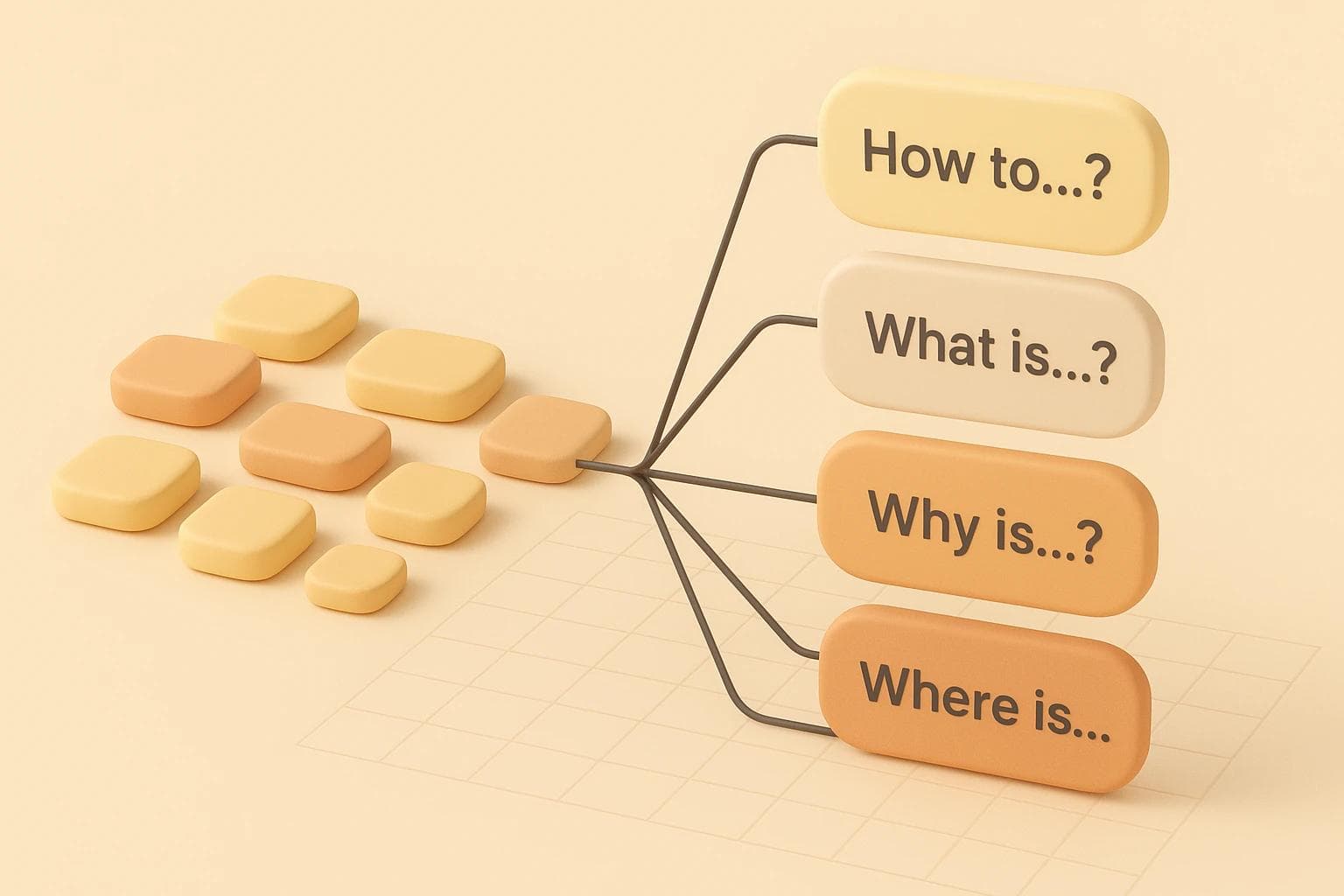
Content Inventory 101: Map Your Pages to the Questions Real Users Ask
Ever asked a chatbot on a website a simple question, only to get the dreaded, "I'm sorry, I can't answer that"? Or maybe you've noticed your competitors showing up in the "People Also Ask" section of Google, while your site is nowhere to be found.
The problem often isn't your product or your people. It's a disconnect between the content on your website and the real, conversational questions your customers are asking every single day.
You have answers, but they're buried. They're locked in blog posts written for old-school keywords, hidden on pages with unclear titles, or simply missing altogether. In the age of AI, where search engines and virtual assistants are becoming answer engines, this isn't just a missed opportunity—it's a critical flaw in your digital strategy.
The solution starts with a simple, powerful process: a content inventory. But not the dusty, forgotten spreadsheet of yesteryear. We're talking about a new kind of inventory, one designed to map what you have directly to the questions your audience asks, preparing your content to be the definitive source for both humans and AI.

Back to Basics: What Are We Even Talking About?
Before diving into the "how," let's get on the same page. Industry jargon can make this feel more complicated than it is. Think of it like organizing your kitchen.
What is a Content Inventory? (The "What You Have")
A content inventory is simply a list of every piece of content you own. It's the step where you open up all your digital cupboards and see exactly what's inside. This is a quantitative list: every blog post, every landing page, every PDF download, every video. No judgment, just a comprehensive list.
For most people, this lives in a spreadsheet and includes basic information like:
- URL
- Title
- Content Type (e.g., Blog, Landing Page)
- Publication Date
What is Content Mapping? (The "Who Needs It and When")
Content mapping is the strategy layer. If the inventory is your list of ingredients, mapping is the recipe book. You're connecting each piece of content to a specific audience, a specific question they have, and a specific point in their journey with you.
You're asking:
- Who is this for? (e.g., a new small business owner)
- What question does this answer? (e.g., "How do I set up a business website?")
- When do they need this answer? (e.g., Early in their journey, when they're just exploring options)
The Key Difference: Inventory vs. Audit
This is where people often get tripped up. The Nielsen Norman Group, a leader in user experience research, draws a clear line:
- Inventory = Quantitative. It’s a list of what exists.
- Audit = Qualitative. It’s an evaluation of how well that content is performing and if it's still relevant, accurate, and effective.
You can't do a good audit without an inventory first. You have to know what's in the kitchen before you can decide which ingredients are fresh and which have expired.

The New Frontier: Auditing Through an AI Lens
A traditional content audit might look at things like traffic, bounce rate, and keyword rankings. That's all still important. But to win in the new era of search, you need to add a new layer: auditing for AI-readiness.
From Keywords to Questions: The Conversational Shift
For two decades, marketing was driven by keywords. We tried to figure out the 2-3 words people would type into a search box. Today, that's changing. People talk to their phones, smart speakers, and chatbots using full, natural sentences.
- Old search: "content inventory tools"
- New query: "What are the best tools to help me start a content inventory for my small business?"
AI models are designed to understand and answer these conversational queries. If your content is only optimized for the old keyword, you're invisible.
How to Find the Real Questions Your Customers Are Asking
So, where do you find these questions? It's easier than you think. You don't need expensive tools to start. Listen.
- Talk to your sales team: What questions do they hear on calls every single day?
- Check with customer support: What are the most common issues in their support tickets and chat logs?
- Look at Google: Type in a topic related to your business. What questions appear in the "People Also Ask" box? That's a goldmine.
- Mine your site search: What are people typing into the search bar on your own website?
Collect these questions. They are the foundation of your new, AI-focused content map.
Identifying "AI Answer Gaps"
This is the "aha moment." An "AI answer gap" isn't just a topic you haven't written about. It's a specific question you haven't answered clearly and directly.
You might have a 2,000-word blog post about "The Ultimate Guide to Digital Marketing," but if an AI can't quickly find a direct answer to "Is email marketing or social media better for a local coffee shop?" within that article, an AI answer gap exists. The information might be there, but it's not structured for an answer engine.

A Simple Framework for Your First AI-Focused Content Inventory
Feeling overwhelmed? Don't be. You can start this process with a simple spreadsheet and a few hours of focused work.
Step 1: Build Your Inventory Spreadsheet
Create a spreadsheet with these columns: URL, Title, and the new, crucial column: Target Customer Question.
Go through your website and list out your core pages and blog posts. Don't worry about getting every single one on the first pass. Start with your 20-30 most important pieces of content.
Step 2: Map Each Page to a Core Question
Now for the audit part. For each URL, try to fill in the "Target Customer Question" column. Be honest. Does this page truly answer one of the real questions you collected earlier? Is the answer clear, direct, and easy to find?
If you can't easily assign a single, clear question to a piece of content, that's a red flag. It might be trying to do too much, or its purpose may be unclear.
Step 3: Rate Your "AI Answer Potential"
Add one more column: Answer Potential (High, Medium, Low). This is your qualitative rating.
- High: The page has a clear title that matches a question, uses headings to structure the answer, and provides a direct, concise response. An AI could "lift" the answer from this page with confidence.
- Medium: The answer is on the page, but it's buried in a long paragraph or mixed in with other topics. An AI might struggle to isolate it.
- Low: The page is vague, outdated, or doesn't directly address a real customer question.
When evaluating this, think about signals of quality and trust. Search engines prioritize content that demonstrates expertise and authoritativeness. Auditing your content against Google's guidelines for E-E-A-T (Experience, Expertise, Authoritativeness, and Trustworthiness) is a fantastic way to gauge its potential to be served up as a definitive answer. High-quality, trustworthy content is exactly what AI models are looking for.
What This Means for Your Business
Once you complete this exercise, even with just 20 pages, you will see your website in a new light. The gaps will become glaringly obvious. You'll see which questions have no answer at all, and which pages need to be rewritten to be more direct and AI-friendly.
This inventory is more than a list. It's a strategic roadmap. It shows you exactly where you need to invest your time and resources—revising old content and creating new pieces to fill the gaps. By doing this, you're not just improving your SEO. You are building a comprehensive, structured knowledge base that can power chatbots, fuel AI answers, and establish your brand as the go-to resource in your space.
Frequently Asked Questions (FAQ)
How do I start a content inventory?
The simplest way is with a spreadsheet (like Google Sheets or Excel). Use a tool like Screaming Frog to crawl your site for a list of all your URLs, then manually add columns for content type, target question, and your quality rating.
How is a content audit different from an inventory?
An inventory is a list of what you have (quantitative). An audit is a judgment on the quality and performance of what you have (qualitative). You need the inventory list before you can perform the audit.
How do I map content to the customer journey?
First, define the simple stages of your customer's journey (e.g., Awareness, Consideration, Decision). Then, for each piece of content in your inventory, ask: "What stage is a person in when they need this information?" This helps you identify if you have too much content for one stage and not enough for another.
What tools can I use?
For beginners, a spreadsheet is all you need. As you scale, SEO platforms like Semrush or Ahrefs can help with content gap analysis against competitors, and content management systems sometimes offer basic inventory features.
Your Next Step: From Mapping to Making
Your existing content is a treasure trove of knowledge. An AI-focused inventory is the map that shows you where the gold is buried and, more importantly, where you need to start digging next.
Don't wait for your competitors to become the default answer for your customers' questions. Start your inventory, identify your gaps, and begin the crucial work of transforming your website from a simple brochure into a powerful engine for answers.
Roald
Founder Fonzy — Obsessed with scaling organic traffic. Writing about the intersection of SEO, AI, and product growth.
Stop writing content.
Start growing traffic.
You just read about the strategy. Now let Fonzy execute it for you. Get 30 SEO-optimized articles published to your site in the next 10 minutes.
No credit card required for demo. Cancel anytime.

How Schema Markup Helps AI Understand Your Content
Learn how schema markup boosts AI visibility and trust without needing developer skills to optimize your content.
Technical Foundations of Crawlability Schema and AI Page Signals
Learn how crawlability schema and page signals impact AI understanding and trust of your website content.

Why AI Needs Linked Sources and Primary Data for Citations
Learn why original data and clear attribution are vital for AI to trust and cite your information correctly.