Choosing the Right Content Formats for Conversational Queries

The Right Tool for the Job: How to Choose Content Formats for AI & Conversational Search
Ever asked your phone for the weather, queried a chatbot about a return policy, or used a smart speaker to settle a dinner table debate? You’re using conversational search. It’s natural, it’s intuitive, and it’s completely changing how we find information.
For businesses and creators, this shift is a seismic event. The old rules of stuffing keywords into a blog post are fading. Today, winning in search means providing the clearest, most direct answer to a question, in a format that both humans and AI can instantly understand. But how do you do that?
The secret isn't just what you say, but how you package it. Choosing the right content format—be it a deep-dive guide, a quick-reference glossary, or a laser-focused explainer—is the difference between becoming a go-to resource and getting lost in the noise.

Understanding the Conversational Query Spectrum
Think of the questions people ask as a spectrum. On one end, you have broad, exploratory questions. On the other, you have specific, targeted ones.
- "What is…?" queries: These are definition-seeking. The user needs to understand a term, concept, or acronym. (e.g., "What is generative engine optimization?")
- "How to…?" queries: These are process-oriented. The user needs a series of steps to accomplish a goal. (e.g., "How to set up a content calendar?")
- "Why is…?" queries: These are explanation-seeking. The user wants to understand the reason or cause behind something. (e.g., "Why is my website traffic dropping?")
- "Best…for…" queries: These are comparison-focused. The user is evaluating options and needs help making a decision. (e.g., "What are the best content formats for AI search?")
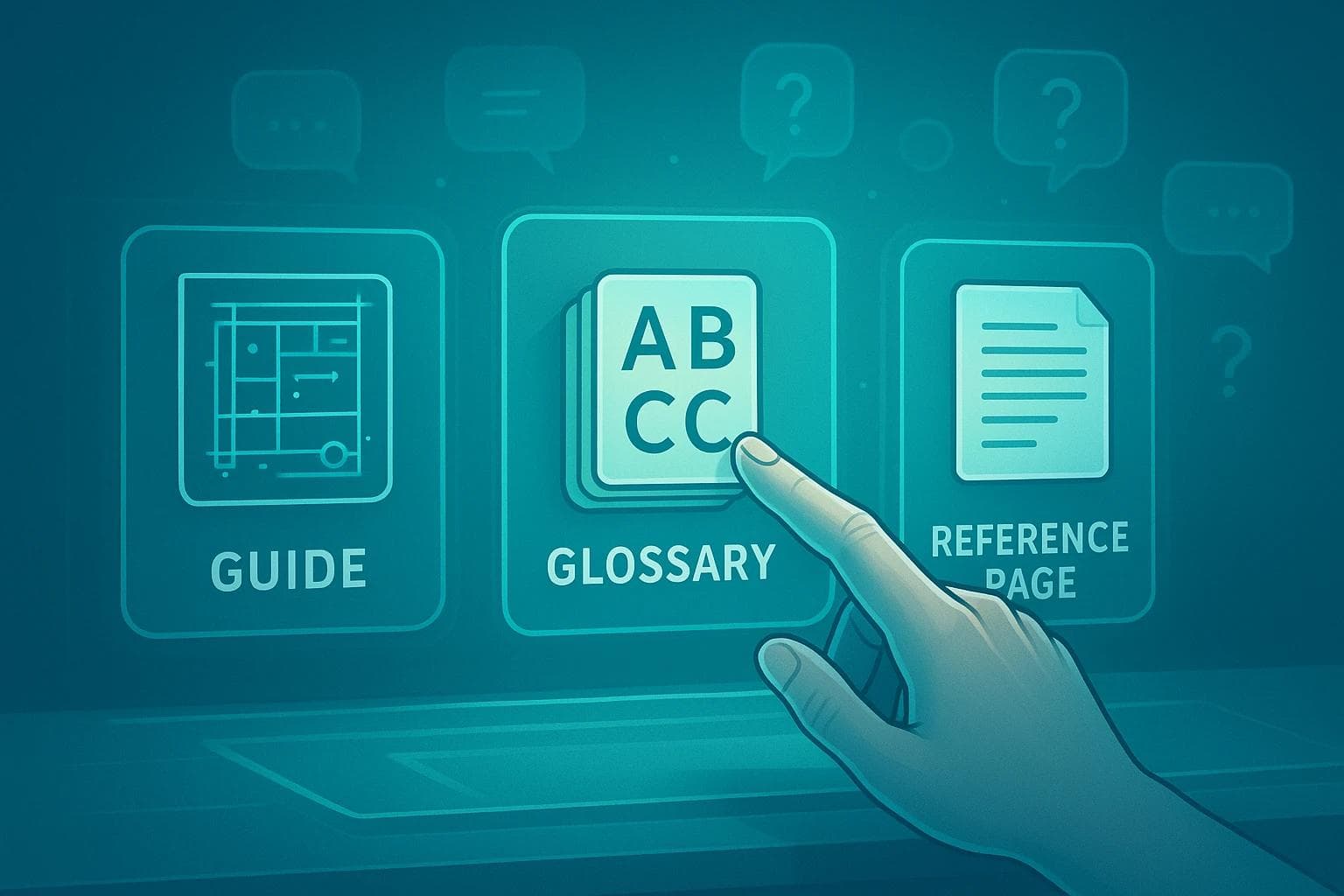
Your job is to match the right content "container" to the user's question. Let's break down the primary formats and when to use them.

Deep Dive #1: The Comprehensive Guide
Comprehensive guides are your educational workhorses. They are the perfect format for answering complex "how-to" or "why is" questions that require multiple steps, detailed explanations, and a logical progression of ideas.
When to Use a Comprehensive Guide:
- Explaining a multi-step process (e.g., "A Practical Guide for AI-First Content Marketing").
- Exploring a complex topic from multiple angles.
- Establishing your authority on a core subject in your industry.
Structure for AI & Humans: The key is to think like a teacher. Use a question-first approach for your headings. Instead of a generic heading like "Guide Structure," use "How Should I Structure My Guide for Readability?" This mirrors the user's query. Breaking down a guide this way is crucial, as the impact of heading structure on AI extractability is significant—AI engines look for these clear, question-based signposts to pull answers for their summaries.
Deep Dive #2: The Evolving Glossary
A glossary is more than just an A-Z list of terms. In the age of AI, it’s a foundational knowledge hub that answers all the "what is" questions related to your niche. AI and search engines love glossaries because they provide clear, concise definitions for key entities and concepts.
When to Use a Glossary:
- Your industry is filled with jargon or technical terms.
- You want to own the definitions for core concepts in your space.
- You need a central place to link from when you mention a complex term in other articles.
Structure for AI & Humans: Keep each definition short and to the point, ideally between 40-60 words. This makes it incredibly easy for AI to grab as a featured snippet or use in an AI Overview. But don't stop there. Make it an "evolving glossary" by linking each term to a more comprehensive guide or reference page where the user can learn more. This transforms a simple list into a powerful, interconnected web of knowledge.
Deep Dive #3: The Precision Reference Page
This is one of the most underutilized but powerful formats for conversational search. A reference page is designed to answer a single, specific question with extreme precision. It's not a long blog post; it's a direct answer. Think of it as a single, highly detailed index card.
When to Use a Reference Page (or Single-Concept Explainer):
- Answering a very specific troubleshooting question (e.g., "How to fix error code 502?").
- Providing a specific data point or statistic.
- Explaining one isolated feature of a product or service.
Structure for AI & Humans: Get straight to the point. The title should be the question. The first paragraph should be the direct answer. Use bullet points, numbered lists, or simple tables to present the information in the most digestible way possible. This format is optimized for "zero-click" searches, where the user gets their answer directly on the search results page—and you become the trusted source that provided it.
Tying It All Together: Building Your Content Ecosystem
These formats don’t live on separate islands. The magic happens when they work together, creating a seamless learning journey for your audience and a rich knowledge graph for search engines.
A user might land on a glossary term for "Answer Engine Optimization." From there, they click a link to your comprehensive guide on the topic. Within that guide, you might link out to a reference page that lists the top 5 AEO ranking signals.
This intentional interlinking does two things:
- It guides the user: You anticipate their next question and provide a clear path for them to continue learning.
- It signals authority to AI: You demonstrate a deep, well-organized understanding of a topic, making your entire site a more credible source.

Frequently Asked Questions (FAQ)
What are conversational queries?
A conversational query is a question asked in natural, everyday language, just like you'd ask a friend. Instead of typing "best SEO tool," a user might ask, "What is the best tool for improving my website's SEO?" This shift requires content that directly answers these full-sentence questions.
How do I write in a conversational tone?
Write like you speak. Use simple language, ask questions, and use personal pronouns like "you" and "we." The goal is to sound like a knowledgeable friend explaining something over coffee, not a textbook. Read your writing out loud—if it sounds robotic, simplify it.
Why are FAQs so important for AI search?
FAQs are naturally conversational. They are structured as question-answer pairs, which is the exact format AI language models are trained on. Including a well-structured FAQ section in your articles, or creating dedicated Q&A pages, makes it incredibly easy for AI to find and extract direct answers.
How does E-E-A-T (Experience, Expertise, Authoritativeness, Trustworthiness) fit into this?
E-E-A-T is more important than ever. In a conversational format, you build trust by providing clear, accurate, and helpful answers. You demonstrate expertise by creating comprehensive guides, show experience through case studies or real-world examples, and build authority by creating an interconnected ecosystem of content that proves you are a reliable source.
Your Next Step: Start Listening
The best way to win at conversational search is to listen to the questions your audience is actually asking. Look at your customer support emails, browse forums like Reddit or Quora, and use search listening tools.
Every question is an opportunity. Your task is to choose the right format—the right tool for the job—to provide the very best answer. By matching the query to the format, you stop just creating content and start building a true educational resource that will serve your audience and grow your visibility for years to come.
Roald
Founder Fonzy — Obsessed with scaling organic traffic. Writing about the intersection of SEO, AI, and product growth.
Stop writing content.
Start growing traffic.
You just read about the strategy. Now let Fonzy execute it for you. Get 30 SEO-optimized articles published to your site in the next 10 minutes.
No credit card required for demo. Cancel anytime.

How Schema Markup Helps AI Understand Your Content
Learn how schema markup boosts AI visibility and trust without needing developer skills to optimize your content.
Technical Foundations of Crawlability Schema and AI Page Signals
Learn how crawlability schema and page signals impact AI understanding and trust of your website content.

Why AI Needs Linked Sources and Primary Data for Citations
Learn why original data and clear attribution are vital for AI to trust and cite your information correctly.