Author Identity and Content Provenance Guide to Digital Trust

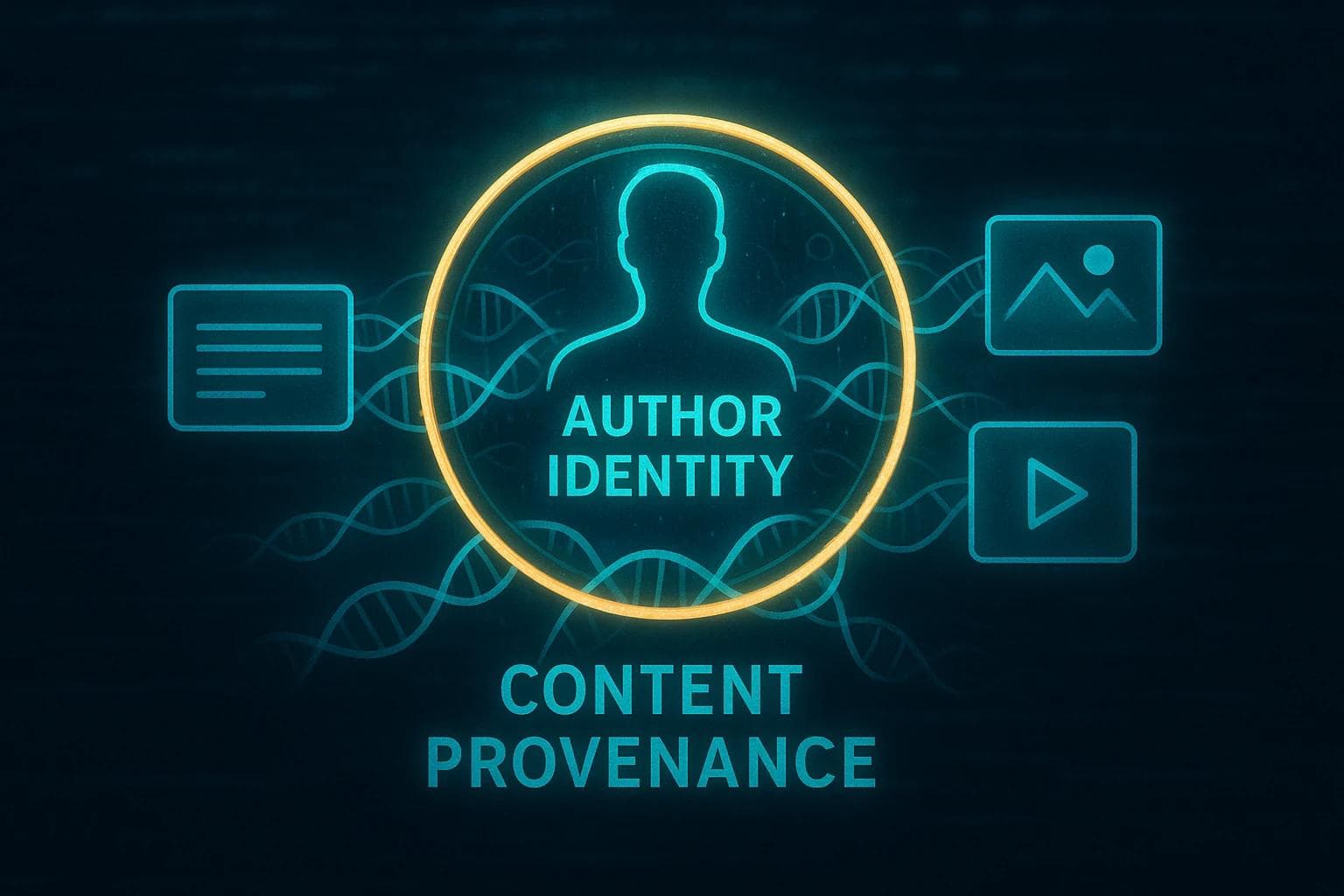
Author Identity and Content Provenance: Your Guide to Building Trust in the AI Era
Ever had that sinking feeling? You pour hours into crafting a insightful article, only to see it appear on another site without credit. Or maybe you're staring at a search results page flooded with generic, AI-generated articles, wondering how your genuine expertise can possibly stand out.
If this sounds familiar, you're not alone. We're in the middle of a digital trust crisis. As AI makes it easier than ever to produce content, it's become harder for readers—and search engines—to tell the difference between authentic expertise and a well-prompted algorithm. The old signals we used to rely on are no longer enough.
But what if you could embed a verifiable "seal of authenticity" directly into your content? What if you could prove, without a shadow of a doubt, who created your work, when they created it, and that it hasn't been tampered with since?
This isn't science fiction. It's the future of credible content, built on two powerful concepts: Author Identity and Content Provenance. Getting this right is how you'll win trust and get found in the new age of AI search.

The Building Blocks of Digital Trust: What Are We Really Talking About?
Let's break down these ideas into simple terms. Think of them as the layers of your website's reputation.
Author Identity: More Than Just a Name on a Page
A simple byline like "By Jane Doe" is a start, but it's not enough. True author identity is about creating a verifiable, consistent digital footprint for your experts. It’s the difference between a name and a reputation.
This means connecting the author's name on your site to their real-world credentials—their LinkedIn profile, their other publications, their official company bio. For search engines like Google, this is a cornerstone of E-E-A-T (Experience, Expertise, Authoritativeness, and Trustworthiness). They want to see that your content is written by real people with demonstrable experience.
Content Provenance: The Verifiable "DNA" of Your Content
If author identity is who created the content, provenance is its verifiable life story. Think of it like the tracking information for a package. It answers critical questions:
- Origin: Where did this piece of content (an image, a video, an article) come from?
- History: What tools were used to create or edit it?
- Integrity: Has it been altered since it was published?
This history isn't just written in plain text; it's cryptographically sealed and attached to the content itself, making it tamper-evident.
Trust Signals: The Clues Your Audience (and Google) Looks For
Trust signals are all the little cues that tell visitors your website is legitimate and credible. Some are simple, like having a clear "About Us" page or customer testimonials. But author identity and content provenance are advanced, powerful trust signals that work behind the scenes. They provide hard, verifiable proof that your content is authentic.
A Quick Intro to C2PA and Content Credentials
So how is this "content DNA" actually created? The leading technology here is called C2PA (Coalition for Content Provenance and Authenticity).
Don't let the acronym scare you. In simple terms, C2PA is an open standard—like JPEG for images or PDF for documents—that allows creators to attach a secure history to their content. This attached information is called a Content Credential.
Imagine a "nutrition label" for your content. This label is securely attached and shows all the "ingredients"—who made it, with what tools, and when. Crucially, as the C2PA's own FAQ clarifies, this is not a form of copy protection (DRM). It’s a voluntary, transparent way to declare authenticity.
Why "Good Enough" Isn't Good Enough: The Challenge of Scaling Trust
Right now, you might have author bios at the bottom of your blog posts. That’s a great first step! But a major challenge arises as your content library grows: scalability.
Ask yourself:
- If an author on your team earns a new certification, how many articles do you have to manually update?
- If you have 500 blog posts, how can you consistently manage the author data for all of them?
- How do you prove the images and videos within your articles are also authentic, not just the text?
A static bio on each page is a trust signal, but it’s not a scalable system. It doesn’t create a centralized, authoritative hub for your experts, and it doesn't do anything to verify the authenticity of the content itself. This is the gap where scalable author identity and content provenance become essential.

A Practical Framework for Scaling Your Credibility
Moving from basic bylines to a robust, scalable trust strategy doesn't have to be overwhelming. Here’s a step-by-step approach.
Step 1: Standardize Your Author Identity Foundation
Consistency is key. The goal is to make it incredibly easy for both users and search engines to understand who your experts are.
- Create Standardized Bios: Develop a template for all author bios that includes their title, a brief summary of their expertise, and links to their professional social profiles (like LinkedIn) or academic profiles (like ORCID).
- Build a Central Contributor Hub: Create a single "Our Experts" or "Contributors" page. This page should list all your authors with their photos, short bios, and links to every article they've published on your site. This centralizes their authority.
- Use Structured Data (Schema): This is a bit of code that gives search engines explicit context about your content. By implementing
Personschema, you can tell Google, "This article was written by this specific person, and here is the proof," linking to their bio page and other profiles. For businesses and coaches looking to dominate their niche, learning how to leverage this is crucial for an AI-driven SEO and content strategy.
Step 2: Begin Implementing Content Provenance
As tools for C2PA become more common in platforms like Adobe and Microsoft, you can start small.
- Focus on Key Assets: Start by attaching Content Credentials to your most important visual assets—original photography, infographics, or key report documents. This demonstrates a commitment to authenticity where it matters most.
- Check Your Tools: See if the software you already use for content creation has options to include provenance metadata. Many professional tools are beginning to integrate these features.
Step 3: Embrace Transparency in the AI Era
Using AI in your content creation process isn't inherently bad, but hiding it is. Authenticity is about honesty.
- Disclose AI Assistance: If you use AI for brainstorming, outlining, or drafting, be transparent about it. A simple disclosure like, "This article was outlined with AI assistance and written and verified by our human editorial team," builds trust.
- Use Provenance to Show Human Oversight: Content Credentials can specify the role of AI and humans. This allows you to show that while a machine may have assisted, a qualified human expert was the final authority, editor, and fact-checker. This is a powerful way to leverage AI's efficiency without sacrificing credibility.

The Future is Verifiable: From Basic Trust Signals to Provenance
The internet is evolving. Simply claiming you're an expert is no longer enough. The future belongs to those who can prove it.
By moving from basic trust signals like testimonials to a robust system of scalable author identity and verifiable content provenance, you're not just playing an SEO game. You are future-proofing your brand. You're building a foundation of unshakeable trust with your audience and sending a clear message to search engines that your content is authentic, authoritative, and deserves to be seen.
Your Questions Answered: A Quick FAQ on Author Identity and Provenance
What is the difference between an author bio and author identity?An author bio is a simple block of text. Author identity is a scalable, interconnected system. It uses a centralized hub and structured data (schema) to create a verifiable and authoritative profile for your expert that search engines can easily understand.
Is C2PA the only standard for content provenance?C2PA is the leading, cross-industry standard backed by major tech companies like Adobe, Microsoft, and Google. While other metadata standards exist (like EXIF for photos), C2PA is designed specifically to provide a secure, unified solution for verifiable provenance across all content types.
Do I need to be a developer to implement this?Not entirely. You can implement Step 1 (standardizing author identity and building a contributor hub) with most modern Content Management Systems (CMS) without any code. Implementing schema and C2PA may require some technical help, but plugins and automated tools are making this easier every day.
How does this relate to Google's E-E-A-T?It's directly related. Scalable author identity provides the proof for Expertise, Authoritativeness, and Trustworthiness. Content provenance adds another layer of Trust by verifying the content's integrity. It's the technical backbone that makes your E-E-A-T claims verifiable.
Can I start doing this on a small budget?Absolutely. Start with what you can control. Standardizing your author bios and creating a contributor page costs nothing but time and is a huge step forward. These foundational practices set you up for success as more advanced tools become widely available.
Ready to Build Unshakeable Trust?
The digital landscape may feel chaotic, but the path to building credibility is clearer than ever. It starts with an intentional shift from simply publishing content to proving its authenticity at every step.
Begin by auditing your own website. Do you have consistent author bios? Is it clear who the experts behind your content are? Answering these simple questions is the first step on the journey to building a brand that both people and search engines trust implicitly. As you grow, you'll find that having a system to automate content creation and SEO with these principles in mind becomes a powerful competitive advantage.
Roald
Founder Fonzy — Obsessed with scaling organic traffic. Writing about the intersection of SEO, AI, and product growth.
Stop writing content.
Start growing traffic.
You just read about the strategy. Now let Fonzy execute it for you. Get 30 SEO-optimized articles published to your site in the next 10 minutes.
No credit card required for demo. Cancel anytime.

How Schema Markup Helps AI Understand Your Content
Learn how schema markup boosts AI visibility and trust without needing developer skills to optimize your content.
Technical Foundations of Crawlability Schema and AI Page Signals
Learn how crawlability schema and page signals impact AI understanding and trust of your website content.

Why AI Needs Linked Sources and Primary Data for Citations
Learn why original data and clear attribution are vital for AI to trust and cite your information correctly.