How to Write Opening Paragraphs AI Can Reuse

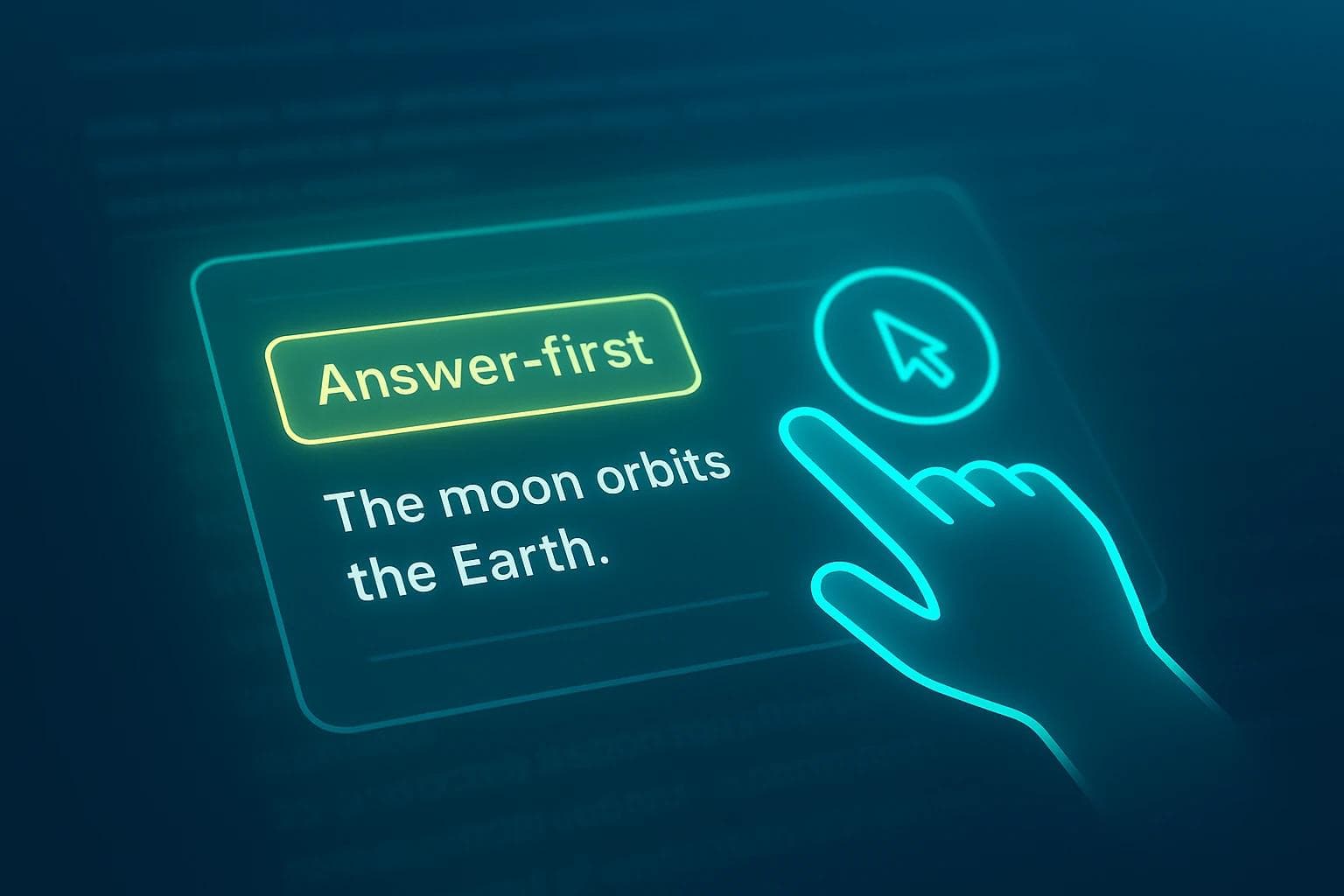
The AI Citation Formula: How to Write Opening Paragraphs AI Will Actually Reuse
You’ve spent hours researching, writing, and polishing the perfect article. You hit publish, feeling confident you’ve created the definitive resource on your topic. A week later, you ask an AI assistant like Perplexity or Google's AI Overviews a question your article answers perfectly.
The AI generates a response… and cites your competitor.
It’s a frustratingly common scenario. But it’s not random. AI models aren't just looking for good content; they’re looking for usable content. And their definition of "usable" is changing the rules of online writing. The secret to getting cited instead of ignored often comes down to the first 30 words you write.
Welcome to the world of Generative Engine Optimization (GEO), where crafting clear, direct, "answer-first" opening paragraphs isn't just a stylistic choice—it's the foundation of your entire AI visibility strategy.
What Are Answer-First Paragraphs, Really?
An answer-first paragraph is an opening that directly answers the user's core question in the first one or two sentences. It doesn't waste time with long, winding introductions, personal anecdotes, or rhetorical questions. It delivers the payload immediately and uses the rest of the paragraph to add essential context or supporting evidence.
Think of it like the classic "inverted pyramid" from journalism, but supercharged for algorithms.
Instead of this:
"In the ever-evolving world of digital marketing, many business owners find themselves wondering about the best ways to connect with their audience. One powerful technique that has stood the test of time is email marketing. But with so many different metrics to track, which one is the most important for gauging success? Let's explore…"
Try this:
"The most important email marketing metric is the conversion rate, as it directly measures how many recipients took a desired action, such as making a purchase. While open and click-through rates are valuable for gauging engagement, the conversion rate is the ultimate indicator of a campaign's ROI."
See the difference? The first example builds suspense. The second delivers value instantly. In a world where AI assistants are scanning millions of pages for the clearest, most definitive answer, the second example wins every time.
Why AI Models Crave Direct Answers: A Peek Under the Hood
To understand why this works, you have to think like an AI. Large Language Models (LLMs) and the systems they operate in, like Retrieval-Augmented Generation (RAG), aren't "reading" in the human sense. They're processing information to find the most efficient and accurate data to fulfill a user's prompt.
Here’s what’s happening behind the screen:
- Efficiency is Key: When an AI needs to answer a question, it sifts through vast amounts of text. A direct, unambiguous answer at the very beginning of an article is computationally "cheap." It allows the model to quickly identify a high-quality candidate for its response without having to parse long, fluffy intros.
- Certainty Reduces Errors: AI models want certainty. Vague language or "throat-clearing" sentences are red flags that the content might be low-quality or evasive. A clear, factual statement is a strong signal of authority and reduces the risk of the AI generating an incorrect or "hallucinated" answer.
- Extractability for Citation: The primary goal is to be cited, not just summarized. When your first sentence is a perfectly formed, self-contained answer, it’s easy for the AI to extract it verbatim or with minor changes and attribute it back to you. Research suggests that pages with clear, paragraph-length answers at the top have a 35% higher inclusion rate in AI-generated snippets.
By front-loading the answer, you’re essentially formatting your knowledge in the exact way an AI needs to consume and reuse it.
[IMAGE: An infographic titled "The Inverted Pyramid for AI." It shows a wide top section labeled "Direct Answer (First 1-2 Sentences)" narrowing down to "Key Context & Supporting Facts" and then to a smaller base labeled "Deeper Dive & Nuance."]
The Anatomy of a Perfect AI-Ready Opening
Crafting these opening lines is more science than art. While there’s room for your brand voice, the most effective answer-first paragraphs follow specific, repeatable patterns.
### The Direct Answer Pattern
This is the most common and powerful structure. You state the answer as a fact.
- Formula: [Topic] is [Answer] because [Reason].
- Example: "Generative Engine Optimization (GEO) is the practice of creating and structuring content to be easily found, understood, and cited by AI-powered search engines. It focuses on clarity and directness to increase visibility in AI-generated answers."
### The "How-To" Pattern
When the user's query is about a process, lead with the most critical first step.
- Formula: To achieve [Goal], the first step is to [Action].
- Example: "To improve your website's loading speed, the first step is to compress all of your images. This single action can significantly reduce page weight and decrease load times for users."
### The Definitional Pattern
For "What is…" queries, provide a concise, dictionary-style definition.
- Formula: [Term] refers to [Definition], which involves [Key Characteristic].
- Example: "A keyword cluster refers to a group of related keywords that all share a similar user intent. This strategy involves targeting a primary 'pillar' topic with content that also covers numerous related sub-topics."
### Best Practices for Any Pattern:
- Keep it Short: Aim for 1-2 sentences, ideally under 30-40 words in total.
- Integrate Keywords Naturally: The main keyword or question should be present in the answer itself, but it shouldn't feel forced.
- Prioritize Facts over Opinions: Lead with verifiable information. You can add your brand's unique perspective later in the article.
Beyond the First Paragraph: Signaling Trust to AI
While the opening paragraph is critical, you need to support it with other structural signals throughout your content. These tell AI that your entire article is a well-organized, authoritative resource.
- Use Question-Based Headings: Structure your H2s and H3s as the questions your users are asking (e.g., "How Does Answer-First Content Impact SEO?"). This makes it easy for AI to map sections of your content to specific queries.
- Leverage Lists and Tables: Bullet points, numbered lists, and simple tables break down complex information into a highly scannable and extractable format that AI loves.
- Anchor Your Entities: Consistently use the same names for people, products, or concepts. This helps AI understand the key "entities" in your content and connect them to its broader knowledge graph.
Thinking about these elements transforms a simple writing tweak into a core component of your broader [Generative Engine Optimization (GEO) strategy], moving you from just creating content to engineering it for discovery.
Frequently Asked Questions (FAQ)
### What's the biggest mistake people make when writing for AI?
The most common mistake is "burying the lede"—hiding the main point behind a long, narrative introduction. AI assistants will simply move on to a source that provides the answer more quickly. Another red flag is using vague or ambiguous language, which AI systems interpret as a lack of authority.
### Will writing like this sound robotic to my human readers?
Not at all! In fact, human readers also appreciate getting to the point quickly. An answer-first approach respects your reader's time by delivering immediate value. You can still use your brand's unique voice and storytelling ability in the subsequent paragraphs to elaborate on the initial answer.
### How is this different from writing for Google's old featured snippets?
It's an evolution. The principles are similar—clarity, conciseness, and structure. However, with Generative AI, the emphasis on being the citable, definitive source is even higher. AI Overviews and chatbots construct new answers, and they are programmed to reference the most direct and seemingly authoritative source for each fact they present.
### Can I use multiple answer-first paragraphs in one article?
Absolutely. You should treat every H2 section as an opportunity to answer a new question directly. A long-form guide can have multiple answer-first paragraphs, each optimized to be extracted for a different, more specific query, maximizing your overall citation opportunities.
Your Next Step: From Writing to Engineering
Shifting to an answer-first mindset is the single most effective change you can make to your content process right now. It prepares you for a future where being found is less about keyword density and more about being the clearest, most direct source of truth.
Start by auditing your most important existing articles. Look at the opening paragraph. Does it answer the question in the first two sentences? If not, rewrite it using the patterns we've discussed.
By making your content more accessible to AI, you’re not just optimizing for bots; you’re creating a better, more efficient experience for your human audience, establishing your brand as the go-to resource in an AI-first world.
Roald
Founder Fonzy — Obsessed with scaling organic traffic. Writing about the intersection of SEO, AI, and product growth.
Stop writing content.
Start growing traffic.
You just read about the strategy. Now let Fonzy execute it for you. Get 30 SEO-optimized articles published to your site in the next 10 minutes.
No credit card required for demo. Cancel anytime.
How to Design Pages for Conversational Flows
Learn how to map multi-step questions into clear content sections for better user guidance and AI understanding.

Topical Breadth vs Depth How Coverage Influences AI Answers
Learn how balancing topical breadth and depth helps your content get cited by AI answer tools and build authority.
Building topical authority that AI and search engines trust
Learn how to shift from keywords to entities and build the expertise AI and search engines recognize and trust.