Guide to Structuring Content for AI Conversational Retrieval

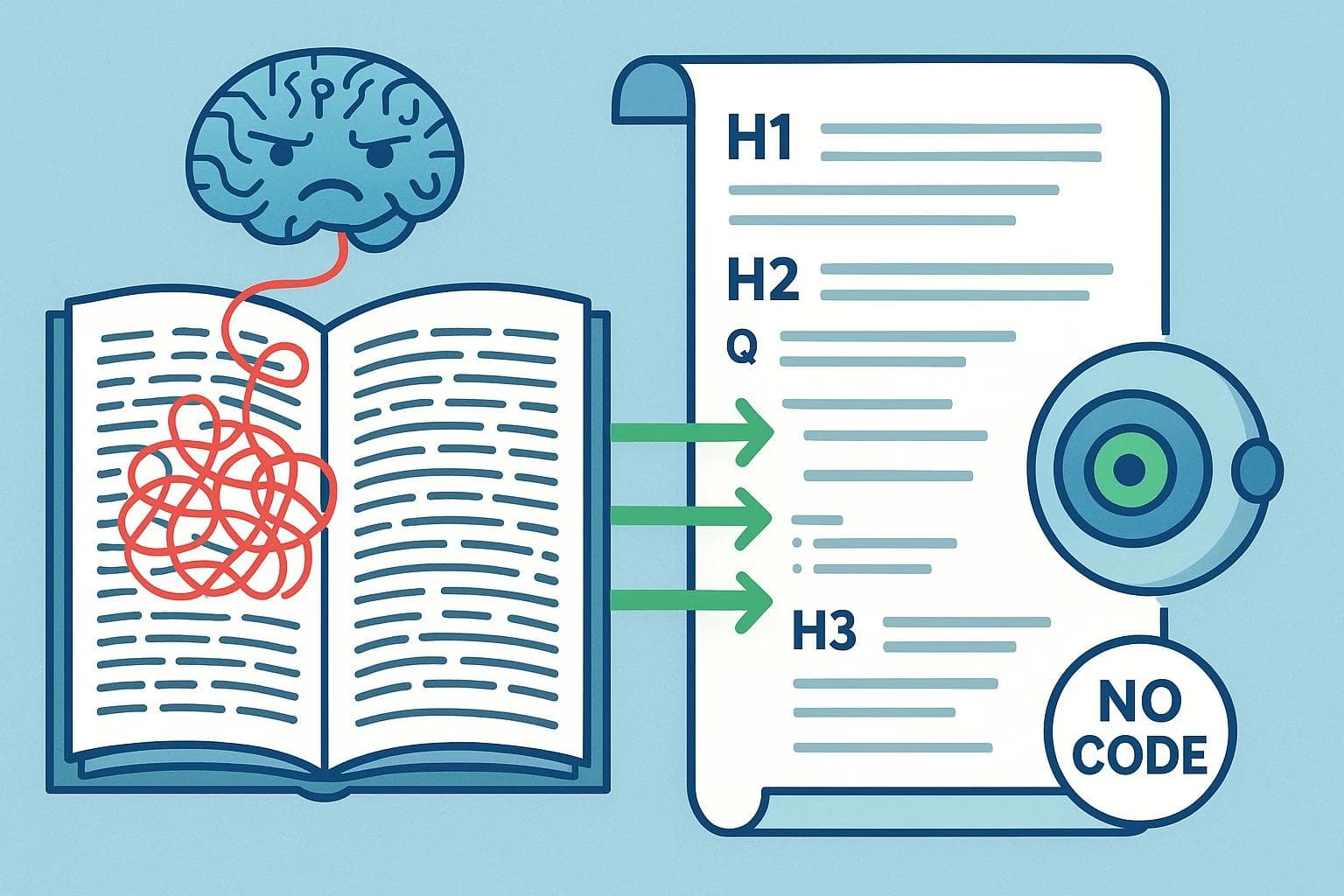
Headings, Qs, and Micro-Answers: A Guide to Structuring Content for AI Search (Without Touching a Line of Code)
You’ve done everything right. You spent hours researching, writing, and polishing the perfect article. It’s packed with value, answers a critical question for your audience, and follows all the classic SEO rules.
Then, you ask a chatbot or check Google’s new AI Overviews for that very question, and it quotes your competitor.
It’s a frustrating moment that leaves many content creators scratching their heads. The problem isn’t your content’s quality; it’s the structure. Conversational AI models—the engines behind chatbots and AI-powered search answers—don’t “read” your page like a human. They scan for signposts and shortcuts to find the most direct answer possible.
The good news? You don’t need to be a developer or learn complex schema markup to make your content AI-friendly. By focusing on three simple, code-free elements—headings, inline Q&As, and micro-answers—you can transform your pages into a clear, readable script for artificial intelligence.
How AI Really Reads Your Content (It's Not Like Us)
Imagine you’re trying to assemble a piece of furniture using only the instruction manual. A human reader might skim the whole booklet first to get the gist. An AI, on the other hand, is like a robot looking for a specific command: "Step 3: Attach Leg A to Base B with Screw C." It needs explicit, unambiguous instructions.
When an AI scans your webpage, it’s not appreciating your beautiful prose. It's deconstructing it into logical chunks of information to find the most efficient answer to a user's query.
This is the fundamental shift from traditional SEO to AI retrieval optimization:
- Traditional SEO is about signaling relevance through keywords, backlinks, and domain authority.
- AI Retrieval Optimization is about providing clarity through logical structure, concise language, and direct answers.
While technical structured data (like schema markup) can help, it's often optional. As the experts at Gradient Group rightly point out, "Structured writing and formatting are not." Clear formatting is the universal language that both humans and AI understand perfectly.
The Three Pillars of Code-Free AI Content Structure
To make your content instantly more readable for AI, focus on mastering these three foundational elements. They act as a blueprint that guides retrieval engines directly to the information they need.
Pillar 1: Headings as Unmistakable Signposts
Headings are the single most important structural element on your page. For an AI, they aren’t just stylistic choices; they are the table of contents for your article. A clear, logical heading hierarchy tells an AI exactly what each section is about and how different concepts relate to one another.
Think of it like this:
- Your <h1> is the book title. There should only be one.
- Your <h2> tags are the chapter titles. They introduce the main topics.
- Your <h3> tags are the sub-sections within a chapter. They break down the main topics into smaller, digestible points.
The key is to write descriptive headings that function as standalone statements of what’s to come.
Poor Heading Structure (Vague and Unhelpful):
<h2>Introduction<h2>Our Process<h3>Step 1<h3>Step 2<h2>Final Thoughts
Good Heading Structure (Clear and Descriptive):
<h2>Understanding How AI Scans Web Pages<h2>A 3-Step Process to Structure Your Content<h3>Step 1: Crafting Descriptive Headings<h3>Step 2: Integrating Inline Q&A<h2>Key Takeaways for AI-Friendly Content
The second example gives an AI (and a human) a perfect outline of the content, making it easy to pull specific information. Research into what’s the impact of heading structure on ai extractability? consistently shows that clarity and hierarchy are paramount for getting your content featured in AI-generated answers.
[IMAGE: A simple flowchart comparing a confusing, poorly nested heading structure with a clean, logical H1 -> H2 -> H3 hierarchy. The "good" side has a green checkmark and a smooth line for an "AI reading path," while the "bad" side has a red X and a jagged, confused path.]
Pillar 2: Inline Q&A as Direct Answers
Have you ever noticed how AI answers often sound like a direct response to a question? That’s because they are frequently pulled from content structured in a question-and-answer format. You can create these opportunities right inside your content body—no special FAQ schema required.
An inline Q&A is simply a question followed immediately by a concise answer, formatted to stand out.
Here are the simple, non-technical rules for formatting an inline Q&A:
- Make the question bold. This acts as a strong signal.
- Place the answer in the very next paragraph. Don't add fluff in between.
- Keep the answer self-contained and direct. It should make sense on its own, without needing the rest of the page for context.
- Use a clean paragraph break. The separation between the question and answer is a crucial structural cue.
Here’s an example:
How is AI retrieval optimization different from traditional SEO?AI retrieval optimization focuses on structural clarity and directness to help AI models extract specific answers, whereas traditional SEO often prioritizes broader relevance signals like keywords and backlinks to rank an entire page.
This simple format makes it incredibly easy for an AI to identify a common user question and grab the perfectly packaged answer you’ve provided.
Pillar 3: Micro-Answers and Summary Bullets
AI models love scannable, easily digestible information. Dense paragraphs of text are hard to parse for specific facts. Bulleted lists and short, summary statements act as "micro-answers"—atomic nuggets of information that are perfect for retrieval.
You can use them in two strategic ways:
- Front-load your sections: Start a section with a summary box or a few bullet points that give the main takeaway. This gives the AI the answer first before you elaborate.
- Summarize your sections: End a long section with a "Key Takeaways" bulleted list. This reinforces the main points and provides a perfectly packaged summary for an AI to grab.
Before: A Dense Paragraph
To optimize your content for AI, you need to ensure that your headings are descriptive and follow a logical hierarchy, from H1 down to H3. It's also crucial to answer questions directly within your text by using a bolded question format followed immediately by a concise answer. Finally, breaking down complex information into bulleted lists or summary points makes the key takeaways easier for both users and AI to extract quickly.
After: An AI-Friendly Micro-Answer List
To optimize your content for conversational AI, focus on these three structural elements: * Descriptive Headings: Create a logical outline using H1, H2, and H3 tags that clearly state the topic of each section. * Inline Q&A: Answer questions directly in your text using a bolded question followed by a concise answer. * Bulleted Summaries: Use lists to break down complex topics and highlight key takeaways for easy extraction.
The "After" version is practically begging to be used in an AI-generated summary, and you didn't need a single line of code to do it.
Your No-Schema AI Optimization Checklist
Use this simple checklist to audit your existing content or guide your next article.
[IMAGE: A visually appealing graphic of a checklist with icons next to each point.]
- [ ] One H1 Only: Does my page have a single, clear
<h1>that defines the overall topic? - [ ] Descriptive Headings: Do my
<h2>and<h3>tags accurately describe the content that follows? Do they read like an outline? - [ ] Logical Hierarchy: Are my headings properly nested (e.g., no
<h3>s without an<h2>above them)? - [ ] Direct Answers: Have I identified potential user questions and answered them directly with the bolded Q&A format?
- [ ] Scannable Summaries: Have I used bullet points to summarize key concepts or steps?
- [ ] Clarity Over Cleverness: Is my language clear and straightforward, avoiding jargon where possible?
- [ ] One Idea Per Paragraph: Does each paragraph focus on a single, core idea?
Frequently Asked Questions
Do I really not need schema markup for AI to understand my content?That's right. While schema can provide additional context, a well-structured page with clear headings, lists, and Q&A formatting gives AI models powerful signals to understand your content. For many creators, focusing on "structured writing" is more practical and just as effective.
How is this different from good on-page SEO?There's a lot of overlap! Good on-page SEO has always valued clear structure. The key difference is the emphasis. Traditional SEO might focus on getting a keyword in the heading, while AI optimization focuses on ensuring the heading is a direct answer or a clear topic label. It’s a subtle but important shift from signaling relevance to providing clarity.
How long should my inline answers be?Aim for 1-3 clear, concise sentences. The goal is to create a self-contained answer that can be lifted directly from your page and still make perfect sense.
Will this help my content appear in Google's AI Overviews?Yes. Google's AI models are designed to find and synthesize the most direct, helpful answers from the web. By structuring your content with clear signposts and pre-packaged answers, you significantly increase the chances that your information will be selected as a source for these summaries.
Your Path to Becoming an AI-Favorite Source
You don't need a technical background to win in the new era of AI-powered search. The power is already in your hands as a content creator. By thinking of your content not just as an article, but as a clear, logical script for a conversation, you can make it a go-to resource for retrieval engines.
Mastering these manual techniques is the essential first step. As you grow, you might wonder how to apply these principles consistently across dozens or hundreds of pages without spending all your time on formatting. That’s where you can begin to explore how automation can help you scale your efforts, ensuring every piece of content you publish is perfectly structured for discovery.
Roald
Founder Fonzy — Obsessed with scaling organic traffic. Writing about the intersection of SEO, AI, and product growth.
Stop writing content.
Start growing traffic.
You just read about the strategy. Now let Fonzy execute it for you. Get 30 SEO-optimized articles published to your site in the next 10 minutes.
No credit card required for demo. Cancel anytime.
Get Your Content Cited by ChatGPT
Learn how to build authoritative, AI-optimized content that ranks on Google and gets cited by ChatGPT to reach high-intent customers.

DIY Tests to Check if ChatGPT Uses Your Content
Learn simple experiments to discover if ChatGPT is referencing your unique content in its answers.
Content freshness and update cadence for AI answer selection
Discover how content recency and update frequency impact AI answer rankings and why freshness is crucial for visibility.