Structured Content at Scale Making Websites Machine-Readable

Structured Content at Scale: A Guide to Making Your Website Machine-Readable
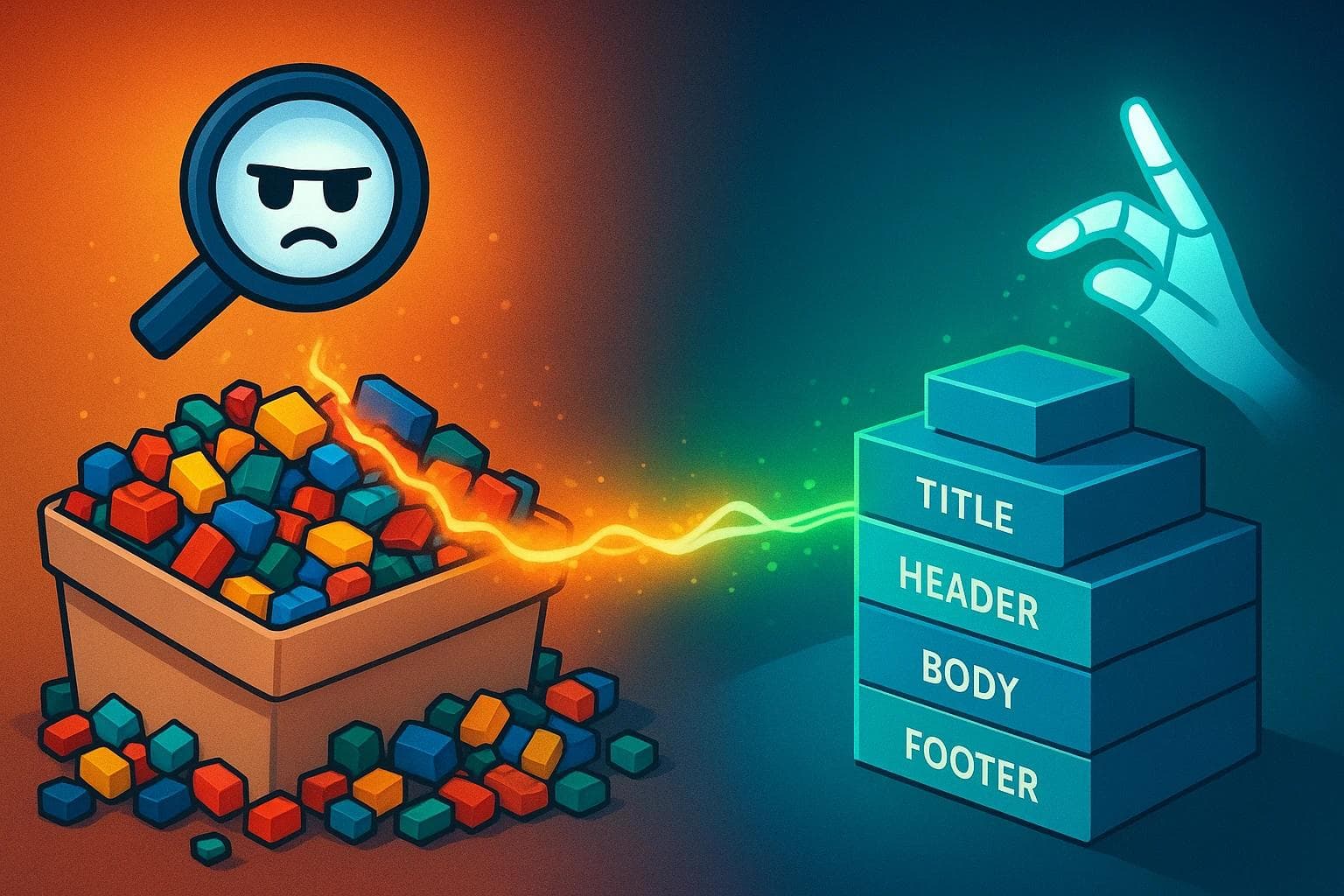
Ever tried to find a specific Lego brick in a giant, disorganized tub? You know the piece you need is in there somewhere, but you're stuck digging through a chaotic mess. For an AI, that's what it feels like trying to understand most websites today.
Your content might be brilliant for human readers, but for the search engines, chatbots, and AI answer engines that are increasingly becoming the gatekeepers of information, it’s just that—a messy tub of bricks.
This is where structured content comes in. It’s not about fancy formatting or stuffing keywords; it’s a fundamental shift in how we create and organize information. It’s about turning your content from a messy pile of words into a perfectly organized, labeled, and machine-readable library. And in an era where being understood by AI is as important as being understood by humans, this isn't just an advantage—it's essential for survival.
What is Structured Content, Really?
Think of your content not as a single, static page, but as a collection of reusable Lego bricks. A single "blog post" isn't just one block; it's made up of smaller, distinct pieces: a headline brick, an author brick, a publication date brick, and multiple paragraph bricks.
Structured content is the practice of defining, organizing, and interlinking these "bricks." This approach, often called the COPE principle (Create Once, Publish Everywhere), means your core information is separate from its presentation. The same "author brick" can appear on a blog post, a webinar page, or an author bio—all pulling from a single, reliable source.
This transforms your website from a collection of documents into a database of information. It’s a shift from "content as a page" to "content as data."
Why Your Business Needs Machine-Readable Content Now
You might be thinking, "My customers are human, so why do I need to cater to machines?" The answer is simple: machines are the new intermediaries. According to research, AI is increasingly involved in how users find information, whether through Google's AI Overviews, voice assistants, or specialized chatbots.
When content is unstructured, AI has to guess. It might misinterpret a product name as a person's name, mistake a customer review for the product description, or fail to understand the relationship between a problem and your solution. As Talonic's research highlights, this ambiguity is a primary reason AI fails to extract useful insights from documents.
Machine-readable content removes the guesswork. It provides explicit signals that tell AI exactly what each piece of information is and how it relates to everything else, ensuring your message is delivered with perfect clarity and context.
The Four Pillars of AI-Ready Content
Making your content machine-readable at scale isn't about a single magic bullet. It's about building a solid foundation on four key pillars.
1. Schema Markup: The AI's Cliff Notes
Schema markup is a vocabulary of code (most commonly JSON-LD) that you add to your website to give search engines more context. Think of it as adding invisible labels to your content. Instead of just showing an AI a block of text about an event, you can use schema to explicitly label the event name, date, location, and ticket price.
Common schema types that act as signposts for AI include:
- Article: Identifies the headline, author, and publication date.
- FAQPage: Clearly marks questions and their corresponding answers.
- HowTo: Outlines the steps of a process in a sequential order.
- Product: Details the product name, brand, price, and reviews.
These labels allow AI to understand your content with near-perfect accuracy, making it easier to feature in rich results, answer boxes, and generative AI responses.
2. Semantic Headings (H1, H2, H3): The Content's Skeleton
A logical heading structure is one of the most powerful and overlooked tools for machine readability. Headings (H1, H2, H3, etc.) create a clear hierarchy and outline for your content.
- H1: The main title of the page. There should only be one.
- H2s: The main sections of the article.
- H3s: Sub-points within each H2 section.
This structure acts as a skeleton, allowing an AI to instantly grasp the main topics and the relationships between them without having to parse every single word. It can quickly identify the core theme (H1), key supporting arguments (H2s), and specific details (H3s).
3. Consistent Templates: The Assembly Line for Information
Imagine trying to extract the price from 1,000 different product pages where the price is in a different place every time. It would be a nightmare.
Consistent templates solve this problem. By ensuring that every piece of content of the same type (e.g., all blog posts, all case studies, all service pages) follows the same underlying structure, you train AI where to look for specific information. This process is part of a larger strategy called content modeling, which is about designing the "blueprint" for your content bricks. A consistent blueprint allows for predictable, scalable, and highly accurate information extraction.
4. Strategic Internal Linking: The Content's Nervous System
For years, we've thought of internal linking as a tool for user navigation and passing "link equity" for SEO. But for AI, it does something far more profound: it builds a knowledge graph.
When you link from a page about "Content Marketing" to a page about "SEO Strategy" using descriptive anchor text, you're not just helping a user; you're explicitly telling an AI, "These two concepts are related."
At scale, a deliberate internal linking strategy connects all your content "bricks," creating a rich, interconnected web of knowledge that AI can traverse to understand the full breadth and depth of your expertise.
The Big Challenge: Structuring Content When You Have Hundreds (or Thousands) of Pages
Understanding the four pillars is one thing; implementing them across a massive, existing website is another. This is where theory meets reality, and many businesses stumble.
Avoiding Common Pitfalls: Learning from Others' Mistakes
Insights from content experts at Webstacks show that the biggest hurdles are often strategic, not technical. To succeed at scale, you must avoid these common traps:
- Lack of Buy-In: If stakeholders only see structured content as a "tech thing," it will fail. Frame it in terms of business ROI: better search visibility, content reuse that saves money, and future-proofing for AI.
- Content Type Sprawl: Don't create a new content template for every minor variation. Standardize your "bricks" to a core set of models (e.g., Blog Post, Service Page, Case Study) to maintain consistency.
- Focusing on Presentation Over Meaning: The structure should define the meaning of the content, not just how it looks. A "callout box" isn't a content type; the content inside it might be a "Key Takeaway" or a "Customer Quote."
What About Your Existing Content? An AI-Readiness Audit
For most businesses, the immediate challenge is the mountain of existing, unstructured content. A full-scale migration can be daunting, so start with an audit.
- Identify High-Value Pages: Which pages drive the most traffic, leads, or revenue? Start there.
- Analyze the Structure: Look at one of those pages. Does it have a clear H1? Are the H2s logical? Is the key information (like a product price or a service benefit) easy to identify?
- Test for Schema: Use Google's Rich Results Test to see if any structured data is already present and if it's valid.
- Map to a Model: Try to fit the page into a consistent template. What "bricks" of information are on the page? Could they be standardized?
This audit will give you a clear picture of how much work lies ahead and help you prioritize your efforts.
Beyond Search Engines: How Structured Content Fuels the Future
The benefits of structuring your content extend far beyond today's search results. You're building the foundation for the next generation of AI-powered experiences.
Powering Smarter AI with RAG (Retrieval-Augmented Generation)
Retrieval-Augmented Generation (RAG) is a technique that allows large language models (like the one powering ChatGPT) to pull information from a specific, authoritative knowledge base before answering a question. This dramatically reduces the risk of the AI "hallucinating" or providing incorrect information.
Your well-structured content library is the perfect knowledge base for a RAG system. When a customer asks your website's chatbot a complex question, the RAG system can retrieve the precise "bricks" of content needed to construct an accurate, trustworthy answer, complete with citations.
The "Content as Data" Mindset
Ultimately, this journey is about a mindset shift. When you treat your content as a valuable data asset, you unlock incredible potential. You can power chatbots, automate content creation, personalize user experiences, and ensure your brand's voice is the one AI systems trust and amplify. This is the core principle behind platforms like fonzy ai, which are designed to automate the creation and structuring of content for this new AI-first world.
Frequently Asked Questions About Structured Content
What's the difference between structured content and structured data?
Structured content is the methodology of breaking content into modular components (the Lego bricks). Structured data (like schema markup) is the vocabulary you use to label those components for machines. You need the content methodology first to apply the data labels effectively.
Do I need to be a developer to implement this?
Not entirely. Content strategists and writers can implement pillars like semantic headings and consistent templates. Implementing schema markup often requires technical help, but many CMS plugins and tools can simplify the process.
How do I know if my content is structured correctly?
Use tools like Google's Rich Results Test or the Schema Markup Validator to check your structured data. For headings and templates, a manual review is often the best starting point. The key question is: "Could a machine easily and predictably find the most important information on this page?"
Will structuring my content guarantee I get rich snippets in Google?
No, it doesn't guarantee it. Think of it as a prerequisite. It makes your content eligible for rich results and AI features by making it easy for Google to understand. It significantly increases your chances, but the final decision is up to the search engine's algorithms.
Is this just for SEO?
While it has massive SEO benefits, its impact is much broader. Structured content is foundational for accessibility, content personalization, multi-channel publishing (e.g., web, mobile app, voice assistant), and, most importantly, ensuring your content is ready for a future dominated by AI.
Your First Steps Toward an AI-Ready Website
Transitioning to a structured content model is a marathon, not a sprint. But you can start today.
- Audit Your Top Page: Take your most important service or product page and analyze its structure. Does it have one H1? Are the headings logical? Is it built from a template?
- Identify Your "Bricks": On that same page, list the core components of information. For a product, this might be "Product Name," "Image," "Description," "Price," and "Reviews."
- Explore Schema: Look up the relevant schema type on Schema.org for that page (e.g., "Product" schema). See how the properties match the "bricks" you identified.
By taking these small steps, you begin the crucial shift from simply writing pages to building an intelligent, future-proof content engine. In an age where AI is the new front door to information, making your content its favorite source isn't just a good idea—it's how you'll be found. Building this engine is the core mission of platforms like fonzy ai, which automate the entire content lifecycle to ensure you get found in Google and AI answers.
Roald
Founder Fonzy — Obsessed with scaling organic traffic. Writing about the intersection of SEO, AI, and product growth.
Stop writing content.
Start growing traffic.
You just read about the strategy. Now let Fonzy execute it for you. Get 30 SEO-optimized articles published to your site in the next 10 minutes.
No credit card required for demo. Cancel anytime.
Entity Building 101 How to Become a Trusted Web Source
Learn the basics of turning people products and concepts into trusted recognized web entities for better search visibility
Topical Breadth vs Depth How Coverage Influences AI Answers
Learn how balancing topical breadth and depth helps your content get cited by AI answer tools and build authority.
Building topical authority that AI and search engines trust
Learn how to shift from keywords to entities and build the expertise AI and search engines recognize and trust.