Scaling Content Production An Evaluation Guide for High Volume SEO Organic Growth

Scaling Content Production: An Evaluation Guide for High-Volume SEO & Organic Growth
You've hit a ceiling. Your team is creating great content, but you can't produce enough of it to truly dominate your market. You know that scaling from 10 articles a month to 100 or even 1,000 is the key to capturing organic traffic, but the math just doesn't work—you can't triple your headcount or your budget.
This is the exact challenge that drives growing businesses toward AI content platforms. The promise is alluring: unlimited content, automated workflows, and explosive growth. Yet, the risk feels just as big. How do you choose a partner that delivers on the promise without burying your brand in low-quality "AI slop"?
This guide is your evaluation blueprint. We'll move beyond the hype and give you a clear framework for assessing AI platforms based on the one thing that matters: their ability to help you scale high-quality content that drives real, measurable organic growth.
The Content Scale Imperative: Why Volume is Now a Prerequisite for Visibility
The digital landscape is more crowded than ever. With over 7.5 million blog posts published daily, simply showing up isn't enough. To build topical authority and consistently capture search traffic, you need a steady stream of high-quality, relevant content.
For most SMEs, agencies, and e-commerce stores, this creates a significant bottleneck. The traditional model of human-led content creation struggles to keep pace. This is why a staggering 89% of small businesses are now turning to AI. They're not just experimenting; they're seeing real results. Research shows that 73% of marketing teams using AI have already seen a decrease in content creation costs, freeing up resources to focus on strategy and growth.
The question is no longer if you should use AI to scale, but how you choose the right platform to do it effectively.
Beyond "AI Slop": Navigating the Quality Challenge at Scale
The biggest fear holding decision-makers back is the risk of sacrificing quality. We've all seen it: generic, soulless content that damages brand reputation and fails to rank. This concern is valid. Audience skepticism is on the rise, and platforms like YouTube are actively demonetizing mass-produced, inauthentic content.
Even Google has drawn a clear line in the sand. Their guidance is simple: AI-generated content created primarily to manipulate search rankings is spam. However, high-quality content produced with the help of AI is perfectly acceptable. The focus is, and always will be, on helpfulness and value.
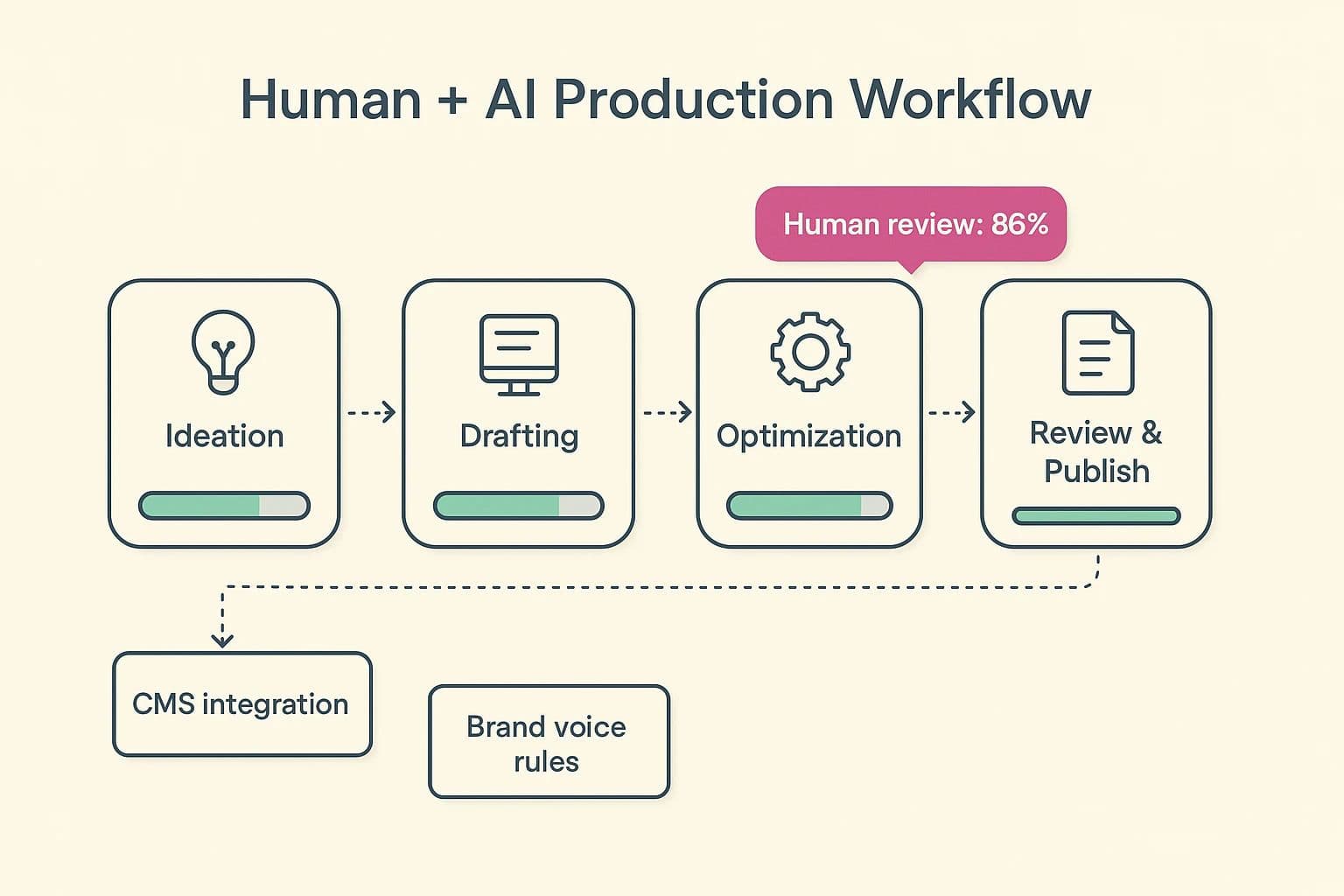
This is why the most successful AI-driven content strategies don't replace humans—they augment them. Data reveals that 86% of teams still edit AI-generated content to align it with their brand voice and quality standards. The goal isn't to remove people from the process but to empower them to manage quality at a scale never before possible. A great platform facilitates this collaboration, it doesn't try to eliminate it.
Your Evaluation Blueprint: 7 Criteria for Choosing a Scalable AI Platform
When you're comparing solutions, surface-level features can be misleading. To find a true growth partner, you need to dig deeper. Here are the seven critical criteria to build your evaluation around.
1. Verifiable Volume & Throughput Capacity
This is the most straightforward but crucial factor. Can the platform actually deliver the volume you need, month after month?
- What to look for: Don't settle for vague promises of "scalability." Look for concrete numbers. Does the platform specify monthly article limits in its pricing plans? Do they have a proven track record, like generating over 10,000 articles for clients? This transparency is a direct indicator of their capacity to deliver.
- Red flag: Platforms that are cagey about output limits or lack case studies demonstrating high-volume production.
2. End-to-End SEO Optimization
Generating text is only half the battle. To drive organic growth, content must be optimized from the ground up.
- What to look for: A platform that integrates the entire SEO content lifecycle. This includes identifying market opportunities, performing keyword research, structuring content with proper headings and meta descriptions, and building smart internal links automatically. The system should be designed not just to write, but to rank.
- Red flag: Tools that are essentially just "wrappers" for a language model, forcing your team to handle all the SEO strategy and on-page optimization manually.
3. Quality Control & Brand Voice Consistency
How does the platform prevent generic outputs across hundreds or thousands of articles?
- What to look for: Robust customization features. The ability to analyze your existing website to learn your tone, style, and subject matter is a powerful starting point. A great platform acts as a brand steward, ensuring consistency whether it's producing its 10th or 10,000th article for you.
- Red flag: Systems that only offer a few basic tone settings (e.g., "friendly," "professional") without deeper brand-specific learning capabilities.
4. Human-AI Collaboration Workflow
Scaling isn't just about automation; it's about efficient management. How does the platform integrate your team's essential oversight?
- What to look for: A clear, intuitive workflow that builds in checkpoints for human review and approval. The system should generate a content plan and calendar for your approval before production begins. This human-in-the-loop model ensures strategic alignment and quality control without creating a bottleneck.
- Red flag: "Black box" systems that produce and publish content with little to no opportunity for strategic input or quality assurance checks.
The Evaluation in Action: A Comparative Look
When you lay out the options, the differences become clear. A truly scalable platform offers more than just words on a page—it provides a comprehensive engine for organic growth. Focus your comparison on guaranteed outputs, integrated SEO features, and quality control workflows.
5. Seamless Integration & Publishing
An AI content engine is only as effective as its ability to connect with your existing ecosystem.
- What to look for: One-click integrations with major CMS platforms like WordPress, Webflow, Shopify, and Ghost. The platform should handle the technical burden of daily publishing and scheduling, ensuring a consistent online presence without manual effort from your team.
- Red flag: Platforms that require you to manually copy, paste, and format every single article, destroying the efficiency gains you were seeking.
Building Your Scalable Production Pipeline
A successful high-volume strategy relies on a well-defined production pipeline. The right AI platform doesn't just automate tasks; it structures the entire process from strategy to publication, with clear points for human oversight to ensure quality and alignment. This transforms content creation from a chaotic, manual effort into a predictable, scalable system. A key part of this is building an evergreen content strategy that allows you to scale from a handful of articles to thousands without burnout or loss of focus.
6. Transparent Pricing & True ROI
The sticker price of a tool rarely tells the whole story. You need to evaluate the Total Cost of Ownership (TCO) and the potential return on investment.
- What to look for: Simple, transparent pricing tiers based on the volume of content you need. A clear understanding of the key metrics for measuring content marketing ROI at scale is essential. Calculate the cost per article and compare it to your current fully-loaded costs (salaries, freelance fees, editing time). The value isn't just in cost savings, but in the speed and volume you unlock.
- Red flag: Complicated pricing models with hidden fees for essential features or usage-based pricing that makes budgeting impossible.
7. Future-Proofing & Adaptability
The worlds of SEO and AI are constantly changing. Your content partner needs to be ready for what's next, from algorithm updates to the rise of Generative Engine Optimization (GEO).
- What to look for: A platform that is explicitly designed to optimize for both traditional search and AI-powered answer engines. This demonstrates a forward-looking strategy that protects your investment and ensures your content remains visible wherever your audience is searching.
- Red flag: Platforms that are silent on their strategy for adapting to major shifts like Google's AI Overviews.
Quantifying the Impact: Connecting Volume to Tangible Value
Ultimately, the decision to invest in an AI content platform comes down to results. High-volume content production is the means, but organic growth is the end. When evaluating platforms, look for proof that they can translate scale into tangible business outcomes. By focusing on maintaining quality and relevance at scale, you ensure that every article contributes to meaningful growth, not just vanity metrics.
Frequently Asked Questions
1. Will Google penalize our site for using high-volume AI content?
No, as long as the content is high-quality and created to be helpful to people, not just to manipulate search rankings. Google's core systems are designed to reward valuable content, regardless of how it was produced. A good AI platform focuses on creating useful, optimized articles that align with this principle.
2. How much human oversight is realistically needed in a high-volume workflow?
The goal is strategic oversight, not manual rewriting. Your team's time should be spent approving the content strategy, reviewing the content calendar, and spot-checking final articles for brand alignment. An effective platform handles 90% of the heavy lifting, allowing your team to function as editors and strategists, not just writers.
3. Can an AI platform truly match our company's unique expert voice?
The most advanced platforms can. By analyzing your existing site content, customer profiles, and market niche, a platform like Fonzy.ai learns your specific voice and terminology. It's not about choosing from a dropdown menu of generic tones; it's about training the AI to be an extension of your brand.
4. How can I justify the cost of an automated platform to my leadership?
Frame it in terms of ROI and opportunity cost. Calculate the cost of producing the same volume of content manually (including salaries, benefits, and freelance fees). Compare that to the platform's subscription fee. Then, factor in the speed to market and the projected organic growth from a consistent, high-volume content strategy. The case is often overwhelmingly positive.
The Future of Content is Scalable, Automated, and Strategic
Choosing to scale your content production is no longer an option—it's a competitive necessity. The right AI platform removes the traditional barriers of time, budget, and resources, allowing you to execute an ambitious SEO strategy that drives consistent organic growth.
By using this evaluation framework, you can move past the marketing hype and identify a true partner—one that delivers volume without sacrificing quality, integrates seamlessly into your workflow, and provides a clear, measurable return on your investment.
Ready to see how an end-to-end platform can put your organic growth on autopilot? Discover how Fonzy.ai gets you found in Google and AI answers, automatically.
Roald
Founder Fonzy — Obsessed with scaling organic traffic. Writing about the intersection of SEO, AI, and product growth.
Stop writing content.
Start growing traffic.
You just read about the strategy. Now let Fonzy execute it for you. Get 30 SEO-optimized articles published to your site in the next 10 minutes.
No credit card required for demo. Cancel anytime.
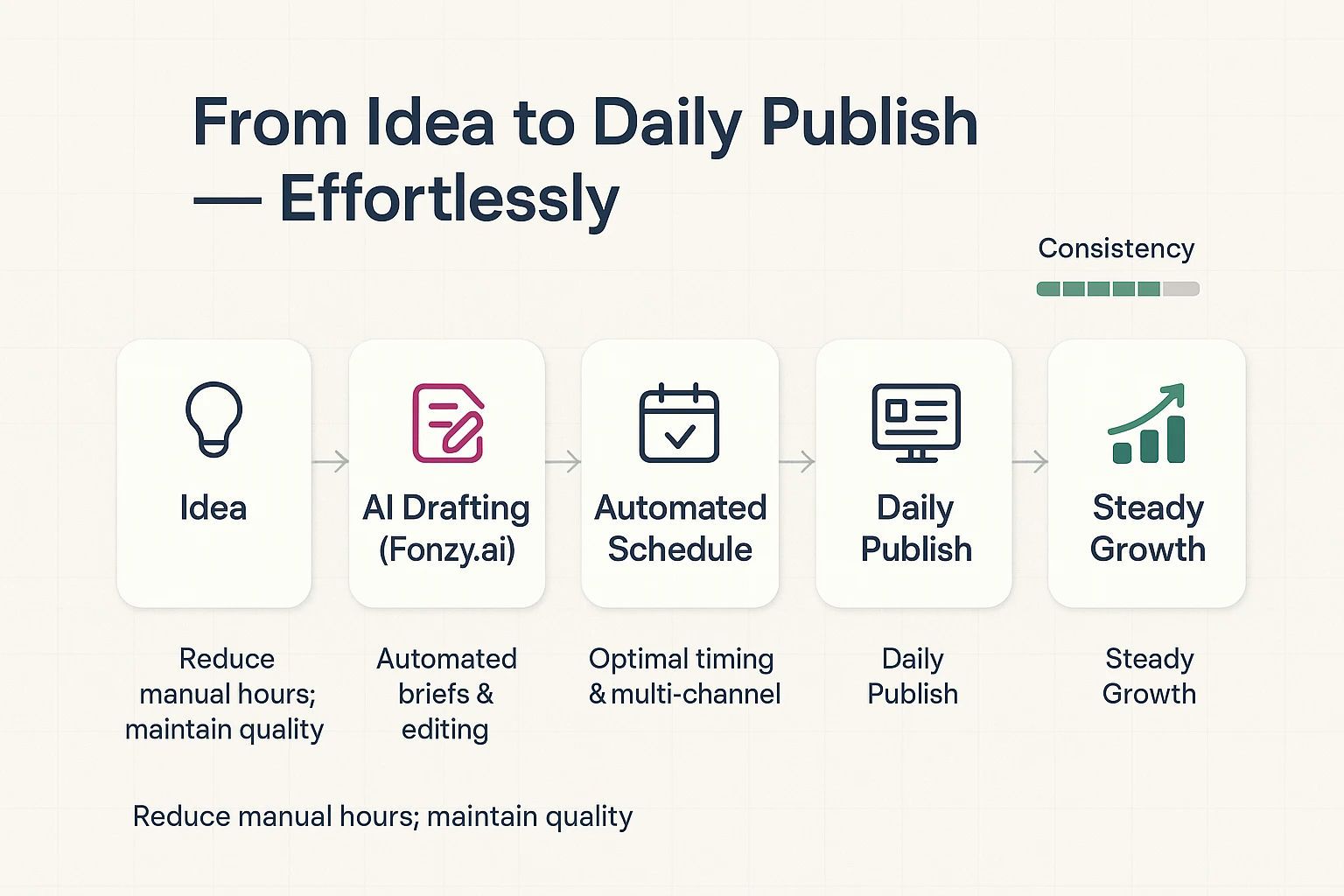
The Daily Content Dilemma How to Achieve Consistent Growth
Discover how to publish daily without burnout using automation for steady growth and higher SEO impact.
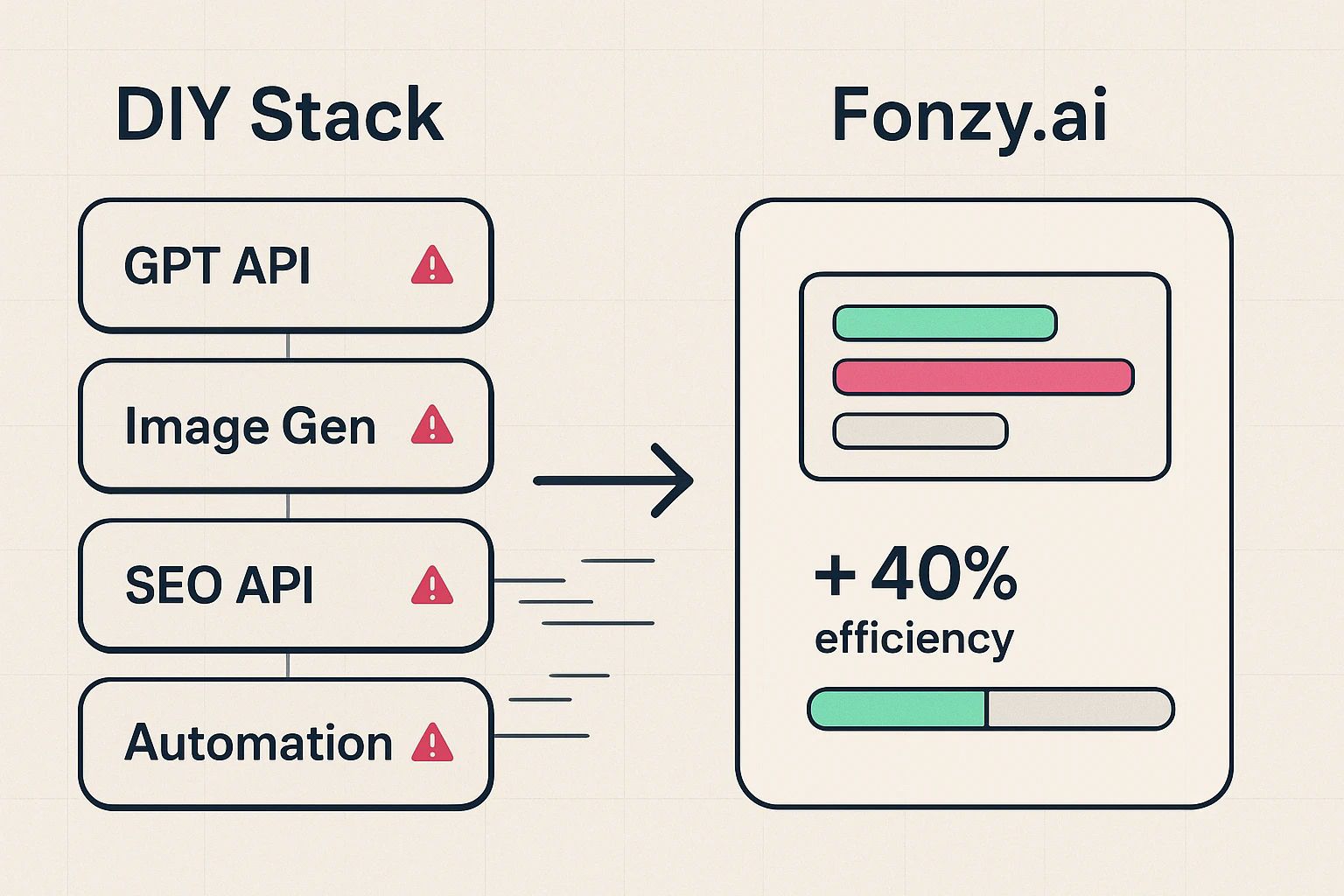
Fonzy.ai vs Building Your Own AI Content Stack Complexity vs Simplicity
Compare Fonzy.ai with DIY AI content stacks to find a simpler, scalable solution that saves time and cuts hidden costs for your SEO growth.
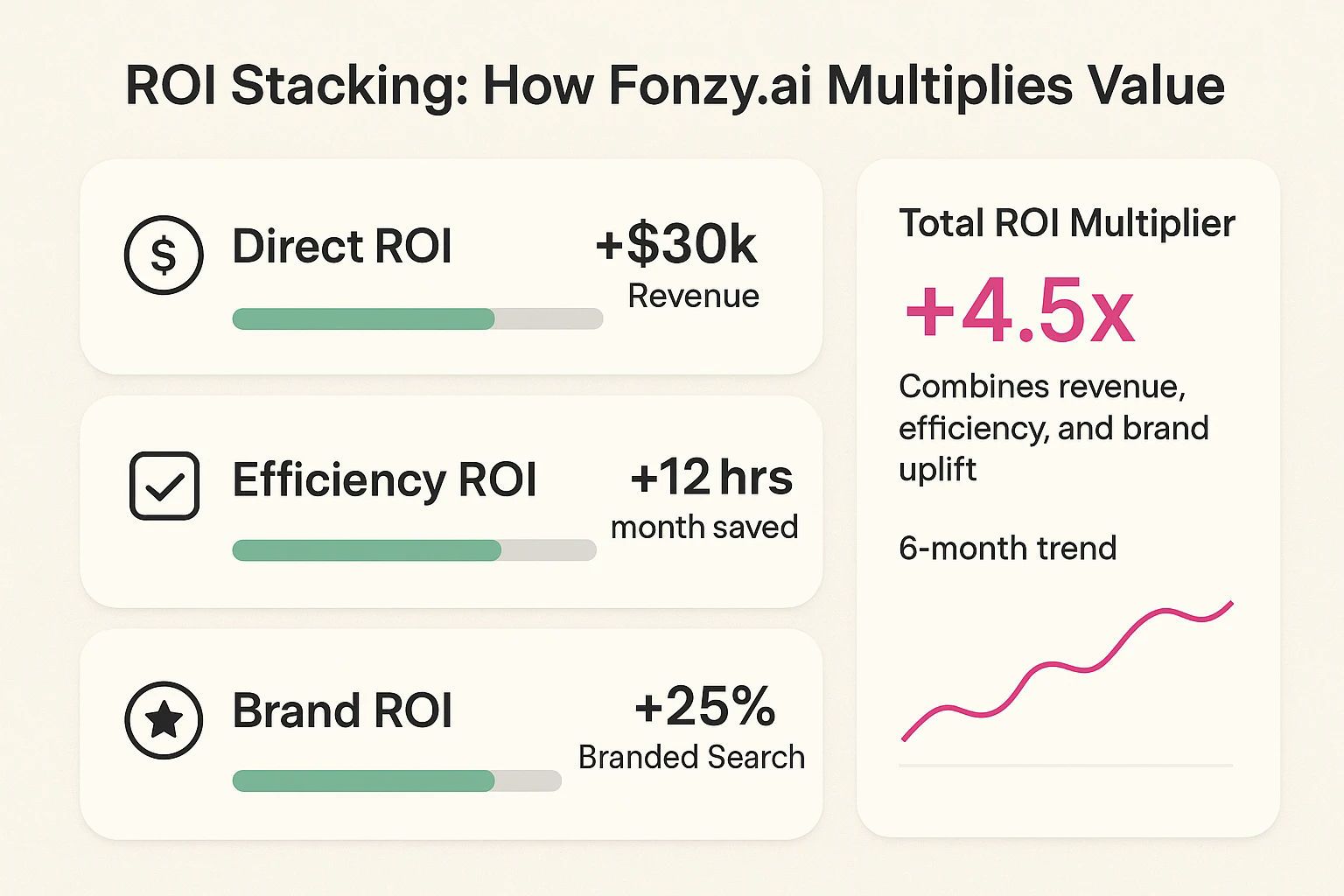
The ROI of Automated SEO Content Calculating Your True Savings and Growth with Fonzy.ai
Discover how automating SEO content cuts costs, boosts efficiency, and drives measurable growth with Fonzy.ai's proven ROI framework.