 Ready to grow?
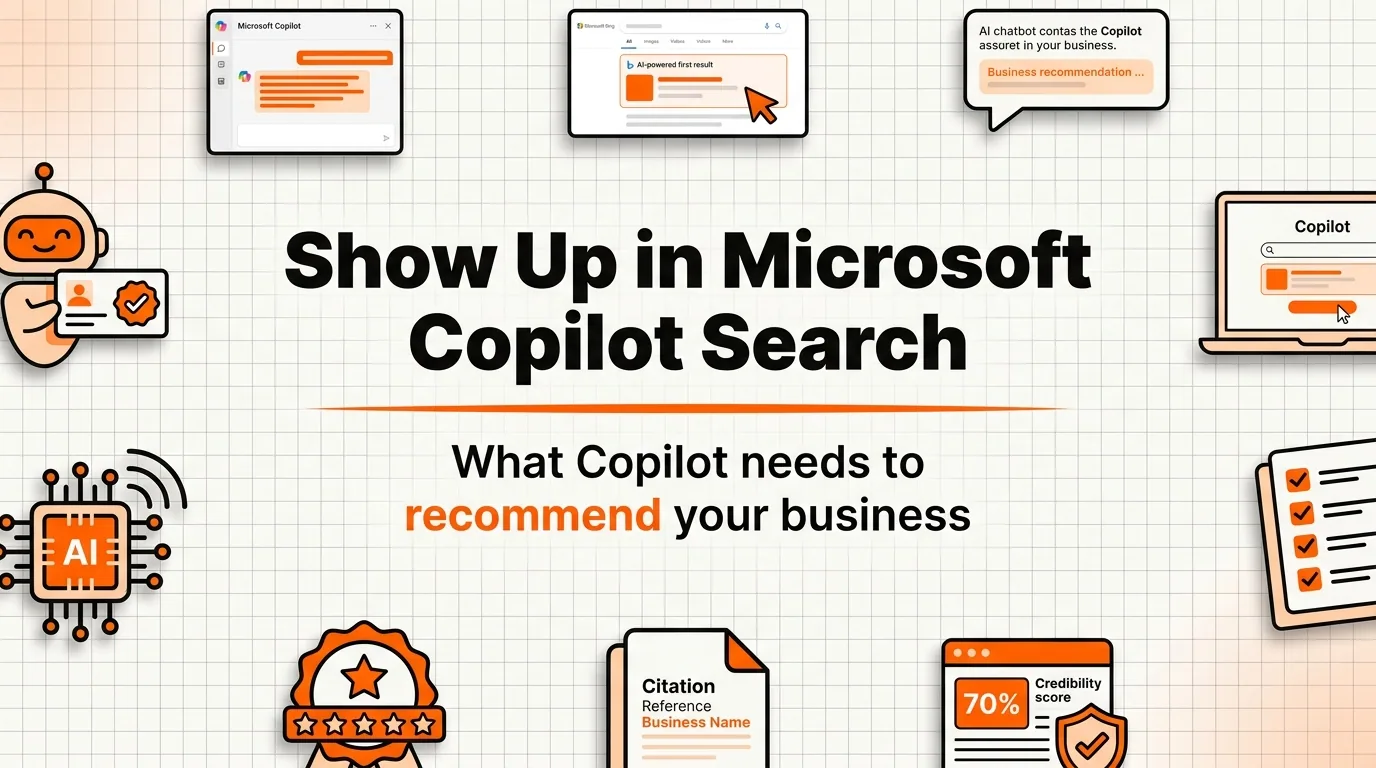
Microsoft Copilot is the AI assistant built into Bing, the Edge browser, Windows, and copilot.com. When someone asks it a question, it writes a short answer and then lists the web pages it pulled from, with numbered links you can click. That last part is what matters for your business: if your page is one of the sources Copilot names, you get seen and you can get the click. Here is how to become one of those sources.
Quick answer: Copilot pulls its answers from the Bing index, so the fastest wins are a complete Bing Places listing, plainly worded pages that state your prices and hours in real sentences, and simple structured data (like FAQ markup) your site or platform can add for you. Everything below walks through why each of those matters and exactly how to do it.
What is Microsoft Copilot for a small business today?
Think of Copilot as a research assistant your customers already have open. It sits inside tools they use every day. A contractor on a Windows laptop, a shopper in Edge, someone tapping the Copilot app on their phone: same assistant, different doors. They type a question in plain English, and instead of ten blue links, they get a written answer with sources attached.
Microsoft introduced Copilot Search in Bing in April 2025. According to Microsoft's Bing Search blog, that mode synthesizes an answer with numbered citations linking to the source pages, shown alongside the traditional results. So you are not replacing your normal Bing ranking. You are competing for a second, newer slot: the list of pages the assistant decided to trust enough to quote.
For a plumber, a dentist, or a shop owner, the practical takeaway is simple. People are asking buying questions to Copilot ("best emergency plumber near me," "how much does a crown cost"), and Copilot is answering with named sources. You want to be named.
How does Copilot search differ from a Google search?
A Google search hands you a page of links and lets you sort it out. Copilot reads several of those pages for you and writes one answer, then shows its work with citations. The difference for you is where attention lands.
On a link page, the customer scans headlines and picks. In a Copilot answer, the customer reads a paragraph first, and the sources sit underneath as proof and as the next click. So a page that ranks fifth on a normal results list can still get cited if it answers the exact question cleanly. Position is less about being number one and more about being the clearest, most quotable source on the specific thing asked.
One more reason this is worth doing now: Bing's own slice of global search has been holding around 4.5% of the worldwide market through 2026, according to Statcounter Global Stats. That's still small next to Google, but it's real, and Copilot rides on that exact same Bing index.
We cover optimizing for ChatGPT, Perplexity, Claude, and Gemini in other guides, and the basics overlap. But Copilot has its own plumbing, and that is the point of this piece. It runs on the Bing index, it leans on Bing Places for local answers, and as of early 2026 it is the one assistant that reports your citations back to you directly. Those three things change what you actually do.
Do the old SEO basics still matter for Copilot?
Yes, and this is worth saying plainly because it's easy to assume AI search threw out the old rulebook. It didn't. Microsoft's own advertising blog put it directly: crawlability, metadata, internal linking, and backlinks "remain essential" for AI search visibility, and they're described as the starting point, not the whole job (see Microsoft Advertising's guide to AI search inclusion). If your site is slow, has broken links, or is missing a title tag, no amount of Copilot-specific tuning will fix that first.
The widely quoted AI-traffic number Microsoft's post points to (and that we'll come back to below) traces to Similarweb's own traffic estimates: AI referrals to the top 1,000 websites spiked 357% year over year, reaching 1.13 billion visits in June 2025. What's new isn't that SEO stopped mattering. It's that ranking a whole page is no longer the only goal; individual passages inside that page now get evaluated and lifted into answers on their own. That's exactly why the plain-sentence, one-fact-per-line approach in this guide works: it gives Copilot a self-contained passage to quote, on top of the technical foundation you already have.
How does Copilot pick its sources?
Copilot does not browse the whole internet fresh for every question. It draws candidate pages from the Bing search index plus the live web, then ranks them before writing.
The Pedowitz Group, an agency that studies how Bing Copilot sources answers, describes the ranking this way: Copilot pulls candidate information from the Bing index and live web, ranks pages for relevance and credibility, and prefers sources that are recent, authoritative, clearly structured, and easy to parse. Read that list again, because it is your to-do list. Recent. Credible. Structured. Easy to parse.
"Easy to parse" is the one most small sites get wrong. If your prices, hours, and service area are buried inside a slideshow or a paragraph of marketing copy, the assistant has to work to extract them, and it often picks a competitor who stated the same facts in a plain sentence. A line like "We charge a flat $149 for a standard drain clearing in Sacramento, available same-day" is trivial to quote. A line like "Our team delivers value-driven solutions tailored to your needs" gives Copilot nothing to cite.
How do Copilot citations appear?
Citations show up as small numbered links inside or right after the answer text. Click one and you land on the source page.
Microsoft made these more visible recently. In its November 7, 2025 Fall Release, per the Microsoft Copilot blog, the company made citations more prominent and clickable, added a "Show all" panel that aggregates every source used, and rolled the search experience out across copilot.com, the iOS and Android apps, and Edge. That "Show all" panel matters because it widens the field. Even if you are not one of the two or three sources quoted in the visible answer, you can still appear in the full sources list, which is another way to get found.
The reason to care about being seen there is volume. Similarweb, a market intelligence provider, reported that AI referrals to the top 1,000 websites spiked 357 percent year over year to 1.13 billion visits in June 2025 (the same figure Microsoft's own advertising blog cites, sourced back to Similarweb). Assistant traffic, Copilot included, is no longer a rounding error. Being in that "Show all" list is a real visit, not a vanity metric.
Does schema markup help Copilot cite you?
It helps, and you don't need to be technical to use it. "Schema markup" (also called structured data) is a small, invisible tag added to your page's code that labels things for machines: this is a business, this is a price, this is a question and its answer. Bing's own webmaster documentation confirms it supports Schema.org markup, most commonly written in a format called JSON-LD, specifically to help it understand what a page contains.
More directly, Microsoft's own Bing Webmaster Tools blog spells out the connection to Copilot citations. In its February 2026 guidance, Microsoft's product managers wrote that "clear headings, tables, and FAQ sections help surface key information and make content easier for AI systems to reference accurately," as part of a broader list of ways to improve inclusion in AI-generated answers. Notice what's on that list: headings, tables, and FAQ sections. Those are things you already control without touching a line of code.
In practice, this means two things for you. First, keep doing the plain-sentence, question-and-answer writing this guide already recommends; that structure is exactly what Microsoft says helps. Second, if your site is on WordPress, Shopify, Webflow, or a similar platform, check whether it has a built-in FAQ block or an SEO plugin that adds FAQ schema automatically; most modern platforms do, and turning it on for your FAQ section is a five-minute task, not a developer project.
Why does your Bing Places profile matter for local answers?
For anything local, Copilot leans on business listing data, not just your website. If someone asks for a "good tax preparer in Tucson open on Saturday," the assistant needs your hours, location, and services, and it often reads those from Places data.
Microsoft's own Bing Webmaster Tools guidance confirms this directly: for local questions, Copilot and Bing's AI answers lean on Bing Places for Business data, and keeping your address, hours, and contact details current there keeps you eligible for inclusion in AI-generated responses. Flip that around and it is a warning: a blank or stale Bing Places profile does not just rank lower; it can take you out of the running for local Copilot answers entirely.
So claim your Bing Places listing. Fill in the hours, the categories, the service area, the phone number, and a description that names what you actually do and where. If you moved, changed hours, or added a service, update it the same week. This is the single highest-leverage thing a local business can do for Copilot, and most of your competitors have not bothered.
What are the concrete steps for Bing Copilot SEO?
Pull the threads together and the checklist is short. Each item maps to how Copilot ranks.
- Answer the real question in plain sentences near the top of the page. If people ask "how much," put the price in a sentence, not a "contact us" button.
- State your facts plainly: prices, service area, hours, what is included, who it is for. Use short headings that match the questions people ask.
- Keep pages current. Add a date, refresh stale numbers, and update anything seasonal. Copilot favors recent sources, so a page edited this quarter beats one untouched since 2023.
- Complete your Bing Places profile and keep it accurate, because local answers depend on it.
- Submit changed pages to IndexNow whenever you add or update a page. Microsoft's own Bing Webmaster Tools blog recommends this specifically so AI systems reference the most current version of your content, instead of an old cached copy.
- Add simple FAQ formatting (a question as a heading, a plain-English answer underneath) and let your platform's schema or SEO plugin handle the markup.
- Earn ordinary credibility signals: a real about page, named author or owner, reviews, and links from local sources like your chamber of commerce or a supplier.
- Verify your site and submit your sitemap inside Bing Webmaster Tools, and add a plain "last updated" date near the top of any page you revise, so Bing finds the change fast and Copilot knows it's reading your newest version.
One concrete example. A two-location pizza shop that adds a plain FAQ ("Do you have gluten-free crust? Yes, on a separate prep surface, for a $3 upcharge") gives Copilot a clean, quotable answer to a question people genuinely type. That single passage can earn a citation that a glossy homepage never would.
How do you track your Copilot citations now?
Until recently you were guessing whether Copilot cited you. That changed in early 2026, and it has kept getting better since.
Microsoft launched a dedicated AI Performance report inside Bing Webmaster Tools in public preview on February 10, 2026, as Search Engine Land reported. It was the first time a major search platform offered first-party citation reporting for AI answers, and it's still free with a Bing Webmaster Tools account. Per Microsoft's own announcement, the dashboard shows five things: Total Citations (how often you were cited), Average Cited Pages (how many of your pages get used per day), Grounding Queries (the actual phrases Copilot searched for when it found you), page-level citation activity, and a visibility trend line over time. In plain terms: Microsoft now tells you, in a free tool, which of your pages the assistant is quoting, how often, and for which questions. Google does not give you that for its AI answers.
Microsoft expanded the report again in June 2026, adding Intents (grouping your citations by whether the query was informational, commercial, local, and so on), Topics (grouping related grounding queries into themes), Citation Share (what percentage of the citations for a given query went to your site versus everyone else's), and Compare (overlaying a prior period to see if you're trending up or down). None of this changes what you need to do; it just makes it faster to see whether it's working.
To read the report honestly, look at which pages get cited and what they have in common, then make more pages like those. The agency Search Influence did exactly this: in an analysis of roughly 20,000 of their own Copilot citations inside the report, they found citation activity was extremely concentrated: one single page captured 69% of all their citations, and their top four pages accounted for 90%, with everything else on the site making up the rest. It was also short-lived: that busiest page averaged around 1,520 citations a day in early December, then fell to about 34 a day by February, a 97% drop in two months. That is one agency's own data, not a universal law, so treat it as a worked example rather than a guarantee. But the lesson held up against everything above: clear, specific, well-structured pages that directly answer one question get quoted, and staying current is what keeps them quoted. The report finally let them prove it instead of guessing.
What is realistic for a small business?
You will not dominate Copilot in a week, and you should be skeptical of anyone who promises that. Citations build as your pages get indexed, get edited to answer real questions, and earn a little trust.
A fair expectation: claim Bing Places and rewrite your two or three most important pages to answer questions plainly, then check the AI Performance report after a month or two. You are looking for first citations on your clearest pages, especially local ones, and a Citation Share that starts moving off zero for your core topics. That is the signal that the approach is working. From there it compounds, because every clean, current, well-structured page is one more thing Copilot can quote.
Frequently asked questions
Do I need to do anything different for Copilot than for Google?
Mostly no, but with a few Copilot-specific moves. The plain-language, answer-first, well-structured page that helps you in Google also helps you in Copilot. The differences are that Copilot runs on the Bing index, so claiming Bing Webmaster Tools and Bing Places matters, and that it gives you a first-party citation report Google does not.
Is Bing Webmaster Tools free?
Yes. A Bing Webmaster Tools account is free, and the AI Performance report Microsoft launched on February 10, 2026 comes with it, now expanded (as of June 2026) with Intents, Topics, Citation Share, and Compare views. You verify your site once, then you can see which pages Copilot and Bing AI summaries are citing, and for which questions.
How long until I show up in Copilot answers?
Plan in months, not days. After you fix your Places profile and rewrite your most important pages, give it a month or two and watch the AI Performance report for your first citations. Local pages with clear facts tend to get picked up first.
Does Copilot only cite big websites?
No. Because it ranks for relevance and clarity on the specific question, a small, focused page that answers something exactly can be cited over a large vague one. Stating your prices, service area, and specifics in plain sentences is what earns the quote.
What is Bing Copilot SEO?
It's the work of making your website one of the sources Copilot names when it answers a question, not a separate skill from good SEO, but a few Copilot-specific habits layered on top of it. Because Copilot runs on the Bing index and leans on Bing Places for local answers, claiming your Bing listings and keeping pages plainly worded covers most of the job. The rest is stating your facts clearly enough, and structuring them with headings, FAQs, and simple schema, that an assistant can quote them without guessing.
What is Copilot Search, and is it different from regular Copilot?
Copilot Search is the specific mode Microsoft added inside Bing in April 2025 that writes a synthesized answer with numbered source citations, shown alongside the regular results list. It's one part of the wider Copilot family, which also includes the Edge sidebar, the Windows assistant, and the copilot.com app. Since Microsoft's November 2025 Fall Release, all of them show citations more prominently, including a "Show all" sources panel that widens your chances of appearing even when you're not one of the two or three names quoted directly in the answer.
How do I check my Copilot search visibility?
Sign up for a free Bing Webmaster Tools account and open the AI Performance report, which Microsoft launched on February 10, 2026 and expanded in June 2026 with Intents, Topics, Citation Share, and Compare. It shows which of your pages Copilot and Bing's AI summaries are actually citing, and which queries triggered it, something Google still doesn't offer for its own AI answers. Give it a month or two after you clean up your pages and your Bing Places listing, then check back for your first citations.
Do I need schema markup or code to show up in Copilot?
Not from scratch. Bing supports schema markup (structured data that labels your content for machines), and Microsoft has said clear headings, tables, and FAQ sections specifically help AI systems reference content accurately. Most website platforms, including WordPress, Shopify, and Webflow, can add basic FAQ or business schema through a built-in block or a plugin, no developer needed. Writing your FAQ section in plain question-and-answer form is the part that matters most; the markup is a bonus on top of that.
What is IndexNow, and do I need it for Copilot?
IndexNow is a free, one-time setup that pings search engines the moment you publish or update a page, instead of waiting for them to crawl it on their own schedule. Microsoft specifically recommends it for AI visibility, so Copilot references your latest information rather than an outdated cached version. It's not required, but it's a quick way to make sure your updates count sooner rather than later.
Showing up in Copilot comes down to being the clearest, most current, easiest-to-quote answer to the questions your customers ask, then keeping your Bing Places profile accurate so local answers can find you. That's steady, ongoing work, not a one-time fix, which is exactly the kind of thing Fonzy was built to keep running for you. You shouldn't have to choose between ranking on Google and getting cited by AI search: Fonzy researches your market and keywords, then writes and publishes plainly worded, well-structured articles straight to your site automatically, no developer and no SEO skills needed. Try it free for 3 days (3 articles on us, cancel anytime) and watch your own pages start showing up as one of those cited answers.