Generative Engine Optimization: How to Win Google Traffic and ChatGPT Citations
You’ve spent years mastering SEO, and now the ground is shifting. AI Overviews are absorbing clicks, and you're caught in a difficult position: how do you capture traffic from this new world of AI answers without abandoning the Google rankings that still drive your business?
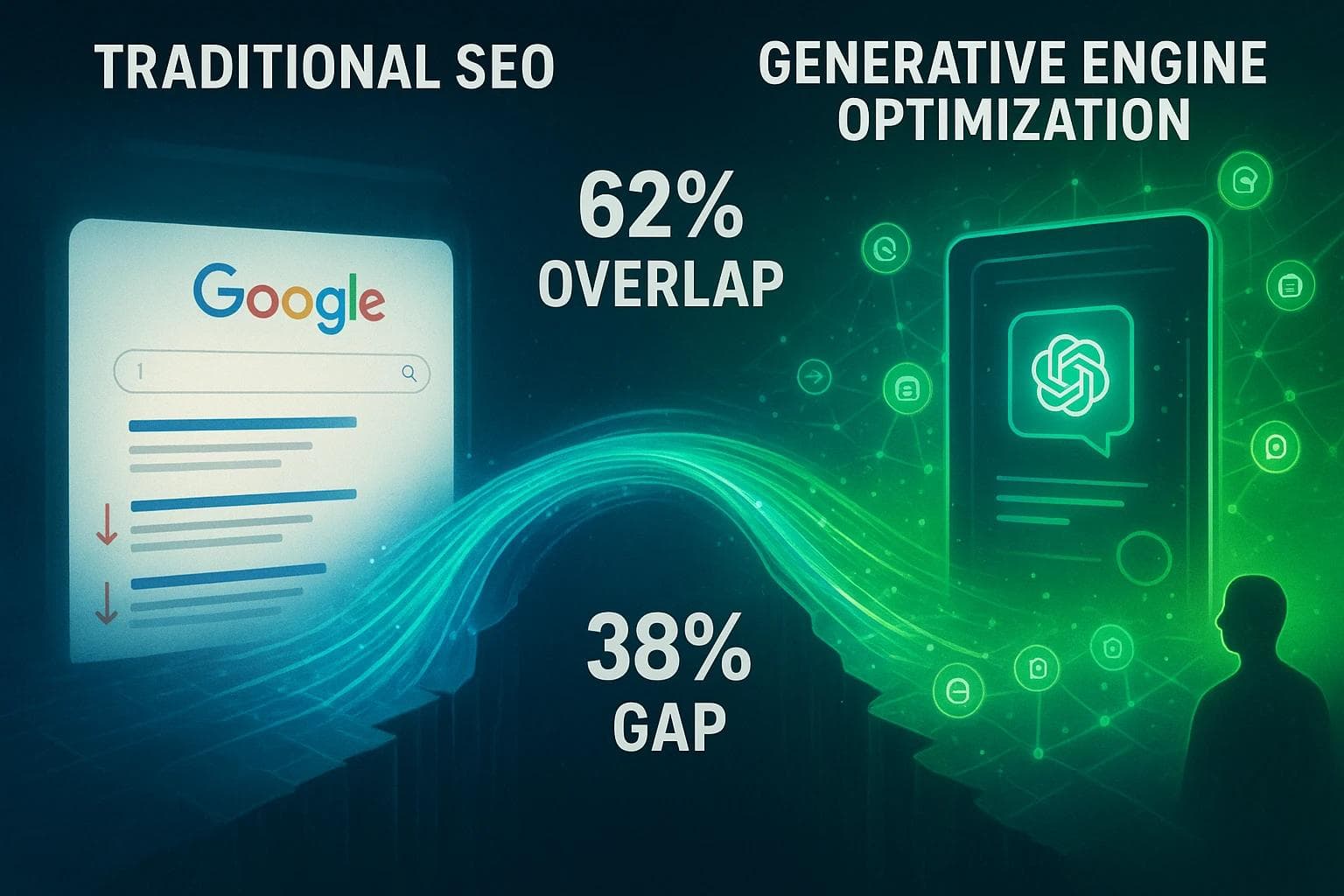
Many assume that great SEO simply translates to AI visibility. That’s a dangerously outdated idea. A groundbreaking study from Chatoptic revealed there's only a 62% overlap between top-ranking pages on Google and sources cited by ChatGPT.
This isn't a minor discrepancy; it's a strategic chasm. It means that nearly 40% of the time, the content AI models trust and recommend is different from what Google ranks highest. Relying on your old SEO playbook alone is like bringing a map of New York to navigate London. You'll recognize some landmarks, but you're fundamentally unprepared for the journey.
This guide provides a clear, actionable framework to bridge that gap. We’ll show you how to secure your Google traffic while systematically engineering your content to become a trusted source for generative AI.

The New Landscape: Why GEO is Non-Negotiable
Generative Engine Optimization (GEO) isn't just a new buzzword; it's a fundamental shift from optimizing for clicks to optimizing for citations. While traditional SEO focuses on ranking a link for a user to click, GEO focuses on getting your information synthesized directly into an AI-generated answer.
The urgency is real and backed by data:
- The Vanishing Click: Around 60% of Google searches are now "zero-click," and this trend is accelerating. Some analysts predict traditional search traffic could fall by over 50% by 2026.
- The Rise of AI Referrals: It's not all bad news. ChatGPT referrals are up 52% year-over-year. This traffic is different—users spend nearly six minutes per session, compared to seconds on Google, indicating much higher engagement.
- High-Quality, High-Intent Traffic: While the volume might be lower initially, traffic from AI answers converts at a dramatically higher rate. One study saw a 1.66% conversion rate from generative AI traffic compared to just 0.15% from traditional search.
The message is clear: the audience is migrating, and they arrive with a higher intent to act. The goal is no longer just to be on the list of options; it's to be the answer itself.
Phase 1: The Foundation for Dual Visibility
Before diving into advanced tactics, you need a strong foundation that serves both Google's crawlers and AI's language models. These are the principles where the 62% overlap exists, and getting them right is table stakes.
Semantic Content Architecture
AI models, much like search engines, need structure to understand context and hierarchy. This isn't just about keywords; it's about clear, logical information flow.
- Hierarchy is King: Use a clean H1-H6 structure. Your H1 is the main topic, H2s are key sub-themes, and H3s provide supporting details.
- Answer Questions Directly: Structure headings as questions (e.g., "How Does GEO Differ from SEO?") and provide a concise, direct answer immediately below. This optimizes for both Google's featured snippets and AI's direct answer retrieval.
- Embrace Scannability: Use short paragraphs, bulleted lists, and numbered steps. Microsoft's own guidance for Bing's AI emphasizes "parsing" and "snippability"—making your content easy to break down into logical chunks.
Uncompromising Content Quality
E-E-A-T (Experience, Expertise, Authoritativeness, Trustworthiness) is even more critical for GEO. AI models are trained to identify and prioritize signals of credibility.
- Originality First: Surface-level summaries won't cut it. Incorporate original research, unique data points, and expert quotes.
- Prove Your Expertise: Don't just state facts; demonstrate how you know them. Link to credible sources, reference case studies, and showcase real-world experience.
- Keep it Fresh: AI models favor up-to-date information. Regularly review and update your content to reflect the latest data and trends, as noted by Semrush's research on AI search.
Phase 2: Citation Engineering to Bridge the Gap
This is where you move beyond the basics and start actively designing your content to be cited by AI. These advanced strategies address the 38% of opportunities that traditional SEO misses. It requires a more technical approach, but it's the key to dominating the new landscape.

The LLMs.txt Imperative
An LLMs.txt file is an emerging standard that functions like a robots.txt specifically for large language models. It allows you to set clear policies for how AI crawlers can interact with your content. This gives you control over access, usage rights, and attribution.
How to Implement It:
- Create a plain text file named llms.txt.
- Place it in the root directory of your website (e.g., yourdomain.com/llms.txt).
- Add directives to specify rules for different AI agents.
Example llms.txt Syntax:
# Allow OpenAI's crawler full accessUser-agent: OAI-SearchBotAllow: /# Disallow Google's AI from training on your 'proprietary-data' directoryUser-agent: Google-ExtendedDisallow: /proprietary-data/# Request attribution for all modelsUser-agent: *Attribution: RequiredLicense: CC BY-ND 4.0This simple file signals to AI developers that you are a sophisticated, rights-aware publisher, which can increase trust.
Advanced Schema for AI Understanding
Basic schema like FAQPage is a good start, but winning citations requires giving AI a much richer, more connected understanding of your content.
- Build an Entity Graph: Use nested JSON-LD to connect concepts, people, and organizations. Instead of just marking up a single "HowTo," show how that process relates to a specific product (makesOffer), is authored by a recognized expert (author), and is published by a trusted organization (publisher).
- Use Canonical URIs: Use the @id attribute to link your entities to definitive sources like Wikipedia or Wikidata. This helps the AI verify exactly what you're talking about, removing ambiguity.
- Add Provenance Metadata: Signal trustworthiness by adding custom schema properties like contentHash or lastVerified. This tells the AI that the information is stable and has been recently fact-checked.
Create "LLM-Ready Micro-Content"
AI models don't read articles; they ingest and synthesize atomic pieces of information. Your job is to create these perfect, bite-sized pieces for them.
- The Atomic Answer: For every key concept, write a self-contained, 50-200 word explanation that can stand on its own.
- The One-Sentence Summary: At the start of major sections, include a single, declarative sentence that summarizes the core takeaway. This is prime material for direct citation.
- Structure for Citation and Click: Design your content bundles to provide a complete, satisfying answer within the AI interface but also create curiosity. End your micro-content with a natural lead-in to a deeper aspect of the topic, encouraging a click-through for more context. For example: "…which covers the foundational setup. The next step, optimizing for real-time data, involves a different set of tools."
Phase 3: Measuring What Matters
You can't optimize what you can't measure. The old KPIs of keyword rank and organic traffic are no longer sufficient. Winning at GEO requires a new set of metrics focused on influence and conversion.

AI Bot Crawling Analytics
Your server logs are a goldmine of information. Go beyond tracking Googlebot and start monitoring for AI-specific user agents like OAI-SearchBot, Google-Extended, and PerplexityBot. Analyzing their crawl patterns tells you:
- What content are AI models most interested in?
- How frequently are they revisiting your key pages?
- Are there sections of your site they can't access?
This allows you to optimize your most valuable content first and fix any technical barriers preventing AI ingestion.
New KPIs for the AI Era
- Citation Share: How often is your brand, data, or content mentioned in AI answers for your target queries? This is the new "rank #1."
- AI-Driven Conversion Rate: Isolate traffic coming from AI referrals and track its conversion rate. As the data shows, this should be significantly higher than your baseline.
- Answer Sentiment: When your brand is cited, is the context positive, neutral, or negative? This helps you understand how AI models perceive your brand's authority.
By focusing on these metrics, you shift from a vanity-driven model (rankings) to an ROI-driven one (influence and revenue).
Your Dual-Platform Optimization Plan
Navigating this new terrain requires a deliberate, two-pronged strategy. You can't afford to ignore Google, but you absolutely must prepare for an AI-first future. By reinforcing your SEO foundation with advanced citation engineering, you build a resilient content strategy that wins today's traffic and tomorrow's citations.
The process is complex, requiring technical precision, consistent execution, and continuous measurement. But for those who adapt, the reward is significant: capturing high-intent users, building unshakeable authority, and future-proofing your business in an AI-driven world.
Frequently Asked Questions
1. Is traditional SEO dead?Not at all. Think of it as an essential foundation. The principles of creating high-quality, well-structured content are still critical. However, relying only on traditional SEO is no longer enough. GEO builds upon that foundation with new techniques specifically for AI models.
2. This sounds too technical for my small team. How can we possibly implement all of this?Start with the "quick wins." Focus first on Phase 1: improving your content structure with question-based headers and clear, scannable lists. Then, tackle one technical element at a time, like creating a basic LLMs.txt file. The key is iterative progress, not a one-time overhaul. This is also where automated platforms can handle the heavy lifting of content creation and optimization, allowing your team to focus on strategy.
3. How long does it take to see results from GEO?It varies. Foundational improvements can impact Google rankings and AI visibility within weeks. Advanced technical changes, like implementing schema entity graphs, may take longer for AI models to process and trust. The key is consistency. Unlike a one-off campaign, GEO is an ongoing process of building authority with both search engines and AI.
4. What's the biggest mistake to avoid in GEO?The biggest mistake is assuming what works for Google will automatically work for AI. The data shows a significant gap. A successful strategy must intentionally and separately address the needs of AI models, particularly around data structure, provenance, and creating citable "micro-content." Ignoring this distinction means you're competing for only 62% of the available opportunity.

Roald
Founder Fonzy — Obsessed with scaling organic traffic. Writing about the intersection of SEO, AI, and product growth.
Stop writing content.
Start growing traffic.
You just read about the strategy. Now let Fonzy execute it for you. Get 30 SEO-optimized articles published to your site in the next 10 minutes.
No credit card required for demo. Cancel anytime.
Is Fonzy.ai Too Automated? How We Balance AI and Human Oversight
Discover how Fonzy.ai blends AI efficiency with human control to deliver scalable, on-brand content without losing your voice or strategy.

How to Get Cited by ChatGPT A Practical Guide
Learn actionable steps to optimize your content for ChatGPT citations and boost your AI-driven visibility and authority effectively.

How Update Cadence and Fresh Content Help AI Notice You
Learn why updating content regularly matters for AI assistants and how freshness boosts your visibility and trustworthiness.